The easiest way to misread JUNGSIK Seoul is to treat it as a legacy brand that already finished its historical work.
That historical work is real. Chef Jungsik Yim's restaurant helped turn "New Korean" from a critical label into something diners around the world could actually picture: traditional Korean flavors, ingredients, and references translated through a modern fine-dining frame.[1] Yim opened JUNGSIK in Seoul in 2009 and later opened JUNGSIK New York in 2011, building one of the clearest two-city arguments that Korean cuisine could travel globally without flattening into generic luxury internationalism.[1]
But that origin story is no longer the most useful reason to book the restaurant. In 2026, the sharper read is formal. JUNGSIK matters because it has turned the idea of New Korean into a room with unusual composure: a menu shape that still feels Korean in its sequencing, reservation mechanics that keep the service rhythm legible, and pairings strong enough that beverage service now reads as part of the restaurant's authorship rather than a sidecar luxury add-on.[2][3][4][7]
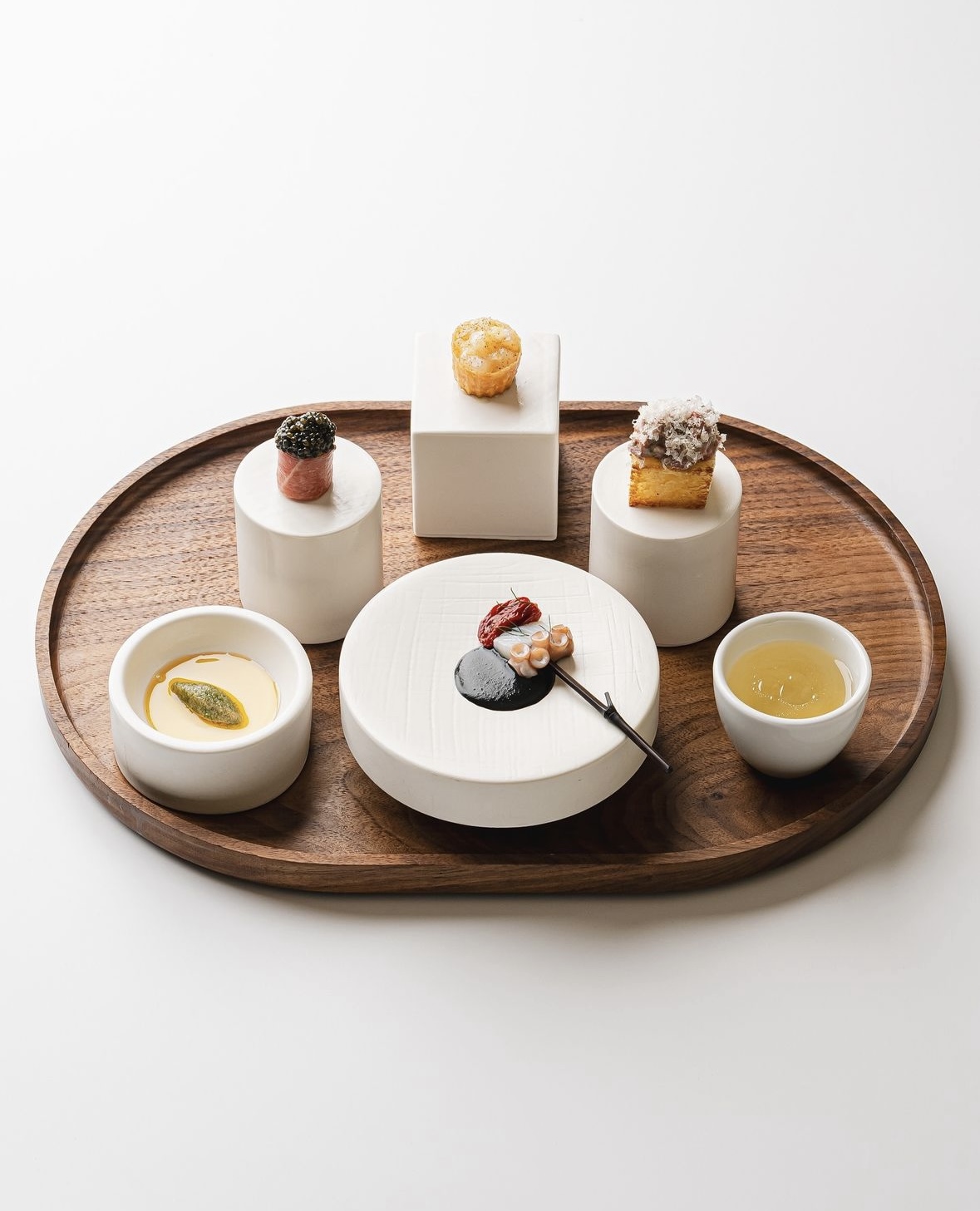
Image context: the lead image comes from JUNGSIK's official photo page and shows a polished tray of opening bites. It is the right visual for this article because JUNGSIK's appeal starts with controlled abundance: many elements on the table, each kept small, exact, and visually quiet rather than piled into spectacle.[6]
New Korean works here because it is organized, not because it is merely updated
Yim's official biography makes the restaurant's technical lineage plain. Before opening JUNGSIK, he studied at the Culinary Institute of America and trained at Aquavit, Bouley, Zuberoa, and Akelarre.[1] That background could easily have produced a familiar global-chef outcome: Korean ingredients inserted into an otherwise standard tasting-menu language. JUNGSIK has lasted because it does something more disciplined than that.
The restaurant's own description says it explores the depth and potential of Korean cuisine where tradition and innovation meet.[1] Read alongside the current MICHELIN listing and 50 Best Discovery page, that claim becomes more concrete. Michelin describes the cooking as innovative while staying entirely authentic, then points to banchan and supplementary courses as part of the experience rather than treating them as decorative folklore.[4] 50 Best Discovery describes a menu divided into appetizer, land, sea, rice, and sweet, with dishes such as sea urchin with kimchi and cabbage that nod back toward familiar Korean flavor logic even when the plating is globally sleek.[5]
That menu architecture is the key. A lot of high-end restaurants speak local in the ingredient list while the actual meal sequence remains generically French-inflected. JUNGSIK feels different because the structure itself carries translation work. Rice has not vanished into the middle of a luxury blur. Banchan has not been reduced to a prelude. The meal still remembers how Korean eating organizes satisfaction, then edits that memory into a calmer and more compressed form.[4][5]
The room chooses calm over spectacle, and that choice explains the service mood
JUNGSIK's reservation page is unusually revealing about how the house wants to run. Lunch runs from 12:00 to 15:00 with last order at 13:15. Dinner runs from 17:30 to 22:00 with last order at 19:15. Reservations open only through Catch Table, and on the first day of every even-numbered month at 11:00 AM KST, the restaurant releases bookings for the following two-month period.[2]
Those facts are not housekeeping trivia. They tell you the restaurant wants demand to arrive in clean waves, not in a constantly renegotiated drip. The room is being protected from improvisational sprawl. That reading gets stronger once you see the floor split. The main dining hall seats parties of one to six and limits access to guests 13 and older; the private dining room seats two to ten with the same menu and no added room fee.[2] In other words, JUNGSIK is not using private space as a separate luxury tax. It is using layout to keep different social energies from colliding.
This helps explain why the restaurant does not feel like a "Korean innovation" showroom even though the cuisine could easily be sold that way. The operational signals point somewhere quieter. JUNGSIK is interested in composure. It wants the meal to arrive as a sequence of measured decisions, not as a barrage of chefly declarations.
Price and pairings show what the house thinks is essential
The current menu page sharpens that reading. Lunch is KRW 230,000 and dinner is KRW 330,000. Lunch pairings run at KRW 160,000 for four glasses and KRW 240,000 for seven; dinner pairings run at KRW 210,000 for five glasses and KRW 290,000 for eight, with a premium five-glass pairing at KRW 700,000 listed for both services.[3] Vegetarian menus must be pre-ordered rather than improvised on the floor.[3]
Those prices matter because they show the beverage track is not being treated as a token upsell. The house has built clear pairing ladders for both lunch and dinner, which suggests it expects many guests to read the meal through the glass as well as through the plate.[3] That interpretation is reinforced by MICHELIN's Seoul & Busan 2025 article, where Min-Jun Kim of JUNGSIK received the Sommelier Award.[7] A restaurant does not accumulate that kind of signal by treating wine service as a polite accessory. It gets there by making beverage sequencing part of the room's intellectual and emotional balance.
This is one of the reasons JUNGSIK still feels alive while some once-important "modern Korean" rooms now read mainly as historical milestones. The restaurant is not leaning on the old headline alone. It keeps refining the translation system around it: course flow, service timing, and beverage authorship all moving together.
Why JUNGSIK is still worth booking now
Seoul's fine-dining scene is broader and more self-confident than it was when JUNGSIK first opened, and that change matters.[7] The restaurant no longer owns the idea of modern Korean ambition by itself. What it still owns is a specific kind of balance.
Book JUNGSIK if you want a room where Korean references have been edited into elegance rather than inflated into theater. Book it if you care about sequencing, if you like luxury that arrives with a low pulse, and if you want a meal whose modernity comes from structure rather than volume.[2][3][4][5] Think twice if what you want from Seoul is a louder, more improvisational night or a restaurant whose pleasure depends on visible excess. JUNGSIK's strength is not maximalism. It is its ability to make refinement feel settled.
That is why the restaurant still matters in 2026. "New Korean" is no longer a surprising phrase. At JUNGSIK, it still feels like a working grammar.[1][4][5][7]
Sources
- JUNGSIK official Hello page, including the restaurant's New Korean positioning, Chef Jungsik Yim's background, and the Seoul/New York timeline.
- JUNGSIK official Reservation page, including service hours, booking-release timing, floor layout, and age rules.
- JUNGSIK official Eat page, including current lunch and dinner menu prices, pairing ladders, and vegetarian-menu policy.
- MICHELIN Guide listing for JUNGSIK in Seoul, current two-star listing with notes on innovative yet authentic Korean cooking, banchan, and supplementary courses.
- 50 Best Discovery profile for JUNGSIK, including the appetizer-land-sea-rice-sweet menu framing and example dishes.
- JUNGSIK official Photo page, used here as image provenance for the lead photograph.
- MICHELIN Guide, "The MICHELIN Guide Seoul & Busan 2025: A New Three-Star Promotion as Seoul's Culinary Landscape Expands with Korean Essence at Its Core," including Min-Jun Kim's Sommelier Award at JUNGSIK.