The easiest way to misread Aska is to file it under Nordic tasting-menu prestige and stop there.
That description is true, but it is not yet useful. In 2026, the sharper reading is operational. Aska is one of those restaurants whose force comes from how little slack it leaves itself: an open-kitchen procession, only ten tables each night, a 12-14 course menu priced at $375 per person, and a booking system released at 12:00 PM ET on the first day of the prior month.[1][2][3] What looks from the outside like quiet luxury is really a room built around narrow tolerances.
That operational reading matters because Aska does not sell abundance in the obvious fine-dining way. Fredrik Berselius' official description still frames the restaurant around Northeastern ingredients filtered through a Scandinavian sensibility, and the room remains tied to the restored 1860s warehouse near the Williamsburg Bridge where Aska reopened in 2016.[1] But the restaurant's strongest signal is not geography by itself. It is the discipline with which geography gets turned into a schedule, a pace, and a threshold.[1][2][3]
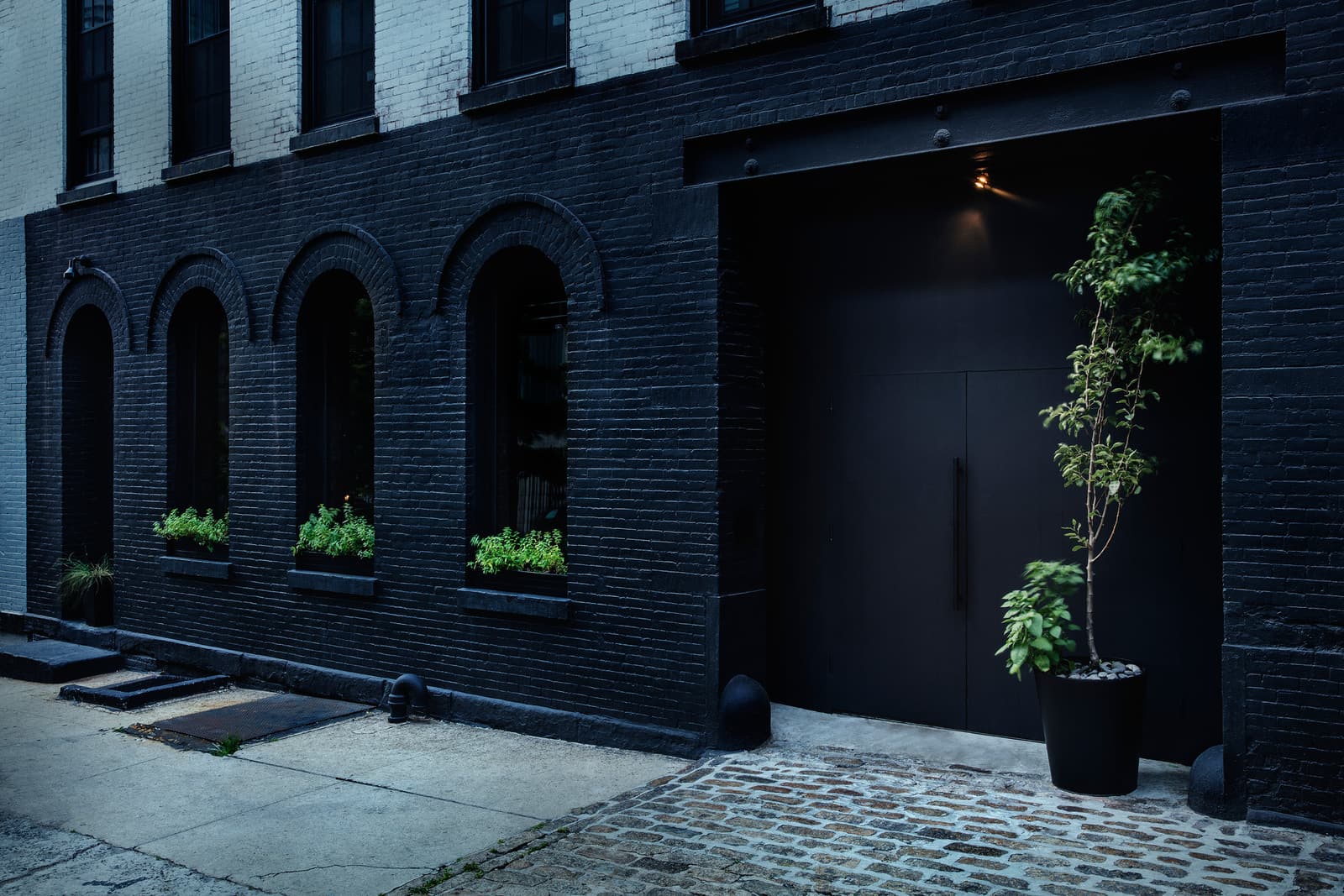
Image context: the cover image shows Aska's black warehouse exterior in Williamsburg. It is the right visual anchor because the restaurant's tone starts before the first course, with a facade that makes arrival feel private, narrowed, and more deliberate than most New York luxury rooms.[5]
Ten tables means the whole system has to stay tight
Aska's own about page gives away the central fact: courses come from an open kitchen and are served to guests of only ten tables each night.[1] That single number changes how the whole restaurant has to operate. A bigger flagship can absorb some variance. It can hide a late party in another section, spread dietary friction across more seats, or let the room's energy diffuse. Aska cannot. Ten tables turns every reservation into structural inventory.
That is why the booking rule matters so much. The FAQ says reservations for the following month drop at 12:00 PM ET on the first day of the previous month, and all parties are reservation-only.[3] This is not just a convenience detail for diners trying to plan a trip. It tells you the restaurant wants demand to arrive in one disciplined window rather than through a slow, improvisational trickle. The release clock keeps the room legible. Everyone knows when access opens, and the restaurant can build the month around a fixed cadence instead of a rolling scramble.[3]
Hours reinforce the same point. Aska runs dinner service from 5 PM to 11 PM, Wednesday through Sunday, with Monday and Tuesday closed.[1][2][3] That does not describe a room trying to maximize seat count through multiple casual turns. It describes a restaurant protecting the long arc of one serious nightly event. Put differently: Aska is not selling "availability" as a luxury marker. It is selling concentration.
The menu is designed as a pacing device, not just a price point
The dining page makes the economics and the pacing unusually clear. The restaurant presents the meal as a 12-14 course journey through the landscapes of New York and the Northeast, with optional wine pairings starting at $250 per guest.[2] The FAQ adds the other number diners actually need: the tasting menu usually lasts 2.5 to 4.5 hours, depending on the party and the menu that night.[3]
Those numbers matter because they explain the specific mood of the room. A lot of expensive tasting menus are long. That fact alone does not make them coherent. At Aska, the length appears inseparable from the scale. Small room, open kitchen, long progression, and limited nightly inventory all support the same idea: the dinner is not meant to feel like a string of luxury plates, but like a single controlled duration.[1][2][3]
This is also where Aska separates itself from louder New York prestige formats. Some flagship rooms want to overwhelm with visual theater, a packed brigade, or a sense that the whole city knows you got in. Aska's official language points in the opposite direction. The emphasis falls on intimacy, locality, and procession.[1][2] Even the exterior does that work. The black facade reads almost withholding, as if the restaurant would rather narrow the field than advertise itself.[5]
The strict house rules are really room-protection rules
Read Aska's FAQ closely and the house starts to look less severe than precise.
Dietary restrictions require 72 hours of notice, and the restaurant says requests presented unexpectedly at the table may not be accommodated.[3] Reservations are sold as final, though the house allows rebookings within 30 days for a $100 per person fee up to 48 hours before the reservation time.[3] Late arrivals may not be accommodated.[3] Children must be 12 or older, and infants are not allowed because of the intimate nature of the dining room.[3] Flash photography and videography are prohibited, while outside recording equipment requires prior permission.[3] Corkage is permitted, but only up to two 750 ml bottles or one magnum, at $100 per 750 ml bottle or $200 for a magnum.[3]
Taken one by one, these can sound like elite-restaurant hardness. Taken together, they read more like room-protection rules. The meal is long, the room is small, the kitchen is visible, and the nightly inventory is thin. Under those conditions, a single uncontrolled variable travels farther than it would elsewhere. A last-minute allergy note changes kitchen sequencing. A loud flash changes the room's darkness contract. A stroller or a restless toddler changes the acoustics for everyone. A speculative cancellation cannot be replaced easily when the whole system is built around ten tables.[1][2][3]
That is the real operational insight at Aska: service standards are doing architectural work. They are not only about manners. They are part of how the room preserves concentration.
Why the warehouse matters
The official history says Aska's second life began in summer 2016, when it reopened in a bilevel space with a main dining room, garden, and cellar bar inside a restored 1860s warehouse near the Williamsburg Bridge.[1] That detail is easy to treat as atmospheric garnish. It is more than that.
Warehouse space gives Aska something many modern luxury rooms lack: separation from the street without full theatrical isolation. The building can feel urban, old, and slightly severe at once. That fits Berselius' broader pitch. He is not presenting Scandinavian cooking as imported purity. He is joining Swedish memory to the Northeastern U.S. region and doing so inside Brooklyn rather than above it.[1][2]
The Michelin Guide keeps Aska in New York's top technical conversation, and the restaurant's own about page still foregrounds its two-star standing.[1][4] Those are useful prestige markers. The more interesting point is that Aska has not needed to get bigger or noisier to stay relevant. Its answer to the status problem has been to remain small and exact, then make that smallness feel expensive.
Why Aska is worth booking now
The strongest case for Aska in 2026 is not that it is a hard table or that it carries Nordic pedigree into Brooklyn. Plenty of restaurants can make those claims in one form or another. The stronger case is that Aska has turned service design itself into part of the pleasure.
The noon release clock tells you access will be rationed cleanly.[3] The ten-table limit tells you every cover matters.[1] The 12-14 course structure and 2.5-4.5 hour duration tell you the restaurant is built for one sustained nightly tempo, not for flexible luxury grazing.[2][3] The rule set on allergies, lateness, children, corkage, and photography tells you the house is defending a specific acoustic and temporal environment rather than trying to please every possible diner.[3]
Book Aska if you want a restaurant whose intensity comes from control, compression, and quiet. Think twice if you want spontaneity, room for negotiation, or the social looseness of a larger flagship. Aska looks strongest when understood not as a generic special-occasion room, but as a finely constrained machine for one exact kind of evening.[1][2][3][4]
Sources
- Aska official about page, including Fredrik Berselius' background, the 2016 reopening in a restored 1860s warehouse, the open kitchen, and the ten-table nightly scale.
- Aska official dining page, including the $375 tasting-menu price, the 12-14 course structure, the Northeastern/New York framing, and starting wine-pairing price.
- Aska official FAQ page, including booking-release timing, service hours, duration, dietary notice, rebooking terms, children policy, photography rules, and corkage.
- MICHELIN Guide, "Aska - New York - a MICHELIN Guide Restaurant" (current New York listing).
- Aska official events page, used here as image provenance for the Williamsburg warehouse exterior and threshold.