The Willows Inn story is often flattened into a morality tale: celebrated island restaurant, ugly allegations, closure. That outline is not wrong, but it is too small. The more useful lesson is about how fine dining can turn a place into a spell, then ask workers, suppliers, critics, and diners to maintain the spell even when the operating system underneath it starts saying something else.
For years, the Willows sold an unusually powerful promise. Dinner required a drive north from Seattle, a ferry to Lummi Island, and a willingness to believe that the meal's remoteness was not inconvenience but proof. The restaurant's rise under chef Blaine Wetzel was endorsed by major food institutions: the James Beard Foundation named Wetzel Best Chef: Northwest in 2015 for his work at the Willows Inn on Lummi Island.[4] The appeal was not simply that the food looked beautiful. It was that the food seemed to compress the island into courses: shellfish, seaweed, berries, smoke, roots, tide, garden, beach.
That is why the later collapse mattered beyond one restaurant. The allegations and wage findings did not merely damage a famous chef's reputation. They attacked the restaurant's core product. If a tasting menu claims place as its moral authority, sourcing opacity and labor abuse are not side scandals. They are defects in the dish's meaning.
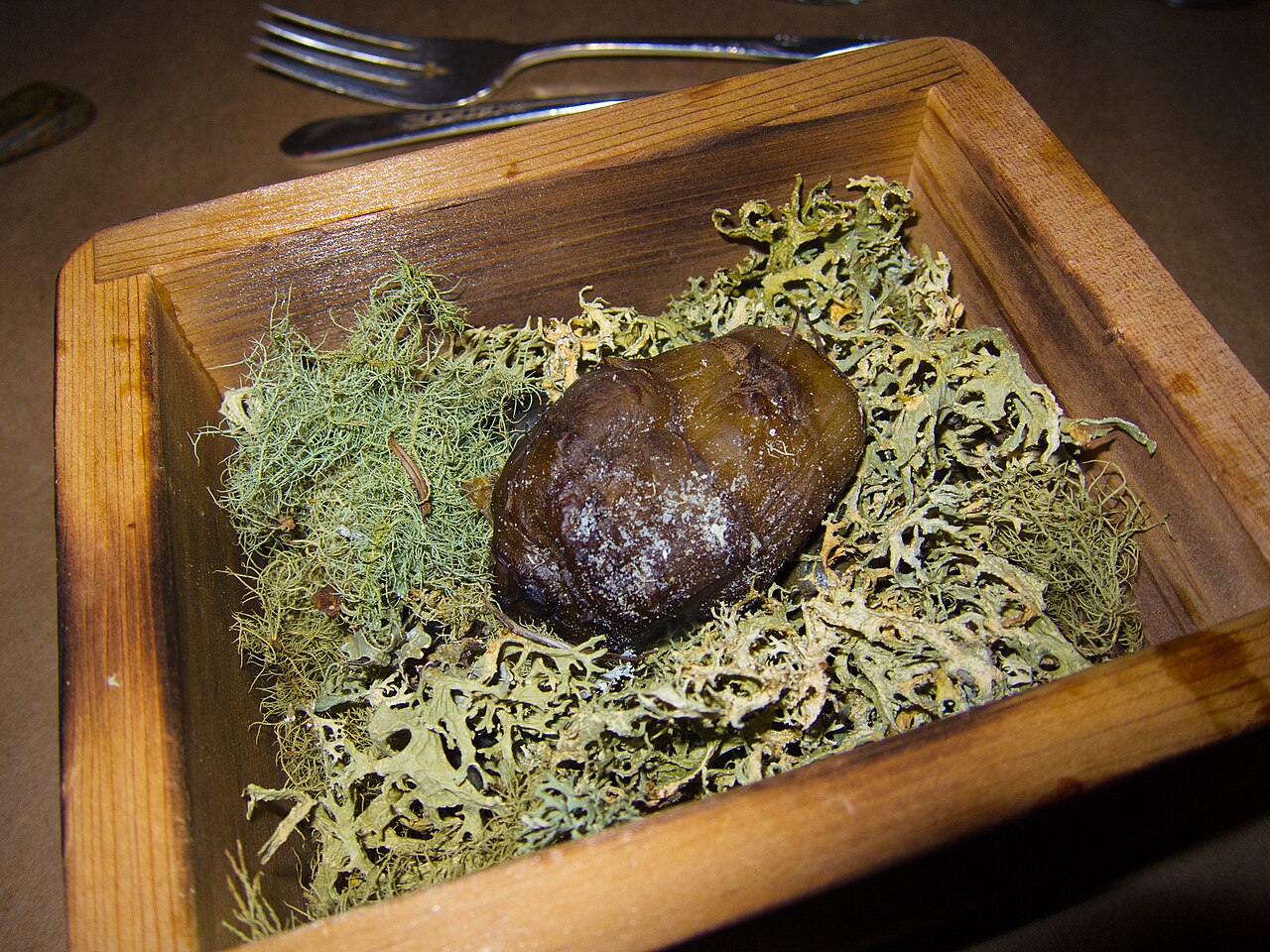
Image context: the cover uses a real 2012 photograph of a Willows Inn dish rather than a generic Pacific Northwest landscape. The point is not to romanticize the restaurant after the fact. It is to show the exact visual language that helped make the restaurant persuasive: dark table, roots, smoke-box memory, and food presented as if it had just been pulled from the island itself.[5]
The prestige machine needed a believable island
The Willows had a rare advantage: it could make geography do editorial work before dinner began. The ferry ride filtered the audience. The island setting made scarcity feel natural. The distance from Seattle allowed ordinary restaurant mechanics to disappear behind a stronger story about foraging, fishing, growing, and cooking from the immediate landscape.
That story was not automatically false. Great regional cooking often begins in exactly this way: a limited pantry, specific weather, local producers, and a room that understands why those constraints matter. The problem appears when "local" stops being a sourcing description and becomes a credential that diners are asked to accept on faith. In its closure report, The Spokesman-Review, carrying a New York Times story by Julia Moskin, summarized the restaurant's fame as built on claims that ingredients were foraged, caught, or grown on Lummi Island; the same report said the Times investigation found employees had been sent to Costco, Target, and other supermarkets when supplies ran short.[3]
That detail is devastating because it breaks the grammar, not because Costco is inherently shameful. A smart kitchen can cook well from a supermarket. Many excellent restaurants buy from broadline suppliers. The issue is misalignment: the diner thought the premium was paying for an island ecology made legible on the plate. If the backup system was mainland shopping and uncredited substitution, then the romance and the procurement ledger were telling different stories.
The sharper reading is not that every course had to come from within a few miles. Remote restaurants can need mainland supply. The sharper reading is that fine dining owes guests a truthful contract. "Pacific Northwest cooking with island influence" is one contract. "This dish is the island speaking almost directly" is another. The Willows became famous by leaning hard into the second.
The labor record was already a warning light
The workplace problem did not begin with the 2021 public reckoning. In 2017, the U.S. Department of Labor announced a settlement with Freshore Hospitality, doing business as the Willows Inn, after finding Fair Labor Standards Act violations. Investigators said entry-level kitchen staff, described as stages, had been required to work a one-month free tryout before possible paid employment; once on payroll, some workers were paid daily rates from $50 per day for shifts up to 14 hours, without weekly overtime premiums.[1]
The resolution was concrete: 19 kitchen workers were owed $74,812 in unpaid overtime and an equal amount in damages, for a total of $149,624. The restaurant also canceled the stage program and agreed to comply with federal wage law.[1] Those numbers matter because they convert a fine-dining abstraction into arithmetic. A remote tasting menu that depends on intensive handwork, long prep, polished service, and elaborate mise en place has to pay for that labor somewhere. If the economics are made to work by underpaying the least powerful workers, then the menu is not only expensive. It is cross-subsidized by people whose names rarely appear in the romance.
This is the part of the Willows story that should make diners uncomfortable even when the food was good. A meal can be technically accomplished and still rest on a broken labor bargain. The Department of Labor's release even named the broader industry point: staging was common in high-end restaurants, but the agency called unpaid work unfair and illegal.[1] The Willows was therefore not an isolated curiosity. It was an unusually visible example of a prestige system that had long treated aspiration as a substitute for wages.
The 2021 allegations made the spell harder to keep
Seattle Met's 2022 essay captured the strange interim period after the New York Times investigation: the restaurant could still produce an impressive dinner, but dining there had become ethically unstable. The piece described the Times report as based on interviews with 35 former staff members and summarized allegations of sexual harassment, verbal abuse, slurs, and ingredient misrepresentation; it also noted the wage-violation class-action context.[2]
The owners and Wetzel denied major allegations, and that denial matters to state clearly.[3] But denial alone does not restore a restaurant's contract with the public. Fine dining is not just a private exchange between chef and guest. It depends on trust across hidden systems: hiring, training, sourcing, credit, safety, and the credibility of the story told at the table.
The Willows was particularly exposed because its brand had so little distance between ethics and aesthetics. Many restaurants can survive a gap between marketing and mechanics because their promise is simpler: good steak, good pasta, good room, good wine. The Willows promised something more total. It asked diners to believe in a complete ecology. When former workers and regulators described another ecology behind it - long hours, unpaid trials, harassment allegations, supermarket runs, frightened or marginalized staff - the restaurant did not just face bad press. Its basic enchantment became harder to inhabit.
That is why the diner's role belongs in the story. Seattle Met's essay is valuable because it does not pretend the consumer dilemma is clean. It describes a meal that still had point of view and beauty, then asks what it means to keep paying when the public record has changed.[2] The uncomfortable answer is that diners are not courts, but they are not neutral either. Prestige restaurants survive through reservation books, award lists, glowing essays, and the willingness of guests to turn uncertainty into appetite.
Closure did not solve the larger problem
The restaurant closed after the 2022 season. The Spokesman/New York Times closure report said that after the 2021 investigation, 137 employees filed a class-action lawsuit over working conditions, wage theft, and wrongful termination, and that it settled for $1.37 million. The report also said the property had been donated to Lighthouse Mission Ministries, which would evaluate its best use and value.[3]
Closure gives the story an ending, but not a solution. The fine-dining world still loves remoteness, scarcity, small producers, young cooks working at the edge of endurance, and menus that claim moral force through place. None of those things is automatically corrupt. In fact, some of the best restaurants in the world use exactly those ingredients honestly. The Willows lesson is that the more total the story, the more transparent the machinery has to be.
The post-Willows standard should be practical rather than performative. If a restaurant sells hyperlocality, it should be able to explain what is local, what is regional, what is bought elsewhere, and why. If a restaurant uses stages or interns, the pay and legal status should be plain before the worker arrives. If the room's pleasure depends on a dozen unseen hands, those hands need safe reporting channels, credible management, and wages that do not require myth to justify them.
The most generous interpretation of the Willows is that it revealed how seductive a coherent food story can be. The harsher interpretation is that the coherence itself became cover. Both can be true. The island was real. The craft was real. The accolades were real. The Department of Labor settlement was real. The later allegations, denials, lawsuits, and closure were real too.[1][2][3][4]
That is the durable warning for fine dining. A restaurant cannot use place as poetry while treating labor and sourcing as footnotes. At the highest level, the story is part of the product. When the story breaks, the plate does not get to stay innocent.
Sources
- U.S. Department of Labor, "Luxury inn on Lummi Island reaches settlement with US Labor Department to pay workers $149K in back pay for overtime, minimum wage violations," June 26, 2017, covering the Willows Inn wage findings, stage-program cancellation, affected workers, and settlement amounts.
- Allecia Vermillion, "Can We Ever Go Back to Junebaby and the Willows Inn?" Seattle Met, October 25, 2022, on dining after the allegations, the New York Times investigation context, diner complicity, and the unresolved question of accountability.
- Julia Moskin, "The Willows Inn closes after abuse allegations, lawsuits," The Spokesman-Review / New York Times, November 29, 2022, on the closure, owners' denials, employee lawsuit settlement, sourcing allegations, and property donation.
- James Beard Foundation, "The 2015 James Beard Award Winners!" May 4, 2015, listing Blaine Wetzel of The Willows Inn on Lummi Island as Best Chef: Northwest.
- Wikimedia Commons, "File:Willows Inn IMG 0330 (8118103470).jpg," real 2012 photograph of a Willows Inn dish, with source, author, date, camera location, and licensing metadata.