The useful way to read The Waterside Inn is not as a museum piece that somehow still has three stars. It is more interesting than that. The restaurant has survived because it turns old-fashioned signals - river setting, jackets, sauces, souffle, tableside work, rooms upstairs - into a service system that feels personal enough to resist becoming stiff.
That distinction matters in 2026 because fine dining has become very good at novelty and less patient with continuity. Many destination restaurants now explain themselves through labs, farms, counter seats, fermentation rooms, ticketing systems, and immersive arcs. The Waterside Inn explains itself through a different grammar: a family-run restaurant with rooms, a team of more than 60, a chef-patron still publicly framed as present in both kitchen and room, and a founding brief that connected service and cuisine from the beginning.[1] The result is not fashionable in the usual sense. It is durable.
The history is almost too neat. Michel and Albert Roux opened Le Gavroche in 1967, then found a shabby old pub on the Thames in Bray and opened The Waterside Inn in 1972.[1] The Michelin ladder followed quickly: one star in the 1974 inaugural UK guide, two in 1977, and three in 1985.[1] In February 2026, Alain Roux marked the restaurant's 41st consecutive year with three Michelin stars, framing excellence as a daily responsibility rather than a settled possession.[7] That language is easy to dismiss as ceremonial until you look at how the restaurant publishes its operating details. The house has not kept its identity by refusing rules. It has kept it by making the rules legible.
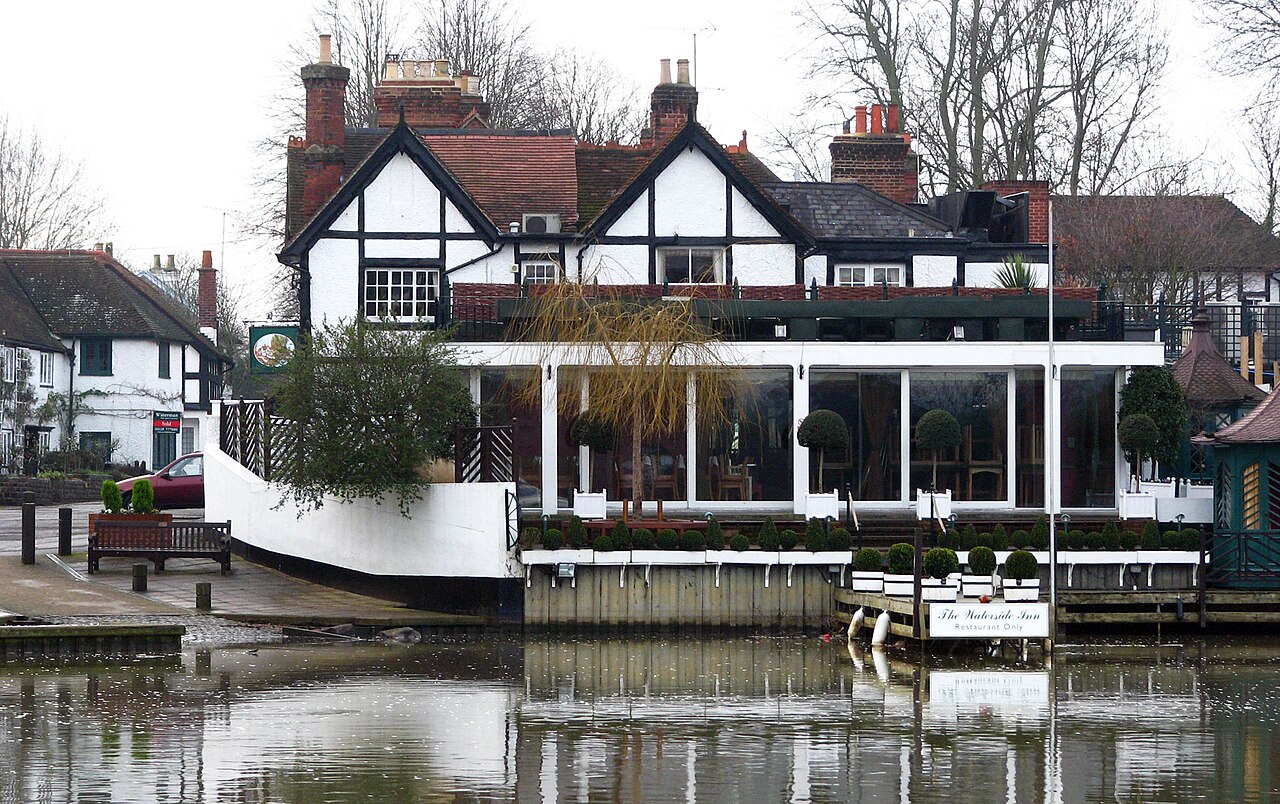
Image context: the lead image is deliberately an exterior river photograph rather than a plated dish. The Waterside Inn's strongest service claim begins before the food: a Thames-side building, a landing stage, a small village address, and an inn format that slows the meal before the first course arrives.[1][6][8]
The room is formal, but the contract is clear
The Waterside Inn's current menu page still introduces the place as an enchanting riverside setting with elegant surroundings, relaxed atmosphere, effortless service, and French cuisine served in Bray since 1972.[2] That wording reveals the house style. The point is not to abolish formality; it is to make formality feel hosted. The restaurant wants guests to understand that ceremony and ease are not opposites.
The dress-code page makes the same operating choice in harder language. Smart trainers are allowed, but sportswear, hooded sweatshirts, T-shirts, shorts, tracksuit bottoms, flip-flops, and sandals are not; gentlemen need a collared shirt, long trousers, and smart shoes or trainers, with a jacket or blazer optional.[5] The policy also says failure to follow the code can mean the reservation is not fulfilled and the cancellation policy applies.[5] That might sound severe in isolation. In context, it is boundary-setting. A house built around old-school hospitality needs the room to hold a certain social temperature. If the dress code were vague, staff would have to negotiate the atmosphere table by table.
The important word is "comfortable." The published rules open by saying guests should feel comfortable expressing individual style while accounting for compulsory limits.[5] That is the modern compromise: less costume, more clarity. The restaurant is not asking every guest to reenact 1972. It is asking the room to arrive prepared for a certain kind of service.
Menus give the kitchen range without surrendering coherence
The current spring 2026 a la carte menu shows why The Waterside Inn should not be flattened into "classical French" as if that were a single static object. The two-course price is GBP 215 per person and the three-course price is GBP 270, with a minimum two courses.[3] The dishes carry old grammar and current sourcing side by side: frogs' legs with garden sorrel and pea fricassee, Orkney scallops with bear's garlic crust and labneh emulsion, Dover sole with langoustines and lemon verbena Nantua sauce, Cornish turbot with kaffir lime and oscietra caviar beurre blanc, grilled rabbit with Armagnac and glazed chestnuts, and warm rhubarb souffle.[3]
That list explains the restaurant better than any ranking. The sauces are not ornamental; they are the spine. Labneh, kaffir lime, lemon verbena, garden sorrel, and bear's garlic show the kitchen is not pretending time stopped with Escoffier. But the plate logic still moves through reduction, texture, temperature, and serviceable sequence rather than through shock or manifesto. Michelin's public restaurant listing makes the same distinction from the outside: newer creations sit alongside French classics, with craft visible in lobster jus and quenelle-style work.[9]
The seven-course Menu Exceptionnel sharpens the structure. It is priced at GBP 280 per person, must be ordered by the whole table, and is offered with three pairing ladders: GBP 195, GBP 575, and GBP 1,800 per person.[4] Those pairing tiers are not just upsell architecture. They let the dining room tune the same meal to different kinds of guests: celebratory but contained, serious wine-led, or maximum-cellar occasion. Coherence comes from the shared menu; personalization comes through the liquid route.
Tableside work is theater with constraints
The Waterside Inn's clearest service-operations signal is the separate page for gueridon classics. The restaurant says its skilled restaurant professionals can enhance the experience by preparing special dishes at the table.[10] The wording matters: this is front-of-house skill, not a garnish around kitchen skill.
The constraints are just as revealing as the dishes. Lobster a la Presse carries a GBP 100 supplement if taken as a principal starter or main course, or GBP 175 as an additional course. It must be pre-ordered, has a seven-day cancellation rule, is limited to one to four guests per table, and only one gueridon classic dish may be taken per course per table.[10] Linguini with caviar, pressed duck, and Crepes Suzette have similarly explicit supplements, guest-count limits, and advance rules; pressed duck is currently unavailable due to avian flu.[10]
That is not fussy bureaucracy. It is how old-school table theater avoids becoming operational chaos. A dining room cannot press lobster, finish caviar linguini, flambe crepes, protect pacing, and serve every other table properly unless the work is rationed. The limits tell guests that the restaurant values the gesture enough to protect it.
They also show why the restaurant's classicism still has life. A mediocre nostalgic restaurant performs old gestures because they look prestigious. A serious one treats them as labor, capacity, timing, and risk. If the table does not understand the advance notice, guest count, and cancellation rules, the romance collapses into waiting time for everyone else.
The inn format changes the pace
The rooms are not incidental. The official accommodation page says guests can stay in one of 11 individually designed rooms after dinner, either in the main building or nearby cottages.[6] Condé Nast Traveler's hotel review makes the same point in more atmospheric language, describing The Waterside Inn as a restaurant with rooms and one of the remaining temples of classical French cooking, where guests can finish the evening with Armagnac in the garden and wake to croissants by the Thames.[11]
For operations, this matters because rooms change the emotional arc of dinner. A guest who can sleep upstairs or next door does not have to treat the meal as a race against the last train or a long drive. The house can sell an evening rather than only a reservation. That makes the dress code, the landing stage, the wine pairings, the table work, and the breakfast afterglow feel like parts of one hospitality product.
The parking page adds smaller but telling mechanics. Non-resident guests have valet parking from the doorman, residents have guaranteed overnight parking, and the site lists five EV charging stations for patrons and Porsche EV drivers, with flat fees for non-Porsche drivers at lunch, dinner, or overnight.[5] These are not glamorous details, but they are hospitality details. The restaurant has to solve arrival and departure before it can claim relaxed elegance.
Legacy is made through people, not only dishes
The official story page says Michel Roux handed the reins to Alain in 2002 and that Alain continues with more than 60 people at his side.[1] The Caterer, writing when the restaurant celebrated 25 years of three Michelin stars in 2010, captured the same service thesis from Michel Roux himself: maintaining Michelin quality was not only about food, but about an entire philosophy of how a restaurant is run, with front-of-house and kitchen teams moving together.[12] That line is the operating key.
The restaurant's recent 41-year note also gives the team credit rather than treating the stars as chef property alone.[7] This is not sentimental window dressing. A restaurant built around consistency has to make continuity transferable. Guests may come for Roux history, sauces, or the Thames setting, but they return only if the team can reproduce warmth without sounding rehearsed.
This is where The Waterside Inn's apparent conservatism becomes more complicated. It is conservative in the sense that it protects form: French sauces, whole-table menus, dress-code boundaries, tableside skills, wine ladders, and the inn structure. But it is adaptive in the way it keeps those forms usable. Smart trainers are allowed. Vegetarian versions of the tasting menu exist.[4][5] Pressed duck is suspended when avian flu makes it impractical.[10] Alain Roux's 2026 note frames excellence as fragile, which is another way of saying the old house has to be earned again every service.[7]
That is the lesson for diners and operators. The Waterside Inn is not relevant because every restaurant should revive its style. Most should not. It is relevant because it shows what happens when a restaurant has the courage to let an identity become an operating system. The river is part of arrival. The rooms alter time. The dress code stabilizes the room. The menus give guests choices without fragmenting the kitchen. The gueridon rules protect theater from overuse. The team makes formality human.
The result is a kind of luxury that feels increasingly rare: not maximal spectacle, not laboratory novelty, not nostalgic cosplay, but a house that knows what it is for. At The Waterside Inn, classicism survives because service keeps translating it back into pleasure.[1][2][7][11]
Sources
- The Waterside Inn, "Our Story" - official history covering the Roux family, 1972 opening, Michelin chronology, 2002 handover to Alain Roux, and team scale.
- The Waterside Inn, "Restaurant | Menus" - current restaurant framing, riverside setting, relaxed service language, and menu-entry links.
- The Waterside Inn, spring 2026 a la carte PDF - current course prices, dish examples, supplements, last-order notes, and service charge.
- The Waterside Inn, spring 2026 Menu Exceptionnel PDF - seven-course menu, vegetarian version, whole-table requirement, menu price, and three wine-pairing tiers.
- The Waterside Inn, "Dress Code | Parking" - smart-dress rules, reservation consequence, valet parking, resident parking, and EV charging details.
- The Waterside Inn, "Rooms" - official accommodation page describing 11 individually designed rooms in the main building and cottages.
- The Waterside Inn, "41 Years of Three Michelin Stars" - February 2026 note from Alain Roux on retaining three stars and the role of daily responsibility and team continuity.
- Wikimedia Commons, "File:Waterside Inn, Bray, Berkshire (Nancy).JPG" - real 2008 photograph used for the lead image, showing the restaurant on the River Thames and its landing stage.
- MICHELIN Guide, "Waterside Inn - Bray" - current guide listing covering three-star status, Thames setting, service, French classics, newer creations, and opening hours.
- The Waterside Inn, "Gueridon Classics" - current tableside dishes, supplements, advance-order rules, guest-count limits, and availability notes.
- Condé Nast Traveler, "Waterside Inn" - hotel review covering the restaurant-with-rooms format, Roux history, classical French identity, and Thames-side overnight atmosphere.
- The Caterer, "Waterside Inn celebrates 25 years of three Michelin stars" (2010) - trade report covering the 25-year milestone, service philosophy, front-of-house continuity, and Michelin chronology.