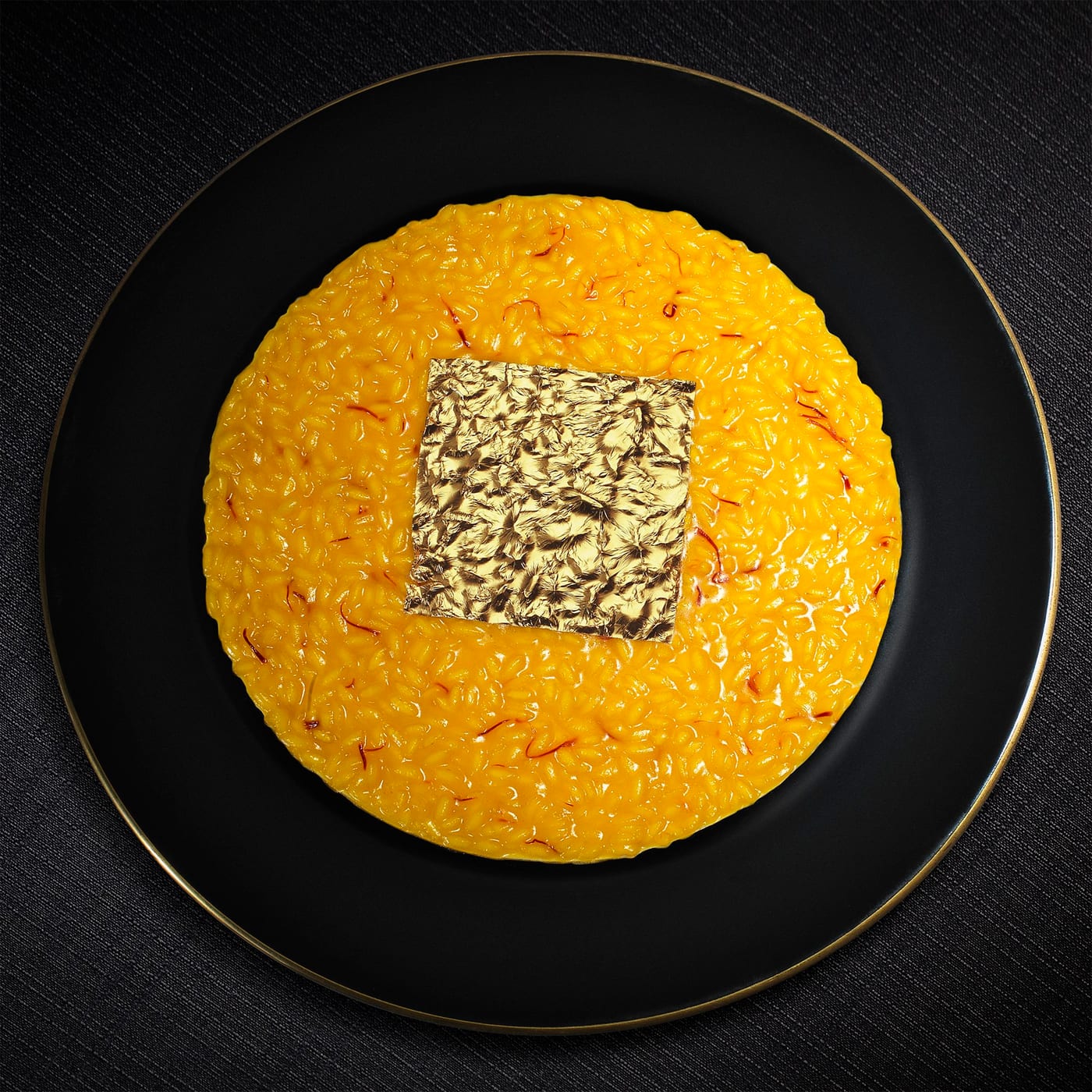
The easy joke about Gualtiero Marchesi's Riso, Oro e Zafferano is that it is saffron risotto wearing jewelry. That joke misses the dish. The gold is not there because the rice needs help looking expensive. It is there because Marchesi wanted a Milanese form so reduced, so frontal, and so controlled that one square of metal could change how the guest read the whole plate.
That is why this dish still deserves a close reading rather than a luxury-garnish shrug. Marchesi's own institutional site frames his cooking as a pure art form, not in the vague sense that food can be pretty, but in the stricter sense that ingredients and techniques become composition.[1] The biographical page makes the same point more concretely: after opening the restaurant on via Bonvesin de la Riva in 1977, Marchesi developed iconic plates including Riso, Oro e Zafferano, the open raviolo, and cuttlefish in ink while treating the color of the plate, the lighting, and the client's gaze as part of the culinary object.[2]
In other words, this is not a risotto plus decoration. It is a dish about where decoration stops being extra.
Image context: the cover uses the official Marchesi photograph of the dish rather than a generic saffron-risotto image. That matters because the plate design is part of the dish's meaning: yellow field, black edge, central gold, and a deliberately flat visual sentence.[1][3]
The old dish is hiding inside the modern one
Marchesi did not invent Milanese risotto. The point was to strip it until the familiar became strange again. The Gold Chef recipe attributed to Marchesi keeps the base recognizable: Carnaroli rice, saffron threads, butter, Parmesan, dry white wine, light chicken broth, onion, salt, and 23 kt edible gold leaf.[4] Nothing about that list asks the diner to forget Milan. It asks the diner to notice which parts of Milanese risotto can carry meaning when the usual comfort signals are restrained.
The most important technical clue is not the gold. It is the acidic butter. The recipe has onion sweated in butter, white wine reduced, more butter emulsified into the reduction, then the mixture strained and cooled before it is used to cream the risotto.[4] That move changes the dish's center of gravity. Instead of heaviness announcing luxury, acidity gives the rice a cleaner line. The saffron still provides warmth, color, and perfume, but the butter has been disciplined. It is not simply fat. It is fat with a bright edge.
That is Marchesi's modernity in miniature. The dish does not reject tradition; it edits tradition until the guest can feel the edit. A conventional risotto alla milanese often leans into abundance, marrow depth, and the comfort of a steaming bowl. Marchesi's version behaves more like a composed surface. The rice must remain all'onda, rippling and creamy, but it is asked to arrive with graphic clarity rather than rustic generosity.[4]
The gold is a stop sign for the eye
The gold leaf is useful because it is almost useless. It adds little in the normal vocabulary of flavor. It does not season the rice, thicken the sauce, or change the texture in any substantial way. Its job is visual and conceptual: it tells the eye to stop, center itself, and read the plate as a made object.
The Marchesi home page states the larger philosophy plainly: cooking, for him, was not just feeding but composing and communicating, with aesthetics and balance treated as essential alongside taste.[1] The Gold Chef interview with Enrico Dandolo, CEO of the Fondazione Gualtiero Marchesi, says the dish represents Marchesi's union of the "cult of goodness" and the "culture of beauty."[3] That phrase can sound grand until you put it back on the plate. The rice gives goodness: warmth, starch, saffron, butter, Parmesan. The gold gives beauty a fixed point: a little square of non-nutritional attention.
This is why the dish can look severe without feeling cold. Yellow rice alone would be beautiful but edible in an ordinary way. Gold leaf alone would be empty theatre. Together, they make a small argument about value. The precious thing is not only the metal. It is the rice made exact enough to hold the metal without looking embarrassed by it.
The plate is part of the recipe
Marchesi was unusually explicit that the vehicle mattered. The Gold Chef interview says the authentic dish is served on a Villeroy & Boch plate with a black and gold edge designed by Marchesi, and that it is to be eaten with a gold spoon also designed by him.[3] The same source notes that no more than one minute should pass between plating and serving.[3] Those details are not ornamental trivia. They tell you that the dish is a timing problem and a design problem as much as a rice problem.
The black rim does a lot of work. It prevents the yellow field from dissolving into the room. It frames the saffron as color rather than just food. It makes the gold leaf feel intentional instead of scattered. In the official photograph, the dish does not ask for height, garnish, tweezed herbs, or sauce dots.[1] It refuses most of the later tasting-menu grammar. One surface, one color, one central flash.
That restraint also explains why imitations can be so fragile. If the rice is too loose, the image collapses. If it is too stiff, the dish stops being risotto. If the gold is off-center or casually placed, it becomes rich-person confetti. If service lags, the texture drifts and the plate's visual confidence starts to detach from the eating experience. Marchesi's rules about plate, spoon, temperature, and timing are not fetish objects. They are guardrails for a dish whose force depends on exactness.[3][4]
Authorship became part of the aftertaste
Riso, Oro e Zafferano also became a legal and cultural object. A 2015 report in Quotidiano Nazionale says the Milan court recognized Marchesi's risotto as protectable for its creativity and artistic value, after a dispute involving a former cook's version. The article also notes that the dish and presentation had been deposited in 2002 as a distinctive design mark, and it emphasizes the black-rimmed plate and edible gold leaf as part of the protected presentation.[5]
The legal story can sound eccentric, but it clarifies the dish's stakes. Marchesi was not merely defending a recipe. Recipes travel; risotto varies by hand; even Marchesi acknowledged that execution changes from one performance to another.[5] What he was defending was the relationship between preparation, presentation, and authorship. In this dish, the "look" is not packaging around the food. It is one of the ways the food thinks.
That is the useful lesson for contemporary fine dining. Plenty of restaurants now plate like designers, borrow from galleries, and talk about dishes as narratives. Marchesi's risotto remains sharper because the means are so few. It does not need twenty components to announce complexity. It uses a familiar rice dish, a refined butter technique, a black-edged plate, a square of gold, and service timing tight enough to keep the idea from going slack.
Why it still lands
The dish survives because it keeps two readings alive at once. It is luxurious, but not in the dumb way. It is minimal, but not in the thin way. It is traditional, but not in the museum way. It understands that Milanese risotto already carries civic memory, comfort, color, and technique; then it asks what happens when those signals are reduced until every remaining decision becomes visible.
That is why the gold leaf is the least important thing and the thing everyone remembers. It works because the rice beneath it has been tuned to accept the gesture. Without saffron, acidic butter, Carnaroli structure, Parmesan, broth, timing, plate, and frame, the gold would be only a stunt. With them, it becomes punctuation.
Marchesi's real move was not to make risotto rich. Milan had already done that. His move was to make richness legible as design: a yellow field, a black edge, a square of gold, and a spoon arriving before the minute is gone.[1][2][3][4]
Sources
- Gualtiero Marchesi official home page, including the official photograph of Riso, Oro e Zafferano and the site's framing of Marchesi's cooking as composition, communication, aesthetics, and balance.
- Gualtiero Marchesi, "Gualtiero," official biography covering the 1977 via Bonvesin de la Riva restaurant, the creation of Riso, Oro e Zafferano among Marchesi's iconic dishes, and his concern with plate, light, color, and the customer's gaze.
- Gold Chef by Giusto Manetti Battiloro, "The Gold of Gualtiero Marchesi," interview feature on the dish's history, 40-year anniversary, black-and-gold Villeroy & Boch plate, gold spoon, one-minute service rule, and beauty/goodness framing.
- Gold Chef by Giusto Manetti Battiloro, "Gold and Saffron Rice," recipe page listing Carnaroli rice, saffron, acidic butter, Parmesan, broth, and 23 kt edible gold leaf, with preparation notes for all'onda texture and final plating.
- Piero Degli Antoni, ""Il diritto d'autore e del cuoco": a Gualtiero Marchesi il copyright del 'suo' risotto," Quotidiano Nazionale, November 16, 2015, on the Milan court decision, design-mark context, black-rimmed plate, gold leaf, and authorship dispute.