Under is too easy to sell as a stunt: go to Norway, descend below the surface, eat beside a vast window, watch the seabed move. That description is accurate enough to be dangerous. It makes the restaurant sound like architecture first and dinner second, as if the menu merely has to keep pace with the view.
The better reading is stricter. Under works when the building becomes a sourcing instrument. Its official food page describes the restaurant as a kind of living periscope into nature's own pantry, and its current kitchen language keeps returning to the small things found just outside the windows: sea, forest, fields, traditions, seasonal availability, and the menu's dependence on what can be gathered or caught.[1] The room is dramatic, but the culinary claim is practical. Dinner is not only served under the sea; it is edited by the sea.
That distinction matters because immersive fine dining often confuses setting with substance. At Under, the strongest concept is not "look where you are eating." It is "look what this place forces the kitchen to notice." The official experience page says guests dine five meters below the surface with a panoramic view onto an ecosystem they would rarely see, while the structure's rough shell is meant to become part of the marine environment over time.[3] Snohetta's project page goes further: the building is 34 meters long, rests on the seabed, withstands rugged sea conditions, and functions not just as a restaurant but as a marine-life research center.[4] That is a rare setup for a tasting menu. The architecture is not decoration around a concept. It is the concept's test.
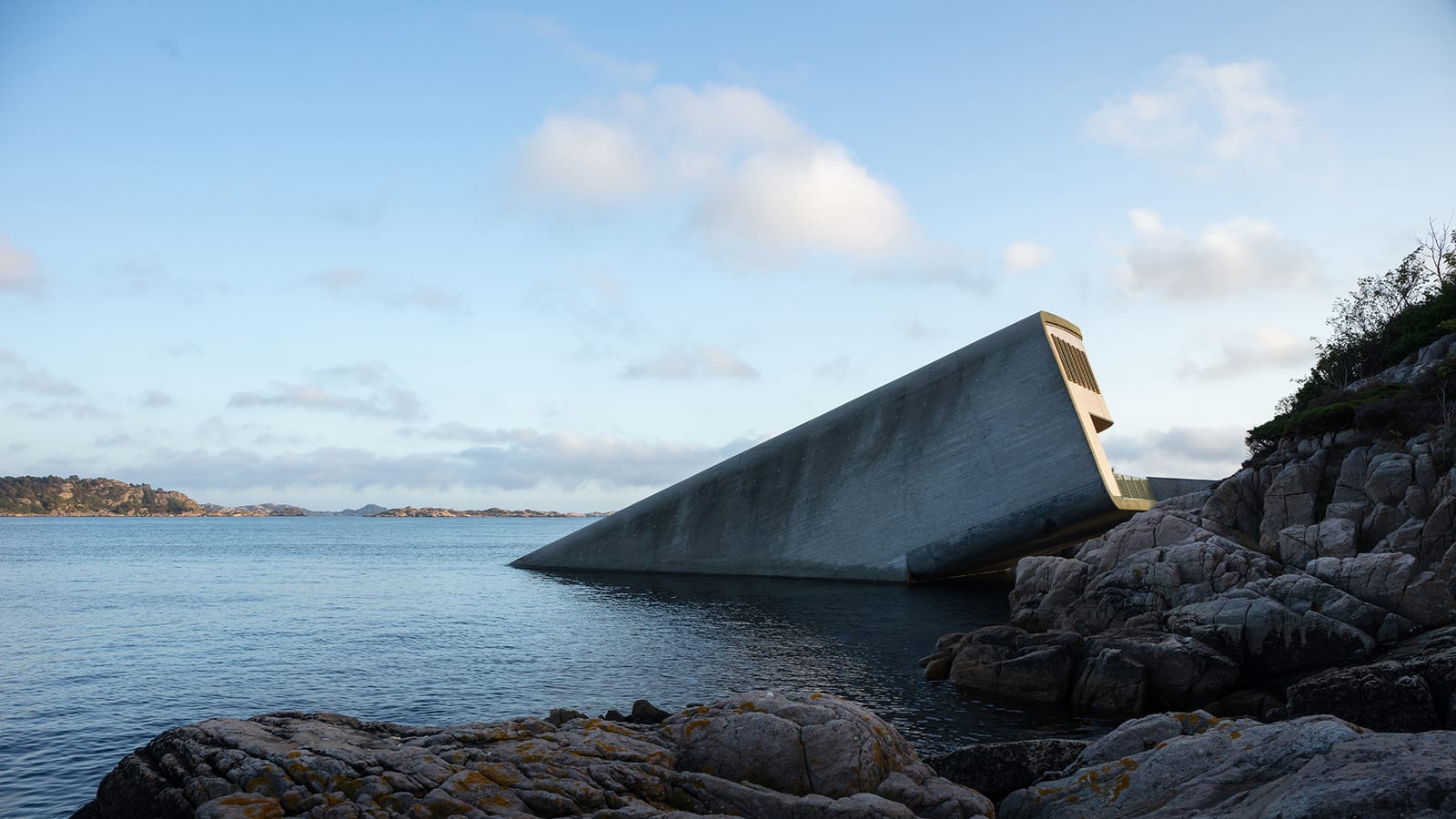
Image context: the cover shows Under from the rocky shoreline, not a plated course. That is deliberate. The profile is about a restaurant whose first ingredient is site pressure: concrete, waves, seabed, window, and southern Norwegian pantry all pushing on the kitchen before a guest sits down.[3][4][7]
The building changes the appetite
The first operational fact is spatial. Under is partially submerged at Lindesnes, the southern tip of Norway, where the visitor enters from harsh coastal weather and moves down into a warmer oak-lined interior.[3][4] This is not a casual city dinner. The journey, the coast, the weather, and the descent all prepare the diner to pay attention.
Snohetta's account helps explain why this attention feels earned rather than theatrical. The building is designed to integrate into its environment, with the concrete shell acting as an artificial reef for limpets and kelp, and with a massive window framing the seabed as it changes through seasons and weather.[4] The official Under experience page repeats the same logic in restaurant language: the building is sensitive to its geography and aquatic neighbors, while the window connects guests to marine life outside.[3]
Architectural Record's opening review catches the same physical pressure from a different angle: a reinforced-concrete tubular restaurant anchored into a rock-lined bay, with an acrylic window roughly 35 feet long and 11 feet high separating diners from the water.[6] The useful point is not the engineering novelty by itself. It is that the room keeps the guest aware of weight, barrier, and exposure. The restaurant is intimate because the sea is not.
That is why the view should not be treated as a screensaver. A normal dining room can close itself off from the supply chain; Under cannot. The dinner happens while the guest watches the living system that the restaurant claims to respect. If the menu were generic luxury seafood, the window would expose the weakness. The room demands a menu that behaves as if the outside matters.
The menu is a local argument, not a fixed display
Under's food page is refreshingly specific about mutability. The evening menu can change at short notice, seasonal changes are kept current, and lunch is a shorter version of the dinner structure.[1] The current format is a fixed 10- to 12-course set menu, seasonal, with dishes rotated according to availability.[1] That matters more than the number of courses. A restaurant under the sea should not be locked into an all-weather prestige script. Its credibility depends on letting conditions disturb the plan.
The pricing and pairing structure makes the contract legible. Under lists dinner at NOK 2,450 per person, rising to NOK 2,750 on Saturdays from April and all days from June, with a wine pairing, nonalcoholic pairing, and a more bespoke sommelier route available.[1] The nonalcoholic pairing is described as handmade juices using local ingredients composed to match the menu.[1] This is a useful signal. If the restaurant's pantry claim is serious, the glass cannot simply import prestige from elsewhere. The drink program has to carry the same place logic.
South Cape Collection's profile gives the visitor-facing version: a 12-course set menu, tailored beverage pairing, lunch from May to September, dinner year-round, and optional seaweed safaris or guided tours for groups.[5] Those details make Under less like a single isolated spectacle and more like a coastal system with hospitality attached. A meal here can be extended into learning, walking, staying nearby, and reading the coastline with more than appetite.
Sustainability is strongest when it becomes procurement
The sustainability page is the real backbone of the restaurant profile. Under says raw-material quality and local anchoring are central, and it prefers a short-travel ingredient with a lower climate footprint over a certified organic ingredient from abroad.[2] That is a sharper position than generic "local and organic" language. It recognizes that labels and logistics can pull against each other, then chooses proximity and quality as the operating priorities.
Foraging is not presented as garnish romance. The page says gathering is a major part of daily work, done with attention to species preservation so there will be more to harvest in the next season.[2] The restaurant says it continuously works to reduce its radius, adapts the menu to seasonal availability and fishermen's catch, and wants dishes to reflect what is natural and available nearby.[2] That is the practical version of an underwater dining room. The sea is not only a window view. It is an unstable source with rules.
The same page also makes preservation central. Under says it researches raw materials and serving methods in a test kitchen, but also learns from older generations who lived by the sea and local fauna; to show diversity through the whole year, the team uses older preserving methods such as pickling, fermentation, salting, smoking, and drying.[2] That sentence explains why the restaurant can avoid becoming a weather-dependent novelty act. Preservation lets a short season speak later without pretending the season never ended.
Waste, by-products, and the neighboring hotel
The stronger sustainability details are the least glamorous ones. Under says it aims for near zero waste: vegetable trimmings, skins, and bones become stocks and flavorings; some by-products move to the kitchen at the neighboring hotel; herb remnants and fallen fruit become vinegars and syrups; and the collaboration with hotel kitchens makes the circular approach possible.[2] This is not as cinematic as the window, but it is where the restaurant becomes credible.
Fine dining has a habit of turning sustainability into stage language. Under's by-product system sounds more operational. It depends on an ecosystem beyond one tasting counter: hotel kitchens, local partners, preservation work, staff roles, and a nearby guest infrastructure that can absorb what the restaurant cannot use in the same way. The fact that Under sits inside the South Cape Collection helps here. The collection frames the restaurant as part of a wider Lindesnes journey, with Lindesnes Havhotell steps away and other southern-coast experiences nearby.[5]
This matters because a destination restaurant often creates waste through the very intensity that makes it desirable: specialized ingredients, unpredictable guest counts, and a high bar for plate perfection. Under's answer is not to claim innocence. It is to make more exits for useful material before it becomes waste.
Why the current kitchen phase matters
Under is no longer interesting simply because it opened as Europe's first underwater restaurant. It has to prove that the concept can survive leadership, menu, and audience changes without shrinking into a famous building. The current official materials show the restaurant making that proof through daily procurement choices rather than through louder spectacle: changing menus, seasonal rotation, a named chef working from nearby elements, local sourcing goals, preservation, and by-product use.[1][2]
The current materials suggest the restaurant understands that risk. The official food page names Saetre as head chef and frames his work around capturing nearby things rather than chasing a detached global luxury vocabulary.[1] The sustainability page sets goals that reach beyond the dish: local producers, sustainable fishing methods, minimal additives, local craftspeople, recycled fishing-net kitchen clothing, ceramics, and collaboration with marine research environments.[2] Some of those goals are broad, but together they reveal the real ambition. Under wants the whole guest journey to behave like a local system, not only the menu.
The current official materials make the original architectural pitch feel more mature. The restaurant is no longer only asking whether underwater dining can be spectacular. It is asking whether the spectacle can keep discipline.
The useful lesson
Under's best lesson for fine dining is that immersion needs consequences. A restaurant can put a guest anywhere: under the sea, inside a theater, in a greenhouse, at a counter, on a farm, in a museum-like room. The location matters only if it changes decisions. At Under, the location changes the architecture, the journey, the sourcing radius, the preservation needs, the drink logic, the waste system, and the story the guest is asked to carry home.[1][2][3][4]
That is why the meal should not be evaluated as a view with courses attached. The view is a pressure source. The concrete shell, rough water, artificial-reef ambition, local foraging, fishermen's catch, preservation work, hotel partnership, and marine-research collaboration all push the restaurant toward one question: can luxury make the sea more legible without turning it into scenery?
When Under is at its strongest, the answer is yes. Not because eating underwater is automatically profound, and not because every dramatic building produces serious cuisine. The answer is yes when the seabed becomes more than backdrop. At Lindesnes, the pantry begins outside the glass, and the restaurant's job is to keep that fact visible all the way to the last course.[2][3][4]
Sources
- Under, "Mat og drikke" - official food-and-drink page covering menu mutability, 10-12-course set menu, seasonal rotation, chef Bernt Saetre, prices, and pairing formats.
- Under, "Baerekraft" - official sustainability page covering local sourcing, foraging, species preservation, preservation methods, by-product use, supplier relationships, marine research, and sustainability goals.
- Under, "Opplevelsen" - official experience page covering the five-meter descent, panoramic seabed view, artificial-reef function, interior transition, and ecological framing.
- Snohetta, "Under" - architecture project page covering Europe's first underwater restaurant, 2016-2019 project timeline, 34-meter concrete form, five-meter seabed placement, artificial reef, and marine-research role.
- South Cape Collection, "Under" - destination profile covering the restaurant's five-and-a-half-meter setting, Snohetta architecture, local seasonal ingredients, 12-course set menu, lunch/dinner cadence, group formats, seaweed safari, and nearby stay context.
- Andrew Ayers, "Under by Snohetta," Architectural Record (May 1, 2019) - architecture review covering the reinforced-concrete bay structure, acrylic dining-room window, construction logic, and marine-observation role.
- Under official image asset, "Under Webres Mike Kelley 15" - source photograph used as the article image.