There is a small comedy built into ambitious restaurants. The kitchen may spend weeks deciding how one broth should lead into one roasted shellfish course, yet the first beverage question is often dispatched in two words: still or sparkling?
A water menu appears to solve that problem. Suddenly there are springs, aquifers, volcanic rock, mountain snow and bottles shaped like trophies. The descriptions become longer; the prices climb; the diner is asked to believe that provenance alone has created a pairing program.
But a rare bottle is not yet a pairing. Water earns a place beside food only when the restaurant can say what it will do: add a brisk carbonic edge, lower the sensory volume, bring a distinctly mineral flavor, change temperature, or simply hydrate without interrupting the plate. The useful variables are in the glass. The romance belongs after them.
This is a sensory and service argument, not a claim that one water objectively belongs with one dish. The direct science establishes that carbonation and dissolved minerals can be perceived. It does not establish a universal code in which a high number on a label automatically belongs with steak and a low number belongs with fish.
The expensive bottle is not yet a pairing
Fine dining has already shown how far the category can travel. In December 2024, Axios reported that The Inn at Little Washington had introduced a list of 13 rare still and sparkling waters, including a $95 Canadian iceberg water. The crucial detail came at the end of the report: guests could also choose a low-minerality Virginia water for free.[1]
The menu makes sense as theatre. A table can taste waters side by side and discover that “neutral” was never quite accurate. One may feel broad and saline, another narrow and soft, another almost spicy with carbonation. Origin can deepen that pleasure, just as the story of a vineyard can deepen a wine.
Yet prestige is a poor substitute for a blind glass. In a 2018 study, more than 100 participants tasted four bottled “fine waters” and tap water. They distinguished among the bottled waters only slightly better than chance, could not reliably match them to expert descriptions, and showed no positive relationship between price and rating; some preferred the inexpensive tap.[6] Four bottles cannot stand for the whole category, but the result is a useful warning: an expensive source story may be easier to perceive than the water itself.
The mistake is letting the story substitute for the sensation. Ancient ice, a remote spring and a heavy glass bottle are narratives of scarcity. None tells the diner, by itself, how forceful the bubbles are, whether the water tastes noticeably mineral, how cold it will arrive, or whether it improves the next bite. A water list becomes gastronomic only when those questions survive the sales pitch.
The bubbles are flavor, not a broom
Sparkling water is often said to “cleanse the palate,” as though bubbles scrub fat from the tongue. The more interesting account is chemical.
A 2009 Science study identified sour-sensing taste cells and the enzyme carbonic anhydrase 4 as central to the taste response to carbon dioxide in mice.[2] Earlier work in The Journal of Neuroscience combined animal experiments with a small human half-tongue test. Blocking carbonic anhydrase reduced the perceived intensity of carbonated water on the treated side, supporting the view that dissolved carbon dioxide produces a chemical sting rather than merely a mechanical tickle from bursting bubbles.[3]
That distinction gives sparkling water a real pairing role. It brings acidity, tingle and a brief irritant edge. After a butter-rich sauce or fried crust, that edge can make the next mouthful feel newly outlined. This is contrast, not cleaning: the water changes the signal arriving after the food.
The same mechanism also gives the pairing a boundary. With a delicate clear broth, a fragile raw fish course or a very quiet custard, hard carbonation can become the loudest ingredient at the table. With fresh chile, pepper or aggressive acidity, its sting may stack on top of irritation rather than offer relief. These are pairing inferences from the sensory mechanism, not clinical rules. The restaurant still has to taste the actual water with the actual dish.
This is why “sparkling” is too crude a category. A soft natural effervescence, a tight stream of small bubbles and an aggressively carbonated water do not occupy the same space in a bite. The useful menu language is practical: gentle or forceful, lean or broad, quick or persistent. “From an untouched source” may be true, but it does not tell the server when to pour.
TDS is a total, not a tasting note
Still water is not blank. Calcium, magnesium, sodium, potassium, bicarbonate, chloride and sulfate are among the components gathered under total dissolved solids, or TDS.[7] The number is useful because it indicates how much dissolved material a water carries. It is limited because it adds unlike things together.
Two waters can therefore post a similar TDS while tasting different. The balance of ions matters, and so do pH, dissolved gas, trace odor compounds and the serving vessel. One headline number cannot reveal the full shape.
A 2013 Water Research paper makes the point without resorting to mysticism. Trained panels blind-tasted 20 bottled waters in one study and 25 bottled and tap waters in another, then researchers compared liking scores with physicochemical measurements. In those samples, preferred waters were associated with moderate TDS and particular balances of bicarbonate, sulfate, calcium and magnesium; high sodium, potassium and chloride concentrations tended to score poorly.[4] That is evidence that composition affects flavor. It is not a law that the most mineral water is the most serious, or that one mineral profile will please every diner.
The World Health Organization draws another useful boundary. Its fact sheet says TDS may affect the acceptability of drinking water, but it does not propose a health-based guideline value because TDS at levels found in drinking water is not itself treated as a health concern.[7] A restaurant should not turn minerality into a wellness ladder. “More minerals” is neither an automatic quality mark nor a permission slip for vague claims about digestion, detoxification or superior hydration.
For pairing, the right question is smaller: can the guest perceive a difference, and does that difference help this food? A moderately mineral still water may give a salty, lactic or roasted course more continuity than an extremely soft water. Or it may simply make the food feel heavier. Blind tasting decides; label prestige does not.
Temperature is the quietest edit
Water service often hides a powerful choice in the ice bucket. In a controlled study of carbonated spring water served at 3, 10, 16 and 22°C, both trained and untrained panels perceived stronger carbonation at lower temperatures; the effect appeared at two carbon-dioxide levels and was more evident at the higher one.[5] Cold does not merely preserve bubbles. It changes how forcefully they register.
That does not establish one correct service temperature. A cold sparkling pour may supply the precise briskness a rich bite needs, while the same intensity may crowd a delicate course. A less chilled still water may make its own flavor easier to discuss, but that, too, has to be tested rather than asserted. The mistake is serving every bottle at one punishing temperature and then describing temperature as if it were neutral.
A serious program should taste each candidate at the temperature it will actually meet the guest. It should also taste the sparkling water at the first pour and again after the bottle has sat open. A pairing that works only during the first explosive minute is an awkward choice for a long tasting menu. Bottle size, cap, pour volume and refill rhythm all become part of the beverage design.
Glassware matters in a similarly unglamorous way. The glass must be clean and free of detergent or cabinet odor. Lemon and ice should be offered, not dropped in automatically; both rewrite the water the restaurant claims to have selected. A stem can make a premium pour feel ceremonial, but ceremony is useful only if the bowl is comfortable and the table does not become a forest of water glasses.
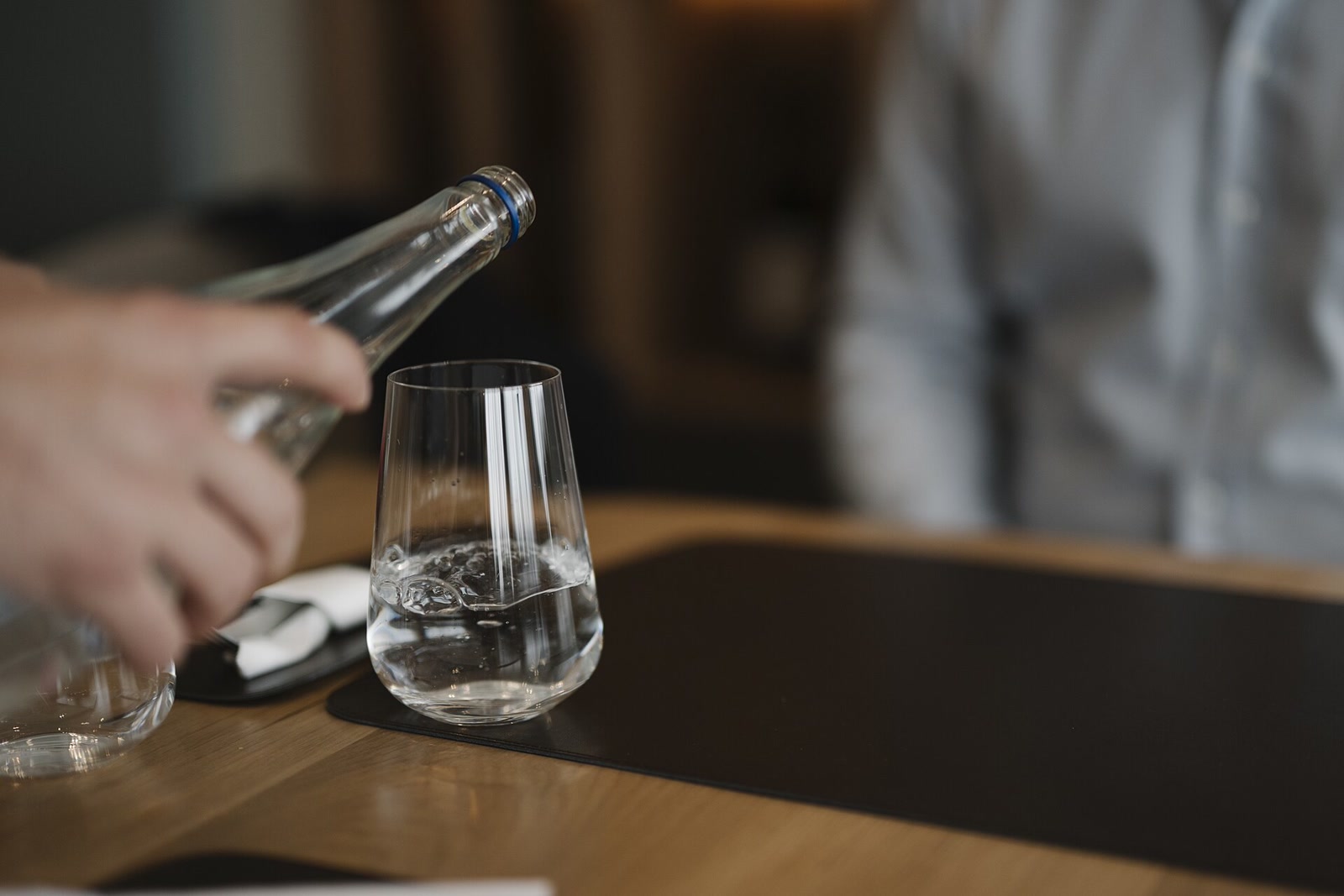
The cover photograph shows a waiter pouring from a clear bottle into a drinking glass in a warm dining room.[8] There is no geological spectacle in the frame. That is precisely why it fits. Water pairing succeeds or fails in an ordinary service gesture: open, pour, explain, replenish, get out of the food's way.
Build the flight in the kitchen, not in the copy
The strongest water program may contain only two choices. Start with an excellent house still water—filtered local water where appropriate, or a restrained bottled still—served freely and without apology. Add one sparkling water whose carbonic intensity has been tested across the menu. A third, more distinctive still water earns space only if the team can identify its sensory job blind.
The trial should happen with food. Put three unlabelled waters beside a delicate broth, a fried bite and the menu's hottest or most acidic course. Ask cooks and servers to write what changes, not which brand feels luxurious. Does the broth lose detail? Does the crust regain definition? Does the spicy course become brighter or merely more abrasive? Repeat at service temperature and after the sparkling bottle has been open for part of a seating.
This exercise usually produces better language than a supplier sheet. “Firm bubbles sharpen the break after the fritter” is a useful service note. “High-TDS water complements robust cuisine” is a category slogan. The first names a sensation, a dish and a moment; the second asks the number to do the tasting.
A full water flight can still be delightful, especially for a guest avoiding alcohol. It should remain optional, modest in pour size and clear in price. Changing water at every course risks turning hydration into homework. The point is not to imitate wine's glass count. It is to offer complexity without alcohol while preserving the one privilege water has always had at the table: it can be present without demanding attention.
Free still water is the hospitality test
The free Virginia option reported alongside The Inn at Little Washington's rare-water list was not an embarrassing fallback. It was the detail that kept the list hospitable.[1] A diner should be able to decline the performance and still receive good water promptly.
That boundary matters because thirst weakens consent. A server who presents only premium labels before mentioning the house option turns a pairing conversation into pressure. Prices, bottle volumes and refill rules should be visible. “Still or sparkling?” should never secretly mean “Which charge would you prefer?”
The ideal explanation is short: the house still is complimentary; this sparkling water has a firm carbonic bite that works particularly well after two richer courses; this optional mineral still is broader and more savory. Then the guest chooses. No invented health benefit, no claim that a remote source makes a person more discerning, no disappointment when tap wins.
Water deserves more attention in fine dining because it is sensorially active and operationally constant. It does not deserve attention merely because a restaurant can make it scarce. Begin with the bubbles. Taste the minerals rather than worshipping the total. Set the temperature, protect the pour and keep the free glass full. If the bottle also carries a wonderful story, the story can arrive last.
Sources
- Anna Spiegel, “A luxury water menu pops up at The Inn at Little Washington,” Axios Washington, D.C. (December 19, 2024) — reported menu size, rare-water pricing and the complimentary local-water option.
- Jayaram Chandrashekar et al., “The Taste of Carbonation,” Science 326 (2009) — experimental identification of sour-sensing cells and carbonic anhydrase 4 in the taste response to carbon dioxide.
- C. T. Simons et al., “Neurobiological and Psychophysical Mechanisms Underlying the Oral Sensation Produced by Carbonated Water,” The Journal of Neuroscience 19 (1999) — animal and human evidence for a carbonic-anhydrase-dependent oral irritation pathway.
- Stefan Platikanov et al., “Influence of minerals on the taste of bottled and tap water: a chemometric approach,” Water Research 47 (2013) — blind sensory panels and physicochemical analysis of bottled and tap waters.
- N. J. Newton Yau and Mina R. McDaniel, “The effect of temperature on carbonation perception,” Chemical Senses 16 (1991) — controlled tasting at two carbonation levels and four serving temperatures.
- Kevin W. Capehart and Elena C. Berg, “Fine Water: A Blind Taste Test,” Journal of Wine Economics 13 (2018) — consumer discrimination, expert-description matching, tap-water preference and the weak relationship between price and blind rating.
- World Health Organization, “Chemical fact sheets: Total dissolved solids” (May 18, 2022) — definition, acceptability note and the boundary against treating TDS as a health-based quality ladder.
- Nenad Stojković, “Waiter serves water in a glass at a restaurant” (photographed April 7, 2026), Wikimedia Commons, CC BY 2.0 — source page for the real restaurant-service photograph used as the hero image.