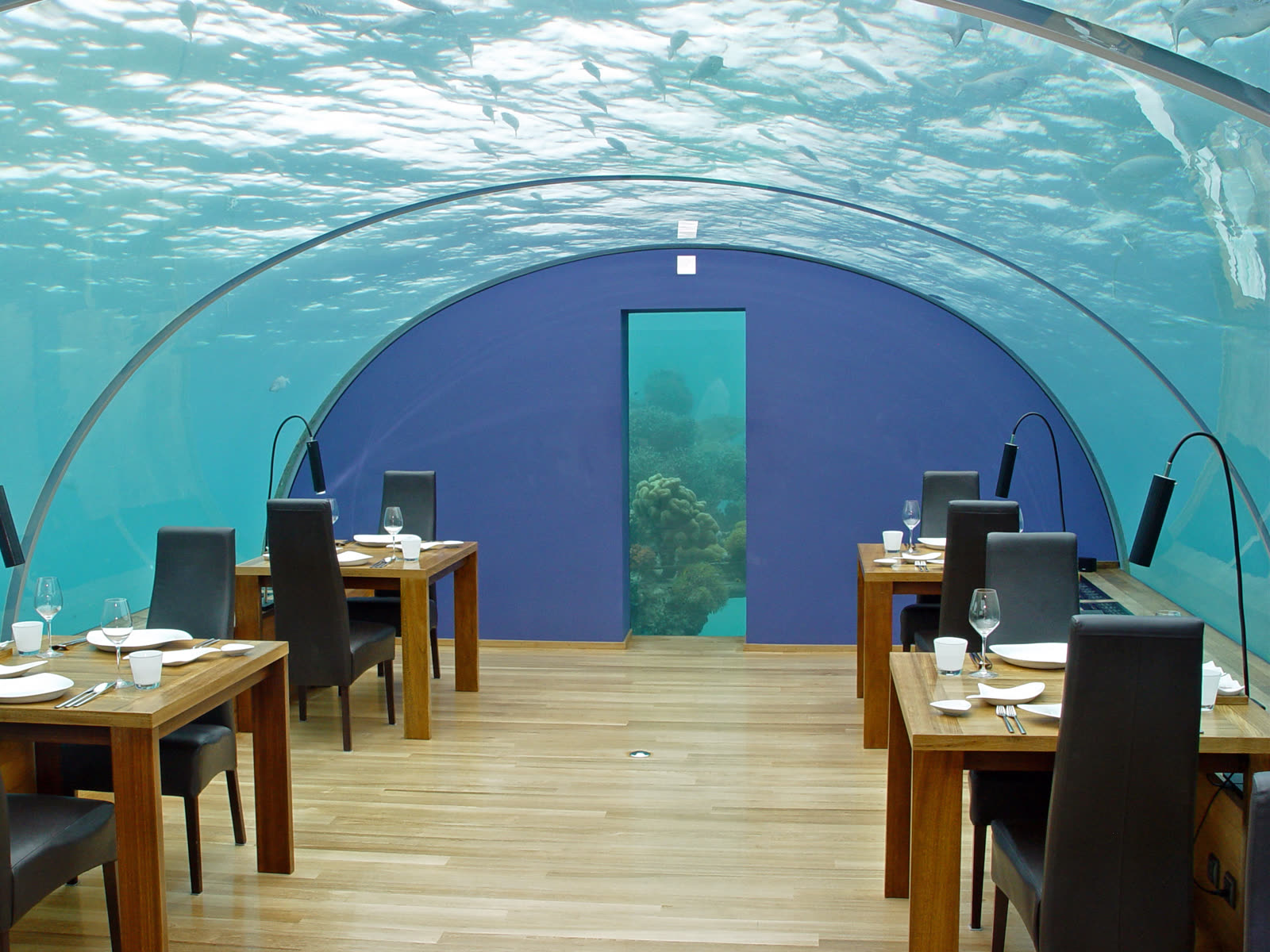
At Ithaa, the ceiling refuses to stay still. Fish cross the pale water above the linen; sunlight wrinkles over the curved acrylic; a dark shape can become a reef shark and disappear before the first course arrives. The restaurant sits five metres below the Indian Ocean and currently advertises just 14 seats. That makes the essential unit of luxury here unusually visible. It is not caviar, Wagyu or even a course. It is one chair inside a very small room beneath the reef.[1]
This distinction matters because Ithaa is expensive enough to invite the wrong calculation. Dividing the bill by the number of plates treats the room as free scenery. Calling the whole thing “priceless” lets the food and price escape scrutiny. A better value test separates four products the restaurant sells at different times—breakfast, visiting hour, lunch and dinner—then asks how much underwater room, cooking, daylight and ceremony each one actually delivers.
This is a document-based analysis, not a claim to have eaten there. The restaurant's public page, live Conrad guest app and menus were checked on August 27, 2026. The app supplies current base prices; the menus supply the dishes. Prices and schedules can still change, so anyone booking should ask the resort to confirm the menu, inclusions, gross total and cancellation terms in writing.[1][2][3][4]
The bill begins before the kitchen
Conrad's live Maruhaba guest app makes the four-step ladder explicit: $199++ for breakfast, $110++ for visiting hour, $270++ for lunch and $340++ for dinner, per person. The official restaurant page schedules those formats at 8 a.m., 11 a.m., 12:30 p.m. and 6:30 p.m., respectively, and says a day visitor can book without staying overnight.[1][2]
The double plus matters. The app defines it as a 10 percent service charge plus applicable tourism GST; Ithaa's current beverage card specifies that GST as 17 percent. The resort's live reservation configuration applies tax to the service fee, producing a multiplier of 1.10 × 1.17, or 1.287.[2][5][8]
That makes the current indicative all-in ladder approximately $256.11 for breakfast, $141.57 for visiting hour, $347.49 for lunch and $437.58 for dinner per person, before extra drinks. These are calculations from the live base prices, not replacement quotes from the restaurant. The sensible booking move is still to obtain the final total in writing—especially if a meal-plan credit, child policy or special event changes what is charged.[1][2]
Four tickets, one acrylic roof
Visiting hour is the purest purchase. At $110++ it strips the proposition down to access: descend, sit beneath the water, eat a few canapés, raise a glass, look. The current visiting menu lists crab and caviar, Maldivian lobster, beef tataki and a cornmeal torte among its bites.[6] For someone who mainly wants to experience the architecture—or make the photograph—roughly $142 all-in is the least costly honest choice.
Its boundary is just as clear. An hour of small bites cannot answer whether Ithaa works as a restaurant over a complete sequence. The public app also prices the slot without spelling out every inclusion on that screen, so the Champagne, dietary route and exact serving format should be confirmed rather than inferred from old accounts.[2][7]
Breakfast is the intriguing middle door. At $199++—about $256 all-in—it is $71 at base, or about $91 all-in, below lunch while preserving morning light.[1][2] Hilton's current Ithaa page also publishes the sequence: a bakery basket, charcuterie and smoked fish, a choice among five mains, then seasonal fruit.[9] That makes breakfast the least expensive documented full meal, although its familiar morning structure offers less tasting-menu ceremony than lunch. Confirm the live inclusions and seating duration before treating it as the automatic value winner.
Lunch adds a fully documented composed meal while keeping the room in its most legible light. The current card opens with yellowfin tuna, moves through duck croustillant with Vacherin and red currant, resets with lemongrass sorbet, then offers either Maldivian lobster tail or marble-score 8+ Wagyu before a hazelnut-chocolate parfait.[3] It is a luxury menu in the conventional sense—shellfish, beef, technique—but at least one main names the surrounding country rather than letting the ocean function only as décor.
Dinner expands the procession. Its current sequence runs from beef tartare and truffle through scallop with sauce Américaine, tomato consommé, octopus with rice and pecorino, a rose-and-raspberry cleanser, then marble-score 9+ Wagyu or lobster with caviar before chocolate parfait.[4] The higher price therefore buys more transitions and a denser inventory of status ingredients. It does not buy a different room.
That last point keeps the course-count arithmetic honest. Moving from the live $270 lunch to the $340 dinner is a 25.9 percent increase at base price, or about $90.09 after service and tax. The menu grows, but the acrylic arch, reef and 14-seat capacity remain fixed.[1][2] Dinner can still be the better value for a diner who wants a long evening and prefers the room after sunset. It simply needs to win on ceremony and cooking, not on the fiction that every extra dollar creates more ocean.
Daylight is part of the food product
The choice between a daytime meal and dinner changes what the expensive room can show. One December 2025 visitor describes the space as bright enough by day to make sunglasses seem reasonable, while artificial lighting turns the evening more theatrical. The same account calls the experience more powerful than photographs suggest and judges its then-current four-course lunch coherent and enjoyable.[7]
These are subjective reports from different menus, not a verdict on current execution. Read together, however, they expose a useful asymmetry. The kitchen can schedule courses. It cannot schedule a turtle, a shark or a school of fish. Daylight improves visibility but offers no wildlife guarantee; dinner deepens mood but may reduce the reef to whatever the external lights catch. The moving view is central to the price and fundamentally uncontrollable.
For lunch, that uncertainty is easier to accept because the room remains visually generous even during a quiet spell: surface light, coral, water and the curvature of the enclosure are still present. At dinner, more of the burden shifts to pacing, service, cooking and lighting. A nocturnal shark would be a gift, not something the tariff can promise.
Breakfast is the lowest-cost documented full meal, and its daylight makes it a credible value choice for diners who prefer a concise morning sequence.[2][9] Lunch is the stronger tasting-menu value for most first-time diners. It purchases both of Ithaa's products—a substantial set sequence and the submerged room—at the hour when the second is most available. That is different from saying lunch is cheap, or that its food is better. It is the lower-priced way to buy the complete tasting-menu proposition without moving the occasion to breakfast.
The wine list shows how fast “once” compounds
The current beverage card makes the add-ons unusually concrete. A glass of R de Ruinart is listed at $41 and a bottle at $195 before service and tax. After the stated 10 percent service charge and taxable 17 percent TGST, those become about $52.77 and $250.97. Ruinart rosé moves from $58 to roughly $74.65 a glass; a Coravin pour of 2008 Château Palmer moves from $381 to about $490.35.[5][8]
For two people, the live lunch base plus one $41 Champagne each lands near $801 all-in. Dinner on the same restrained beverage plan approaches $981. A $195 bottle instead of two glasses puts dinner for two near $1,126. None of those calculations includes transport to the resort, and the official page's permission for day visitors does not make the logistics free.[1][2][5]
The practical lesson is not “never order wine.” It is to choose where the occasion lives. If the sea is the splurge, two glasses preserve it without allowing the cellar to become a second destination purchase. If a rare bottle is the reason for dinner, Ithaa's list can support that choice—but then the claim that one is paying mainly for the underwater room is no longer true.
Fourteen seats are the real scarcity
Current official materials describe Ithaa as the world's first undersea restaurant, unveiled in 2005 and sitting five metres below the ocean.[1] An archival 2006 photograph makes the commercial constraint plain: a narrow aisle and a tightly bounded table layout beneath the curved acrylic.[10] The restaurant still advertises 14 covers.[1]
That room is costly in ways a diner can sense but public documents do not quantify. It had to be designed as marine infrastructure before it could be dressed as a restaurant. Its enclosure, access, climate, lighting and maintenance are part of the product. Yet no public source used here reveals Ithaa's current operating costs or margin, so it would be false precision to assign a certain share of the menu price to engineering. “You are paying for the room” is a description of guest value, not an audit of where every dollar goes.
Scarcity also changes service. Fourteen seats can feel intimate because there is no anonymous middle of the room. It can also feel exposed: late arrivals, phones, photography and pacing are difficult to absorb in such a small cylinder. A diner who dislikes spectacle may find that the architecture amplifies other guests along with the reef. That is a genuine value boundary, not a failure to appreciate novelty.
The right purchase depends on the verb
If the aim is to see Ithaa, choose visiting hour, provided the live quote and inclusions still make sense. It buys the essential room with the least commitment, and it avoids paying for a long menu that was never the point.
If the aim is to eat in Ithaa during daylight, breakfast has the lower live tariff and a published conventional breakfast sequence.[2][9] Lunch is the cleanest first tasting-menu booking: its published menu is substantial, its $270++ base remains below dinner, and daylight gives the reef the best chance to perform without lighting cues.[1][2][3][7]
If the aim is to celebrate at Ithaa, dinner can justify its premium. The longer sequence, evening transformation and broader wine possibilities make ceremony the product. But dinner should be chosen because those additions matter—not because seven stages automatically make $340++ better value than a shorter meal.[2][4][5]
The restaurant's most persuasive luxury is not that every course arrives beneath the sea. It is that only 14 people can occupy this improbable room at once. Once that is understood, the price ladder becomes easier to read. Visiting hour rents the wonder. Breakfast offers the lower-priced full meal. Lunch pairs daylight with a tasting sequence. Dinner turns the room into theatre. The best value is the version that matches the verb a diner came all that way to use.
Sources
- Conrad Maldives Rangali Island, “Ithaa Undersea Restaurant” (accessed August 27, 2026) — current depth, 14-seat capacity, service times, day-visitor access and links to live menus.
- Conrad Maldives Rangali Island, Maruhaba live guest app, Dining screen (accessed August 27, 2026) — current per-person prices for breakfast, visiting hour, lunch and dinner plus the service-charge policy.
- Conrad Maldives Rangali Island, Ithaa Restaurant: Lunch Menu (accessed August 27, 2026) — current published lunch sequence, ingredients and main-course choice.
- Conrad Maldives Rangali Island, Ithaa Restaurant: Dinner Menu (accessed August 27, 2026) — current published dinner sequence, ingredients and main-course choice.
- Conrad Maldives Rangali Island, Ithaa Restaurant: Beverage Selection (accessed August 27, 2026) — current by-the-glass and bottle prices plus the stated 10 percent service charge and 17 percent TGST.
- Conrad Maldives Rangali Island, Ithaa Restaurant: Visiting Hour Menu (accessed August 27, 2026) — current four-canapé selection and allergen notes.
- Claudia Hilmbauer, “Ithaa: Dining at the underwater restaurant in the Maldives,” The Chill Report (December 21, 2025) — first-hand meal account and daylight-versus-evening observations.
- Ithaa Underwater Gem, live TableCheck reservation page (accessed August 27, 2026) — current booking configuration, service-fee tax treatment and cancellation-policy context.
- Hilton, “Ithaa Undersea Restaurant” (accessed August 27, 2026) — current breakfast sequence, operating hours and 14-seat capacity.
- Alexey Potov, “Ithaa inside.JPG,” Wikimedia Commons (photographed December 8, 2006; CC BY-SA 2.5) — archival photograph of the actual dining room used as this article's resized hero image.