Vyn would be easy to flatten into a comeback story: Daniel Berlin closes one admired Skane restaurant, returns in late 2023 with a former farm near the Baltic, wins fast international attention, and builds another destination room. The sharper reading is less biographical. Vyn is interesting because it treats local sourcing as an operating system rather than as a menu adjective.
That difference matters. Plenty of fine-dining rooms say "local" and then behave as if the word solves the hard part. At Vyn, the public record points to something more demanding: a restaurant, food-and-wine bar, greenhouse, garden, boutique hotel, fields, shore, farmers, foragers, hunters, whole animals, and staff schedule all have to fit inside one seasonal radius.[1][2][3][4] The pantry is not just what arrives at the back door. It is the whole planning problem that decides whether the meal can stay specific without becoming brittle.
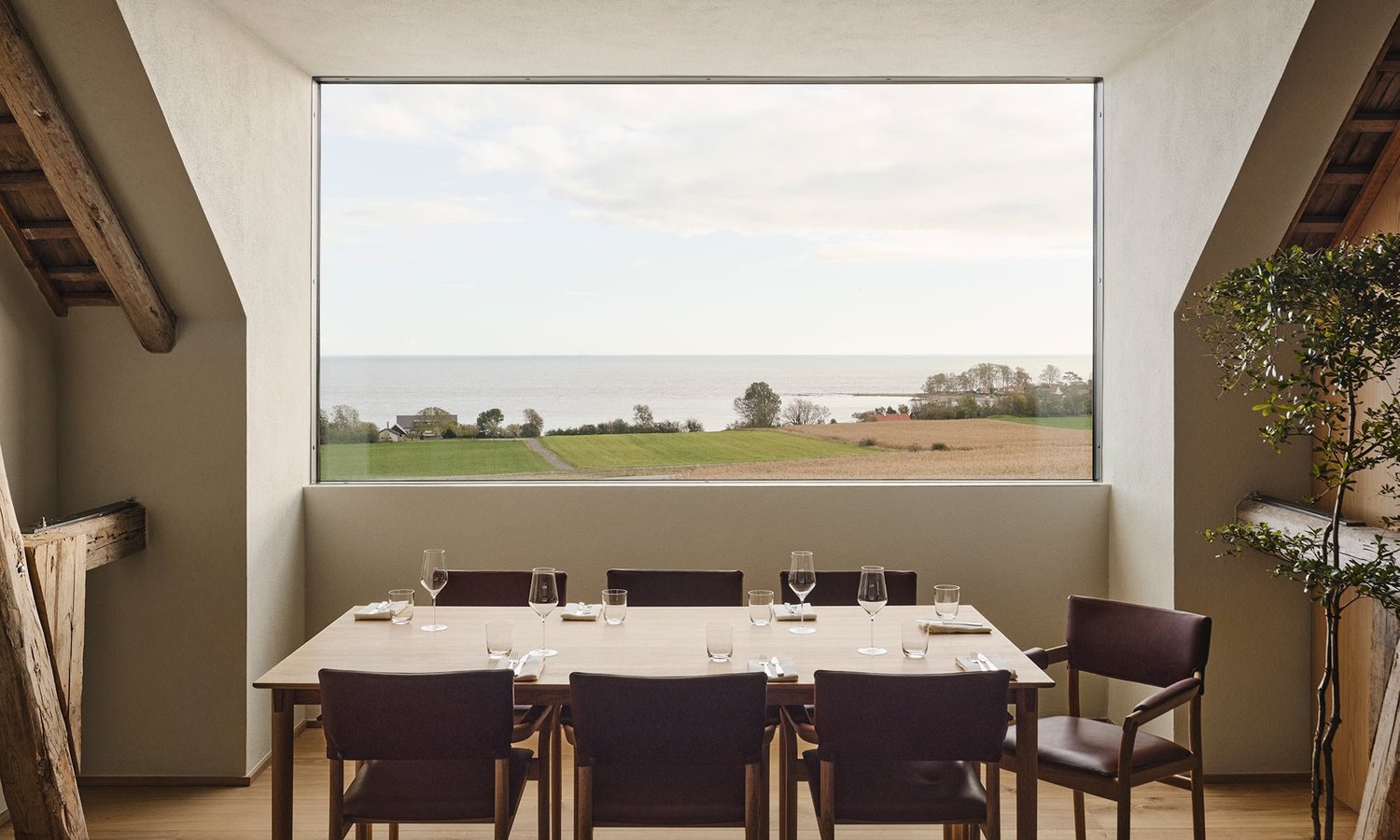
The official site gives the cleanest frame. Vyn says its restaurant is built around seasonal cuisine from Scanian and Scandinavian roots, local flora and fauna, and enough time around the meal for guests to slow down before and after dinner.[1] The same site places the project in southeast Sweden, in Osterlen, on a former farm with views across countryside and the Baltic Sea, and describes roughly 18 acres reaching toward the waterfront.[1] For an ingredient-sourcing report, those acres are not decoration. They are the first constraint.
Local means forecast, not purity
The most useful sentence in Vyn's sourcing story comes from 360 Eat Guide's interview with Berlin. Asked about ingredients from abroad, he says the team avoids buying from other countries and treats seasonality as planning and acceptance rather than permanent availability.[3] That is a quietly radical operational claim because it turns locality from a virtue statement into a forecasting discipline.
If a restaurant refuses the easy international safety valve, the kitchen has to know more months in advance. It has to ask what can be grown, held, preserved, hunted, landed, slaughtered, or foraged at the right quality. It also has to accept gaps. A menu shaped by Skane's fields, forests, and coast cannot be an all-season wish list with Nordic wording. It has to carry weather, crop timing, and animal supply inside its structure.
The official garden page reinforces that point by saying Vyn aims to sustain the kitchen with as many greens and herbs as possible on site, while still working with dedicated local growers for seasonal produce that arrives at the right moment.[1] That is the real luxury: not the fantasy of total self-sufficiency, but a tighter feedback loop. The garden can supply immediacy and small-scale freshness; producers supply breadth; the kitchen decides how to make both feel like one menu.
That is why the term "radius" is more useful than "local." Radius accepts that the restaurant must draw a circle, then manage the circle honestly. It includes the garden, but it does not pretend the garden alone can feed a two-star dining room, a casual bar, breakfast, private dining, and hotel guests. It includes farmers and fishermen, but it does not reduce them to picturesque names printed at the bottom of a dish description. It asks how far the kitchen can reach before the meal starts tasting like a concept rather than a place.
Producer relationships become infrastructure
Berlin's 360 Eat Guide answer on producers is even more revealing. He frames producer relationships around long-term planning, gap-finding, advance quantities, guaranteed purchasing, and sometimes paying ahead.[3] That is not romantic farm talk. It is risk-sharing.
For small producers, uncertainty is often the hidden cost of restaurant prestige. A chef can praise a vegetable or animal one season and disappear the next. Vyn's stated model points in another direction: the restaurant tries to reduce uncertainty for producers, and in exchange receives access to things that may not exist in ordinary wholesale flow.[3] The meal begins before the ingredient is mature. It begins when the restaurant and producer agree what is worth growing, raising, gathering, or saving.
The World's 50 Best description supports this reading from the dining side. Its 2025 listing places Vyn at No. 47 and describes Berlin's menu as roughly 16 courses rooted in sustainability, local tradition, nose-to-tail thinking, and ingredients foraged, grown, or hunted from nearby landscapes and shores.[2] Scan Magazine's profile makes the source field more tactile: local produce, game, seafood from Skane and Scandinavia, ingredients grown on site, ingredients from Skane farmers and producers, and things foraged or hunted by Berlin and the team.[4]
Taken together, the sources describe a kitchen that is less interested in heroic individual products than in a controlled supply ecology. King crab, langoustine, Kalix vendace roe, scallop, game, root vegetables, orchard fruit, and frost-marked greens can all appear in the public descriptions, but the point is not abundance for its own sake.[2][4] The point is seasonal editing. Vyn's pantry is strong when it feels chosen by place and time, not merely collected by budget.
Whole animals change the kitchen's skill map
Whole-animal work is often sold to diners as an ethical flourish. At Vyn, Berlin describes it as training and quality literacy. In the 360 Eat Guide interview, he says whole animals help younger production-team members understand quality and use the entire animal, including cuts that require more skill and are harder to source.[3]
That is the kind of sourcing detail that changes the article's center of gravity. If a kitchen buys only luxury cuts, sourcing remains a purchasing function. If it brings in whole animals, sourcing becomes education, butchery, preservation, staff development, and menu architecture. The less obvious cuts have to find their proper form: broth, farce, cured element, grilled bite, sauce base, snack, staff meal, breakfast use, or bar dish. Nothing about that is automatic. Waste reduction requires technique before it becomes virtue.
The restaurant's wider format makes that more plausible. Vyn is not only the main dining room. It also has a food-and-wine bar serving lighter seasonal dishes, a private Atelier, a greenhouse cocktail bar, and a small hotel.[1][4] Those formats create more landing places for ingredients. The most polished expression may appear in the tasting menu, but a less formal preparation can still belong to the same sourcing chain. That matters because whole-product logic needs outlets. A rigid flagship-only menu can actually make low-waste cooking harder by leaving fewer places for useful irregularity.
The stay is part of the supply chain
Vyn's hotel is not an ingredient, but it changes how the ingredients are received. The official site describes a 15-room boutique hotel next to the restaurant, and 50 Best also emphasizes the stay, the food-and-wine bar, and breakfast for overnight guests.[1][2] Scan Magazine notes the same wider destination structure: guests can eat in the main restaurant, use the more accessible bar, drink in the greenhouse, gather in the Atelier, and sleep upstairs or nearby.[4]
This matters because Vyn is not located like a city restaurant where the guest drops in after work and leaves by subway. The journey from Copenhagen or Stockholm into southern Sweden is part of the experience in 50 Best's description.[2] If the restaurant asks diners to travel for place, then the place has to do real work. Breakfast, bar dishes, pre-dinner drinks, the view, the fields, and the slow morning after dinner all become part of the evidence that the sourcing story is lived rather than staged.
There is a danger here. Destination restaurants can turn landscape into a soft-focus alibi. If the room is beautiful enough, diners may forgive vague cooking or inflated claims of terroir. Vyn's best defense against that risk is specificity: a garden that has to grow useful herbs and greens, producers who have to plan quantities, whole animals that have to be understood, and a menu that has to accept what the season withholds.[1][3][4]
Why Vyn matters now
Vyn opened on October 25, 2023, according to Nordiska Kok's design profile, and independent coverage says it received two Michelin stars within six months.[4][5] Those recognition markers explain why the restaurant drew attention so quickly. They do not explain why it is worth a sourcing report.
The better reason is that Vyn shows where high-end locality becomes serious. It is not enough to have a garden. It is not enough to say "Skane" or "Scandinavian pantry." It is not enough to stage a former farm with a Baltic view. The restaurant's claim only becomes durable when each of those elements produces obligations: plan earlier, buy closer, share risk with producers, train cooks on whole animals, give staff a rhythm that can hold quality, and let guests feel the season without turning the season into a lecture.[1][2][3][4]
That is the hidden discipline behind the view. Vyn's name points outward, but the restaurant's strongest argument points inward, toward the systems that make a view edible. The fields matter because someone has to decide what they can supply. The sea matters because the coast has to enter the menu as more than scenery. The former farm matters because a dining room there should behave differently from one in a capital-city hotel. Locality, at this level, is not a claim of innocence. It is a chain of promises that has to be planned before it can be served.
Sources
- Vyn Restaurant, official site - restaurant, garden, hotel, food-and-wine bar, Atelier, former-farm setting, 18-acre landscape, and seasonal Scanian/Scandinavian sourcing frame.
- The World's 50 Best Restaurants, "Vyn" - 2025 No. 47 listing, Daniel Berlin context, Skane setting, roughly 16-course menu, nose-to-tail framing, and foraged/grown/hunted ingredient notes.
- 360 Eat Guide, "Daniel Berlin" - interview on Vyn's ingredient sourcing, avoiding foreign purchasing, producer planning, advance purchasing, whole animals, and staff work-life structure.
- Malin Norman, "Vyn Restaurant: Sublime culinary experience with a stunning backdrop," Scan Magazine - profile covering Vyn's opening, two-star recognition, local produce, game, seafood, on-site garden, farmers, foraging, hunting, seasonal menu, and destination formats.
- Nordiska Kok, "VYN Restaurant By Daniel Berlin" - design profile with Andrea Papini photography, opening date, former-farm location near Brantevik in Skane, Baltic-view setting, local-focus kitchen quote, and the photographic image source used here.