ILIS did not close like an ordinary ambitious restaurant. On May 11, 2026, Greenpointers reported that the Greenpoint restaurant would end service at 150 Green Street on May 28, 2026, after the building was sold and tenants lost their leases.[1] The official message framed the move as the start of another chapter, not the end of the idea.[1] That may be true. But the closure still exposes a sharper fine-dining problem: ILIS had made its room part of its cuisine.
That is why this is not only a real-estate footnote. Many restaurants can relocate with pain but limited conceptual damage. ILIS was harder. Its public self-description was a wood-fired kitchen focused on seasonal plants, seafood, and game of North America; its chefs cooked and served the meal from a central kitchen; and it called the no-front/no-back service model One House.[2] The room was not neutral. It was a labor diagram, a stage, a menu device, and a promise of intimacy all at once.
The concept depended on the address
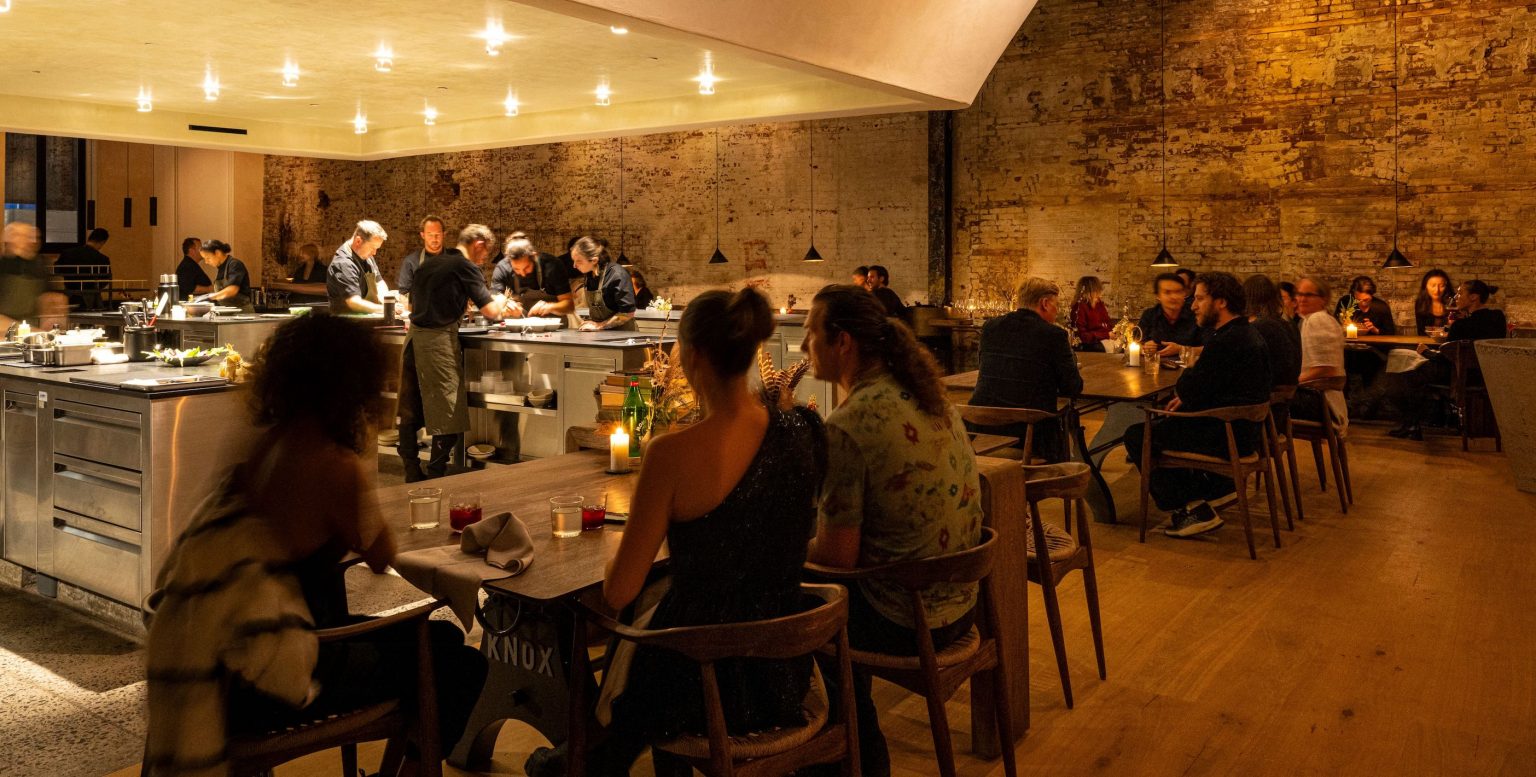
The first wave of ILIS coverage made the building sound inseparable from the restaurant. Vogue described a monumental black steel door, a curtained foyer, an oxidized host stand, a former rubber-factory warehouse, historic rafters, exposed brick, a skylight, and a room where constant kitchen movement defined the experience.[3] Greenpointers' opening report gave the diner-facing version of the same machine: an open plan, a large central kitchen, 58 surrounding seats, a 14-seat bar, a lounge at the entrance, aging compartments, temperature-controlled plant and flower storage, and dried botanicals hanging from workstations and beams.[4]
Those details are not architectural decoration. They are operating facts. A restaurant built around a central kitchen needs sightlines, acoustics, exhaust, circulation, storage, guest approach, and enough theatrical distance for diners to feel invited rather than trapped in production. ILIS's open-room format made the staff's movement legible. It also made the space expensive to reproduce. The more a restaurant turns square footage into identity, the more a lease becomes creative infrastructure.
That is the contradiction at the heart of the closure. ILIS's own website could summarize the idea in a few sentences, but the actual idea lived in a particular machine: a large Greenpoint room, a central kitchen, visible fire, visible cold work, cooks who could cross from station to table, carts, a pantry, a bar, and enough design control to make all of that feel intentional instead of chaotic.[2][3][4]
One House was labor design, not a slogan
The most interesting ILIS claim was never just that Mads Refslund co-founded noma. It was that the restaurant wanted to redraw the line between cooking and service. Vogue reported that ILIS did not have waiters in the traditional sense; the culinary team handled guest interaction as well as preparation, and the point was to make firsthand ingredient knowledge part of the meal.[3] Greenpointers described the same structure more operationally: no front-of-house/back-of-house split, chefs presenting the menu, cooking, and serving, with the 26-chef team rotating between floor and kitchen in two-week blocks.[4]
This is a serious service idea. It tries to solve one of luxury dining's old frictions: the person who knows the dish most intimately often does not speak to the guest, while the person speaking must translate kitchen intent into polished tableside language. One House compressed that gap. The promise was warmer knowledge, fewer handoffs, and a stronger sense that the guest had entered the kitchen rather than simply ordered from it.[2][3][4]
But the model also creates fragility. Cooks who serve need different training, scheduling, emotional stamina, and compensation logic from cooks who remain behind a pass. Guests who sit inside the kitchen need a room that absorbs noise, controls heat, and keeps performance from becoming pressure. Vogue's account even notes a designed ceiling feature over the kitchen that helped define the active prep area and lock in excess sound.[3] In other words, One House was not just culture. It was architecture.
That is why relocation is harder than a lease notice makes it sound. A new ILIS cannot merely reopen with the same menu language. It has to rebuild the choreography that allowed cooks, fire, carts, pantry, table, and guest attention to work as one system.
The menu was flexible, but the machinery was fixed
ILIS liked to resist the standard tasting-menu label. Greenpointers' opening report said the meal began with five courses and allowed guests to add courses, choose ingredients, and choose hot or cold preparations; Vogue described a guest path that began with a kitchen tour, a look at the night's core ingredients, and a field-guide-like structure for choosing how the meal would unfold.[3][4] Eater, before the opening, also framed the policy as unusual: not a tasting menu, but a required minimum spend in the dining room, with the bar operating differently.[6]
The flexibility was real at the table. The operating machinery behind it was less flexible. A restaurant that lets guests choose a route through ingredients needs prep depth, communication discipline, and a pantry capable of supporting many paths without letting the meal feel improvised in the lazy sense. Vogue's opening story described a wall of misos, garums, soy sauce, pickles, syrups, and vinegars built over years.[3] Eater similarly pointed to a library pantry of fermented goods, including aged fish and charcuterie, developed before the restaurant opened.[6]
That pantry helps explain why ILIS felt like more than a fashionable room. Fire and ice were not just a name origin. They were a working grammar: hot and cold treatments, North American plants, seafood, game, preservation, smoke, acidity, and guest choice all had to feed one structure.[2][3][4] The menu could change because the back system was dense.
But dense systems are hard to move. The more a restaurant depends on site-specific storage, exhaust, hearth equipment, prep flow, and the sensory drama of visible cooking, the less portable the concept becomes. ILIS's closure therefore reads as a cautionary case for high-concept fine dining: flexibility at the guest level can hide rigidity at the infrastructure level.
The neighborhood friction was an early warning
The building risk did not appear only at the end. Greenpointers' closure report also noted earlier friction around the oven, including odor and noise complaints and a Department of Environmental Protection violation.[1] That detail matters because it shows the same pattern from another angle. ILIS's fire was central to its identity, but fire in a dense neighborhood is never just flavor. It is exhaust, smell, sound, permitting, neighbors, and mechanical control.
Fine dining often treats place as romance: the warehouse, the gallery-adjacent room, the old industrial shell, the dramatic door. Operations treats place as a list of constraints. ILIS needed both readings to be true. The warehouse had to feel alive to diners and tolerable to neighbors. The fire had to read as elemental but behave like code-compliant equipment. The kitchen had to be visible but not overwhelming. The dining room had to feel like a working room without letting labor become spectacle.
That balance is difficult even before a building sale intervenes. Once the lease disappears, the very things that made the restaurant memorable become questions. Can the next site support the same fire? Can cooks still serve from a central kitchen? Can guest choice remain intimate rather than logistical? Can the new room feel discovered rather than copied?
What the closure says about the next ILIS
Cultured's six-month profile now reads with unintended tension. It described ILIS as a hot table where diners chose between fire and ice treatments of seasonal produce, meat, and fish, and it framed Refslund's return to New York as a long-haul project rather than a short residency.[5] Two years later, the public story had changed from destination momentum to displacement.[1]
That does not make ILIS a failure. It makes ILIS an unusually clear example of how contemporary fine dining can tie creativity to fragile assets. The restaurant's best ideas were not abstract: let cooks serve, put the kitchen at the center, let guests choose through fire and ice, build a pantry before opening, treat North American ingredients through a Nordic-trained but New York-based sensibility, and make the room feel like a workshop instead of a showroom.[2][3][4][5]
The risk is that each strength carried a dependency. A chef-served dining room depends on staffing rhythm. A visible kitchen depends on architecture. A wood-fired identity depends on mechanical permission and neighbor tolerance. A no-standard-tasting-menu format depends on prep complexity. A restaurant that sells the feeling of sitting inside a kitchen depends on having the right kitchen to sit inside.
The next ILIS, if it appears, will have to decide whether to reproduce the Greenpoint system or translate it. Reproduction would mean finding another unusually large, flexible, exhaust-capable, design-friendly room and rebuilding the central theater. Translation would mean asking which parts of ILIS were essential and which belonged specifically to 150 Green Street. The answer should not be obvious. If the concept was truly alive, it can change. If the room was too much of the concept, the move will show it.
For diners, that is the lasting lesson. ILIS made a seductive argument that the wall between kitchen and dining room had grown too thick. Its closure makes a colder argument beside it: when the room becomes an ingredient, the landlord becomes part of the recipe.
Sources
- Jennifer Rosini-Gentile, "Greenpoint's Ilis Announces Closure, Citing Building Sale," Greenpointers (May 11, 2026) - closure date, building-sale explanation, lease-loss context, oven complaint note, and Evan Sung interior image source.
- ILIS official site - self-description of the wood-fired North American kitchen, 150 Green Street address, chef-served central kitchen, and One House service model.
- David Graver, "In Brooklyn, Noma Co-Founder Mads Refslund Opens a Radical Reimagining of the Restaurant Experience," Vogue (October 16, 2023) - opening profile on the warehouse room, One House service, fire-and-ice grammar, ingredient path, pantry, sound design, and art/design context.
- Jennifer Rosini-Gentile, "Noma Co-Founder Opens Ilis in Greenpoint, Offering a One-of-a-Kind Dining Experience," Greenpointers (October 11, 2023) - opening report on fire-and-ice preparations, flexible course structure, carts, One House service, chef rotation, open-plan room, seating, bar, kitchen design, and storage.
- Mika Yassur, "Fire or Ice? At His Brooklyn Restaurant, Noma's Co-Founder Gives Diners a Choice," Cultured (April 9, 2024) - six-month profile on Refslund, fire-and-ice choice, seasonal produce, meat, fish, and ILIS as a long-haul New York project.
- Emma Orlow, "Co-Founder of Noma, 'World's Best Restaurant,' Opens New Spot in Brooklyn," Eater NY (October 5, 2023) - pre-opening report on Greenpoint context, Faurschou-adjacent address, minimum spend, bar distinction, wood-fire kitchen, and fermentation pantry.