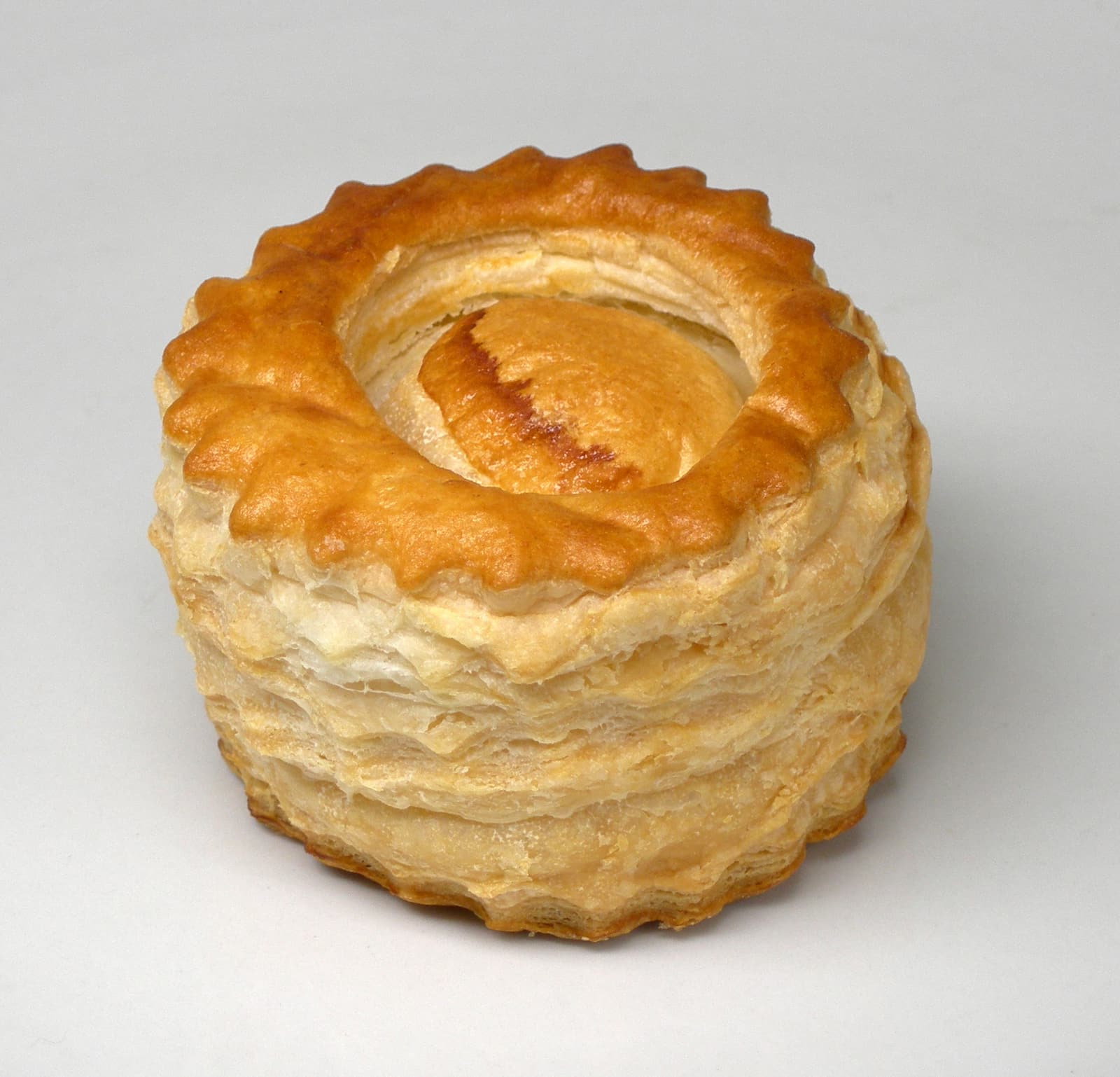
Vol-au-vent looks like a joke until it is good. The name promises air; the plate often arrives as butter, cream, poultry, sweetbread, mushroom, truffle, or seafood trying very hard not to turn a pastry shell into wet cardboard. That tension is the whole appeal. The dish belongs in fine dining because it asks a kitchen to make lightness carry weight.
The old definition is plain enough. A late nineteenth-century English menu compiler glossed vol-au-vent as a pastry case in which stewed meat or fruit is served, then described the fuller restaurant form as a light puff-paste crust, round or oval, filled hot with delicate ragouts of fish, lobster, oyster, meat, veal, rabbit, sweetbread, or chicken.[2] The James Beard Foundation gives the more romantic frame: the name means "flying in the wind," and Careme is traditionally credited with making the puff-pastry box famous as a vehicle for creamed vegetables, meat, fish, or chicken.[1]
Those two descriptions belong together. Vol-au-vent is not just a filling and not just a crust. It is a contradiction staged at service temperature: a shell that should feel almost weightless, carrying a filling that is often rich, hot, and wet. The pastry has to stand up; the sauce has to stay generous; the guest has to receive the dish before the architecture starts losing the argument.
The Shell Is The First Sauce
Puff pastry is usually praised for flake and lift, but in vol-au-vent it also functions like a sauce boundary. It has to create surface area, hold heat, and give buttered crispness to a filling that might otherwise read as a stew. The crust is not decorative trim around the real dish. It is the reason the dish has a shape.
That is why the shell cannot be too polite. If it is thin and underbaked, the ragout will collapse it. If it is thick and dry, the dish becomes a bread bowl wearing Parisian clothes. If the lid is only a garnish, the diner loses the pleasure of breaking through pastry and finding steam underneath. A proper shell should make a small sound when touched, then give way to sauce.
Sirha Food's 2025 account of Jean Sevegnes's version at Cafe des Ministeres makes this structural problem explicit. The shell and base materials are prepared ahead, but the final assembly has to move quickly because the vol-au-vent is delicate and stands tall only for a short interval. The restaurant's version measures roughly 15 centimeters across, uses a sealed top, and manages moisture so the filling does not soak the pastry before it reaches the guest.[3]
That detail explains why vol-au-vent can still feel current. Modern kitchens talk constantly about texture contrast, but this dish has been doing texture contrast as engineering. Crisp pastry is not placed beside creaminess; it is asked to contain creaminess. The shell is a timed vessel.
Ragout Has To Behave
The filling is where vol-au-vent becomes more than puff-pastry nostalgia. Old recipe language tends to say "ragout," but that word hides a lot of discipline. The pieces inside must be tender enough to eat with the pastry, rich enough to justify the form, and small enough to distribute through the sauce without making the shell buckle.
Practical Gastronomy's list of classic fillings is useful because it reads like a map of luxury protein logic: quenelles, mushrooms, truffles, oysters, sweetbreads, crayfish, poultry, veal, fish, and lobster all appear in one form or another.[2] They are not random expensive things. They share a service problem. Most can be cooked separately, finished in sauce, and folded into a hot filling that feels composed rather than merely heaped.
The kitchen has to control moisture at every step. Mushrooms need enough cooking to release their water before they enter the final sauce. Sweetbreads need soaking, blanching, draining, and roasting before they can become luxurious rather than spongy; Sirha's account notes those steps before the Cafe des Ministeres version folds them into the assembly.[3] Poultry has to brown without drying. Seafood has to remain delicate. The sauce has to bind all of it without flooding the pastry.
That is why a weak vol-au-vent is so disappointing. It is not simply old-fashioned. It is a failed contract between pastry and ragout. The diner feels the failure instantly: soggy base, loose sauce, filling that eats like leftovers, pastry that shatters into dust, or a top that slides around as if it never belonged there.
Service Is Part Of The Recipe
Vol-au-vent is a service dish because it punishes hesitation. Sirha describes the final stretch at Cafe des Ministeres as a delicate assembly game: poultry and mushrooms are finished on the stove with cream, the pastry structure comes from the oven, the filling is placed carefully, and the pan contents are poured over the whole.[3] Matching Food & Wine's report on classic versions makes the same point from the dining-room side: sauce may be poured over the filled shell at the table, with extra filling and sauce left for topping up.[4]
That tableside generosity is not just theater. It solves a timing problem. If all the sauce sits in the shell too early, the pastry loses. If the sauce arrives too late, the dish feels dry and fussy. If the kitchen builds the plate and the dining room lets it wait, the guest receives a structural compromise instead of a luxury object.
This makes vol-au-vent closer to souffle than to pie. The craft is partly in preparation, but the truth arrives in a narrow window. It must be baked enough, filled enough, sauced enough, and sent fast enough. Fine dining often hides timing behind calm service. Vol-au-vent lets timing leak into the eating experience. The diner can sense that the dish is alive for only a short period.
Why The Revival Makes Sense
The dish has moved in and out of fashion because it carries contradictory associations. It can look grand, bourgeois, retro, buffet-like, or technically severe depending on scale and execution. Matching Food & Wine noted in 2017 that sightings in Bristol, London, and Paris suggested a possible return, while also warning that the form is neither cheap nor easy and belongs naturally to serious classic kitchens rather than casual nostalgia.[4]
That judgment still holds. Vol-au-vent is not interesting because everything old is charming. It is interesting because the old form makes several modern restaurant values visible at once: pastry craft, offal confidence, sauce discipline, portion generosity, table timing, and a willingness to let comfort remain elaborate. It can be a main course without becoming a slab of protein. It can be rich without using height or tweezers as proof of ambition.
The Cafe des Ministeres example matters because it shows the dish becoming a signature rather than a museum piece. Sirha presents Sevegnes as a guardian of the recipe's vitality, not as a chef trapped by it: sweetbreads, spinach, free-range poultry, mushrooms, truffle, cream, oven timing, and pan sauce become a coherent sequence.[3] The point is not that every restaurant should copy that filling. The point is that the format rewards a kitchen willing to treat assembly as craft.
The Fine-Dining Lesson
Vol-au-vent teaches a blunt lesson: luxury is often a load-bearing problem. The pastry has to carry sauce. The sauce has to carry aroma. The filling has to carry richness. The room has to carry timing. Remove any one of those supports and the dish becomes either a snack shell or a stew with a hat.
That is why the best versions do not feel nostalgic in the sentimental sense. They feel old because they still depend on old skills: laminated dough, hot ragout, sauce reduction, moisture control, and service choreography. But the pleasure is immediate. The guest breaks into crisp pastry, finds creamy heat, gets the perfume of mushrooms, poultry, truffle, seafood, or sweetbreads, and understands why the form has survived so many waves of restaurant fashion.
The photograph used here is humble compared with palace service, and that helps.[5] It shows the central problem without glamour: golden pastry, hollow structure, pale filling, and a plate that has to be eaten before the contrast fades. Vol-au-vent is fine dining when that contrast is not accidental. It is fine dining when air, butter, sauce, and speed hold together just long enough.
Sources
- James Beard Foundation, "Eat this Word: Vol-au-vent" - definition, Careme attribution, name meaning, and classic filling context.
- Internet Archive, Practical Gastronomy: French Menus, or the Complete Menu Compiler and Register of Dishes - historical menu definitions and vol-au-vent filling examples.
- Sirha Food, "Plating the vol-au-vent" - 2025 account of Jean Sevegnes's Cafe des Ministeres assembly, pastry structure, filling, and timing.
- Matching Food & Wine, "The return of the vol-au-vent" - report on the dish's revival, classic restaurant context, and tableside service.
- Wikimedia Commons, "File:Vol-au-vent-1.jpg" - real 2006 photograph by Rainer Zenz used as the article image.