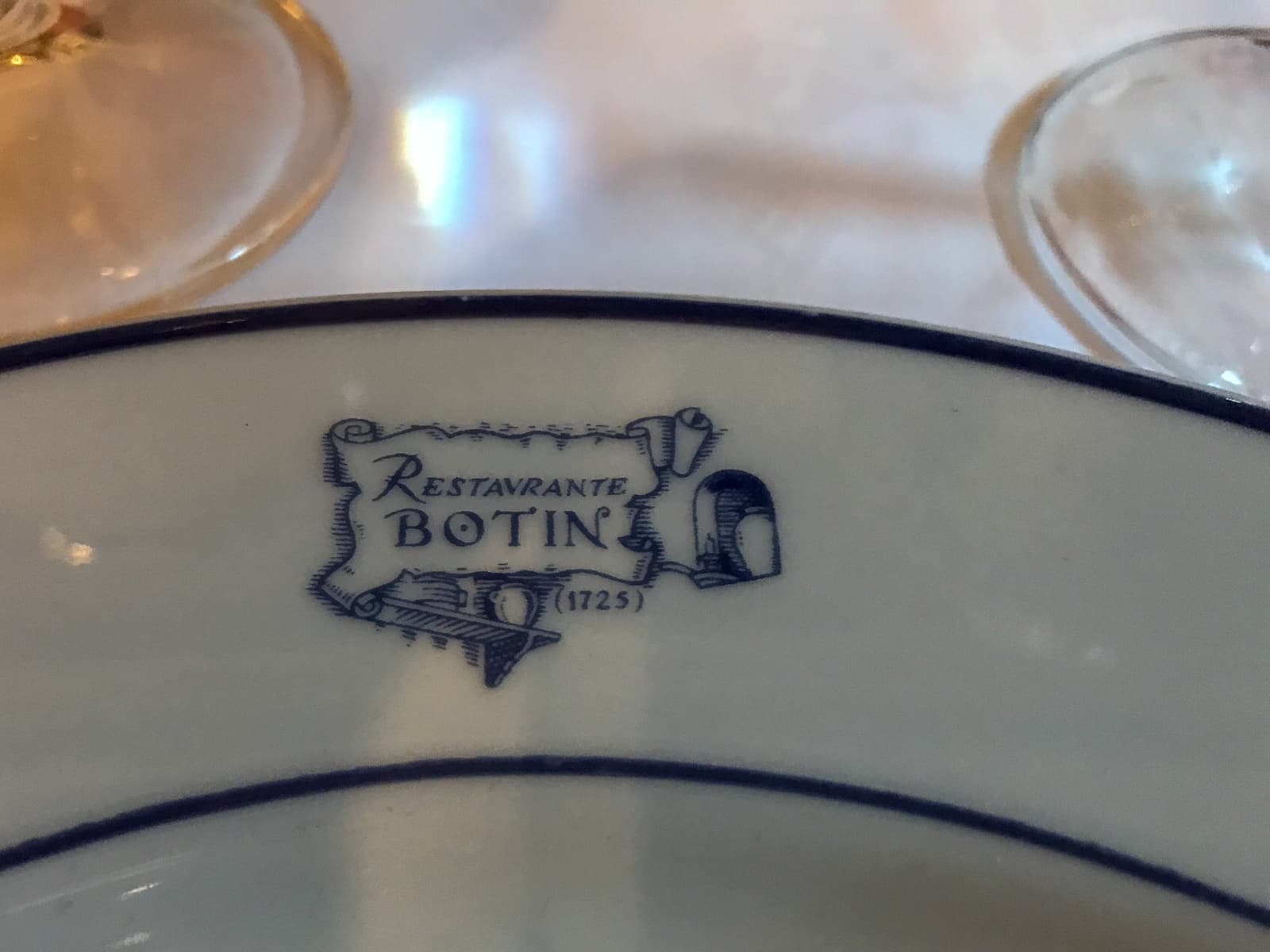
Botín is easy to flatten into a record-book fact: the oldest restaurant, the famous oven, the roast suckling pig. That version is too small. The more interesting story is how a Madrid dining room turns continuity into an active cooking method. At Botín, cochinillo is not compelling because it is old. It is compelling because the oldness has to be reproduced every day through heat, sourcing, room discipline, and the guest's belief that this particular address still knows what it is doing.
Guinness World Records recognizes Restaurante Botín on Calle de Cuchilleros as opened in 1725, and its record page ties the claim to the same old Madrid geography: Plaza Mayor nearby, four retained floors, 18th-century interiors, and the original firewood oven still central to the house story.[1] The restaurant's own public identity leans into the same frame, presenting Botín as a benchmark of traditional cuisine and as a 300-year address rather than as a museum with food attached.[2]
That distinction matters. A museum protects objects from use. A restaurant has to expose its inheritance to appetite.
The Oven Is Not A Prop
The oven is the house's most useful symbol because it refuses to stay symbolic. Cochinillo asado only works if the kitchen can make skin, fat, bone, and flesh arrive at the table in balance: crisp enough to crack, tender enough to surrender, rich enough to feel celebratory without becoming greasy. Botín's current menu keeps the dish plainly visible as "cochinillo asado," beside roast lamb and other traditional plates, priced as a main course rather than hidden inside a tasting-menu mythology.[4]
That plainness is the point. Many elite restaurants create luxury by adding steps until the diner feels the bill in the choreography. Botín creates luxury by narrowing the field. Piglet, fire, timing, carving, table. The drama is not novelty; it is recurrence. A guest does not come to ask whether the restaurant has invented a new form of pork. The guest comes to see whether an old form can still feel alive.
Fine dining often talks about precision as if it belongs only to foams, tweezers, and menu architecture. Roast suckling pig makes a different claim. Precision can also mean knowing exactly when tradition becomes dull, exactly when fat needs more heat, exactly how much room ceremony a rustic dish can carry before it turns theatrical. The old oven gives Botín atmosphere, but atmosphere alone would not feed anyone. Its real job is to make repetition taste intentional.
The Record Is Useful Because It Is Demanding
The "oldest restaurant" title is not as simple as a plaque suggests. In 2025, AP reported on Casa Pedro, another Madrid tavern, challenging Botín's crown by claiming roots back to 1702. The article is useful less for gossip than for its proof problem: Guinness requires substantial evidence of continuous operation, and Botín's side described the standard as operation in the same location with the same name.[6]
That makes the record a culinary question as much as an archival one. Continuity in a restaurant is never only a date. It is a chain of handoffs: ownership, walls, oven, suppliers, staff habits, guest expectation, and a menu that can be recognized without becoming embalmed. If one link breaks, the house may still serve good food, but the lineage claim weakens.
Botín's record therefore works best when treated as a discipline rather than a trophy. The restaurant has to keep proving that the superlative corresponds to experience. A tourist can photograph the facade and leave with the story. A diner ordering cochinillo gives the story a harder test: does the old room still make the dish taste more complete than it would elsewhere?
Literature Helps, But The Plate Has To Win
Madrid's official tourism page gives the restaurant its literary aura, noting Botín's presence in writers including Galdós, Hemingway, Graham Greene, Gómez de la Serna, and María Dueñas.[3] That aura is real value. Restaurants live partly on the stories people bring into them, and Botín has more story than most rooms can hold.
But literary fame can become a trap. If the meal asks only to be admired as heritage, the food becomes a souvenir. The stronger reading is that the writers help explain why the restaurant's narrowness works. Botín does not need to represent all Spanish cooking. It represents a specific Madrid-Castilian idea of eating: a close street near Plaza Mayor, a low old room, roast meat, Rioja-friendly appetite, and enough table service to turn direct food into occasion.
That is why cochinillo is the right flagship. It is not delicate in the modern tasting-menu sense, but it is exacting. It carries celebration without requiring abstraction. It lets the restaurant remain legible to visitors while still speaking a local language of roasts, old dining rooms, and appetite as a civic ritual.
Why The Dish Still Belongs In Fine Dining
Calling Botín fine dining requires a wider definition than star-chasing. This is not the cuisine of constant reinvention. It is the cuisine of maintained form. The luxury is that the guest can enter a room whose promise is unusually specific and then test whether the promise survives contact with dinner.
That kind of luxury is fragile. A roast can be dry. A famous room can become complacent. A record can attract people who want a certificate more than a meal. Botín's best argument against those risks is the way its core dish keeps the house accountable. Cochinillo exposes the kitchen to time in the most literal way: too little heat and the skin fails, too much and the tenderness goes. It also exposes the restaurant to historical time. Every serving invites comparison with the inherited story.
The photograph above shows the exterior rather than the pig because the facade is part of the dish's operating frame.[5] Botín's cochinillo is not just pork from an oven; it is pork from that oven, in that address, under that name, served inside a story that has to be renewed rather than merely repeated.
That is the lineage lesson. Tradition is not safe because it is old. It is safe only when the restaurant keeps converting age into competence. At Botín, roast suckling pig behaves like a timepiece: fire, room, record, and appetite all have to keep time together.
Sources
- Guinness World Records, "Oldest restaurant" - record entry for Restaurante Botín, including the 1725 date, Calle de Cuchilleros setting, retained interiors, and original firewood oven.
- Restaurante Botín, official English homepage - house positioning as the oldest restaurant in the world and a benchmark of traditional cuisine.
- Tourism Madrid, "Botín" - official city tourism profile covering the 1725 foundation claim, Guinness recognition, and literary references.
- Restaurante Botín, "La Carta de Botín" - current official menu page listing cochinillo asado, cordero asado, and other traditional dishes.
- Wikimedia Commons, "File:Sobrino de Botín (29031576078).jpg" - real 2018 photograph of Sobrino de Botín used as the article image.
- Associated Press, "The world's oldest restaurant faces a challenge from another Madrid tavern that says it's even older," 2025 - report on Casa Pedro's challenge and the evidence standard around Botín's record.