A cube of white cream can conceal quite a journey. In Anne-Sophie Pic's published recipe for her white mille-feuille, Tahitian vanilla and jasmine accompany layers of pastry; around the finished dessert sit little spoonfuls of milk foam seasoned with voatsiperifery. The pepper enters through something pale, warm and airy.[1]
That is an inviting introduction to Madagascar's wild pepper. It also sets a demanding brief for whoever buys it. A spice used so delicately has to deliver more than a prestigious name on a menu. Its fragrance must survive the trip from the plant to the pastry kitchen, and the plant must survive the business built around it.
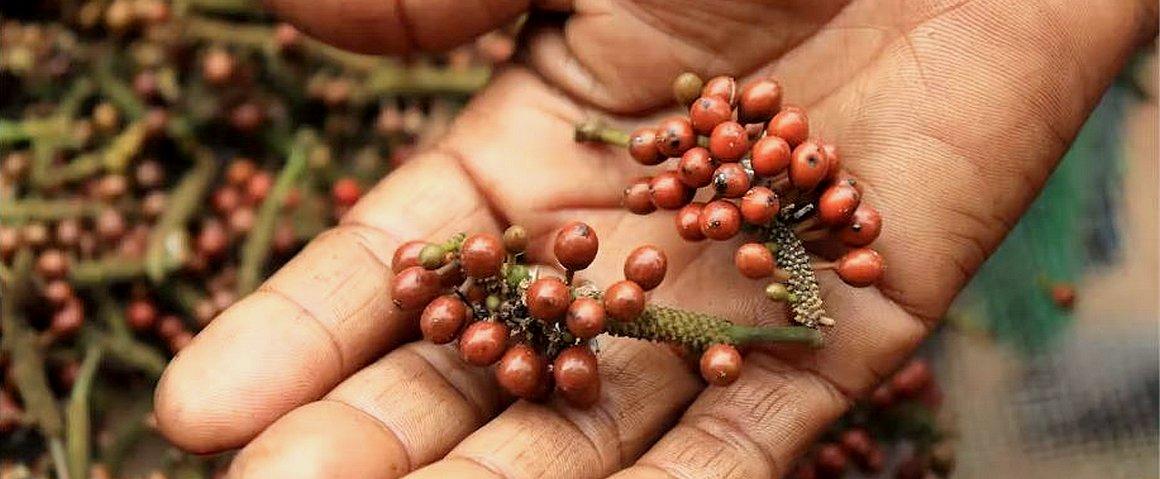
CIRAD, the French agricultural research organization, describes the dried berries as woody, earthy and fruity. The fruit grows high in the forest canopy, on climbing vines.[2] Between that height and a spoonful of milk lies a sourcing story with several opportunities to go wrong.
Bringing the pepper down
A 2017 research overview in Fruits described harvesting that could involve cutting down vines and their supporting trees. The researchers also found that picking brought useful income to poor households, but little compared with the gains of other participants in the trade. These are findings from that period, rather than an audit of every supplier selling the pepper today.[3]
Together, they expose a weakness in the restaurant language of rarity. A difficult harvest can explain why an ingredient costs more without showing that the picker benefits proportionately. Nor does a product gathered from a forest necessarily help preserve that forest.
The practical question is how this particular pepper was brought down. A supplier's account should connect the purchased batch with a collection area, the people gathering it and the harvesting method. Those are reasonable requests prompted by the research; the papers do not certify any commercial bottle. A beautiful aroma provides no answer on its own.
The drying comes with a flavor decision
The journey continues after picking. A 2014 field study compared four production systems in two areas of eastern Madagascar. It identified a dry route and a wet route, distinguished by scalding and a holding stage known as sweating before drying.[4]
The distinction mattered. Piperine, the compound associated with pepper's pungency, was unaffected by the systems studied, while the wet route reduced essential-oil content by up to 27 percent. Processing also changed color. The researchers emphasized both picking at appropriate maturity and controlling treatment after harvest.[4]
That result needs its boundary: it came from the production systems sampled, and the maximum measured loss is not a universal penalty for every wet-processed batch. Essential-oil content is also a chemical measurement, not a score awarded by diners. It does, however, explain why an origin name alone cannot specify the ingredient a cook receives.[4]
For a pastry kitchen, the implication is pleasantly concrete. Compare samples in the preparation where the pepper will be used. Smelling a jar is a beginning; trying it in the milk component reveals whether that batch contributes enough fragrance at the intended dose. Keep the supplier's processing information with the sample. A repeat order should have more to go on than the memory of an unusually lovely smell.
A wild ingredient learns to be cultivated
CIRAD's March 2024 account followed domestication work with four villages. Two abandoned the attempt because vanilla and passion fruit offered more attractive returns. In the other two, researchers and growers made progress with propagation. Surveys three years after replanting found increased vine density and local practices that protected and replenished the plants.[2]
The split outcome is as useful as the success. For a cook, a distinctive ingredient may be an exciting discovery. For a grower, it occupies land, labor and time that could support something else. A sourcing relationship has to make sense from both ends.
An August 2025 CIRAD update showed further work, including tsiperifery growing in Floribis greenhouses. It explained a crucial biological detail: the plant is dioecious, with male and female plants needed for berry production. FOFIFA, Madagascar's national agricultural research center, was leading the public research effort.[5]
Cultivation therefore involves learning how to reproduce a productive population, well beyond putting a promising cutting into the ground. The update describes research and its ambitions for local livelihoods and biodiversity; it does not establish that commercial supply as a whole has become sustainable.[5]
For a restaurant, cultivation should be a subject of curiosity. Ask how the grower produces the berries and what can be documented. The romance of the word wild is a poor reason to dismiss a harvest that keeps its vines alive.
Back to the white plate
In her 2015 account of eating Pic's mille-feuille, the food writer Mercotte described the pepper's citrus and floral character strengthening the jasmine and giving the dessert vivacity.[6] That is one diner's reported response to a particular preparation, and a more useful piece of sensory evidence than a claim that the spice is simply the world's best.
Pic's recipe gives the idea a physical form: the pepper goes into milk heated to 60–70°C, then aerated. It remains a small, distinct component beside the pastry and cream.[1] Reading the recipe this way, the restrained presentation gives an ingredient room to register without making it dominate every mouthful.
The restaurant's fuller story belongs behind that small gesture: who gathered the berries, what happened during processing and whether the next harvest has a future. At the table, the guest can simply enjoy how much interest a spoonful of milk can hold.
Sources
- Anne-Sophie Pic, “Le mille-feuille blanc,” Arts & Gastronomie, 15 July 2020 — attributed recipe, components and milk-foam preparation.
- CIRAD, “À la découverte du meilleur poivre du monde,” 4 March 2024 — aroma, canopy habitat, four-village cultivation results and photograph credited to J. Queste; French original used for the three-year survey interval.
- Harizoly Razafimandimby and colleagues, “Tsiperifery, the wild pepper from Madagascar, emerging on the international spice market whose exploitation is unchecked: current knowledge and future prospects,” Fruits 72(6), 2017, pp. 331–340 — CIRAD abstract on harvesting and income distribution.
- Mathieu Weil and colleagues, “Traitements post récolte du poivre sauvage (Piper spp.) à Madagascar,” Fruits 69(5), 2014, pp. 371–380 — field comparison of processing routes and measured quality attributes.
- CIRAD, “Le meilleur poivre du monde ?”, 8 August 2025 — written companion to its podcast, describing Floribis greenhouse work, dioecy and FOFIFA research leadership.
- Mercotte, “La récré gourmande du dimanche : Anne Sophie Pic une grande dame de la gastronomie,” 6 December 2015 — firsthand account of the mille-feuille's pepper, jasmine and milk mousse.