A communal dinner begins before anyone lifts a fork. It begins when the host decides how long an empty chair may hold up everybody else. Midunu's published nomadic-dining FAQ makes that decision unusually clear: after a guest is more than fifteen minutes late, service can begin; the latecomer joins the meal where it has reached, without the missed courses being replayed.[1]
That small rule opens a window into Selassie Atadika's Accra dining project. A shared table promises company, but it also asks people to share time. The kitchen cannot rewind one person's evening indefinitely while everyone else's dinner moves forward.
There is a larger pause to acknowledge, too. As of September 22, 2026, Midunu's tasting-menu page says public service is resting, with a return planned for later in 2026. It describes a seasonal, Thursday-only format, rather than continuous weekly availability. What follows examines the house's documented approach to hospitality; it is not a report from a dinner attended or an announcement that reservations have reopened.[2]
An invitation becomes a seating plan
In a June 2025 essay, Atadika traces the name to her father's call to eat: “Va midunu.” She remembers food gathering people across very different settings, from family meals in Dakar to a shared plate of kenkey in Accra. The long table at Midunu carries that personal understanding of an invitation into a professional dining room.[3]
Her most revealing anecdote concerns a mother watching her daughter laugh with neighboring diners. The mother assumes they know one another. They have only just met.[3] It is a modest measure of success: an arrangement of chairs has made an introduction possible.
The distinction matters because communal seating can easily become another piece of restaurant scenery. A long tabletop alone does not produce generosity. Someone still has to welcome the hesitant guest, leave room for a quieter conversation and recognize when an explanation of a dish has become an interruption. Those are the service demands implied by Atadika's ambition, rather than a claim to have observed her staff performing them.
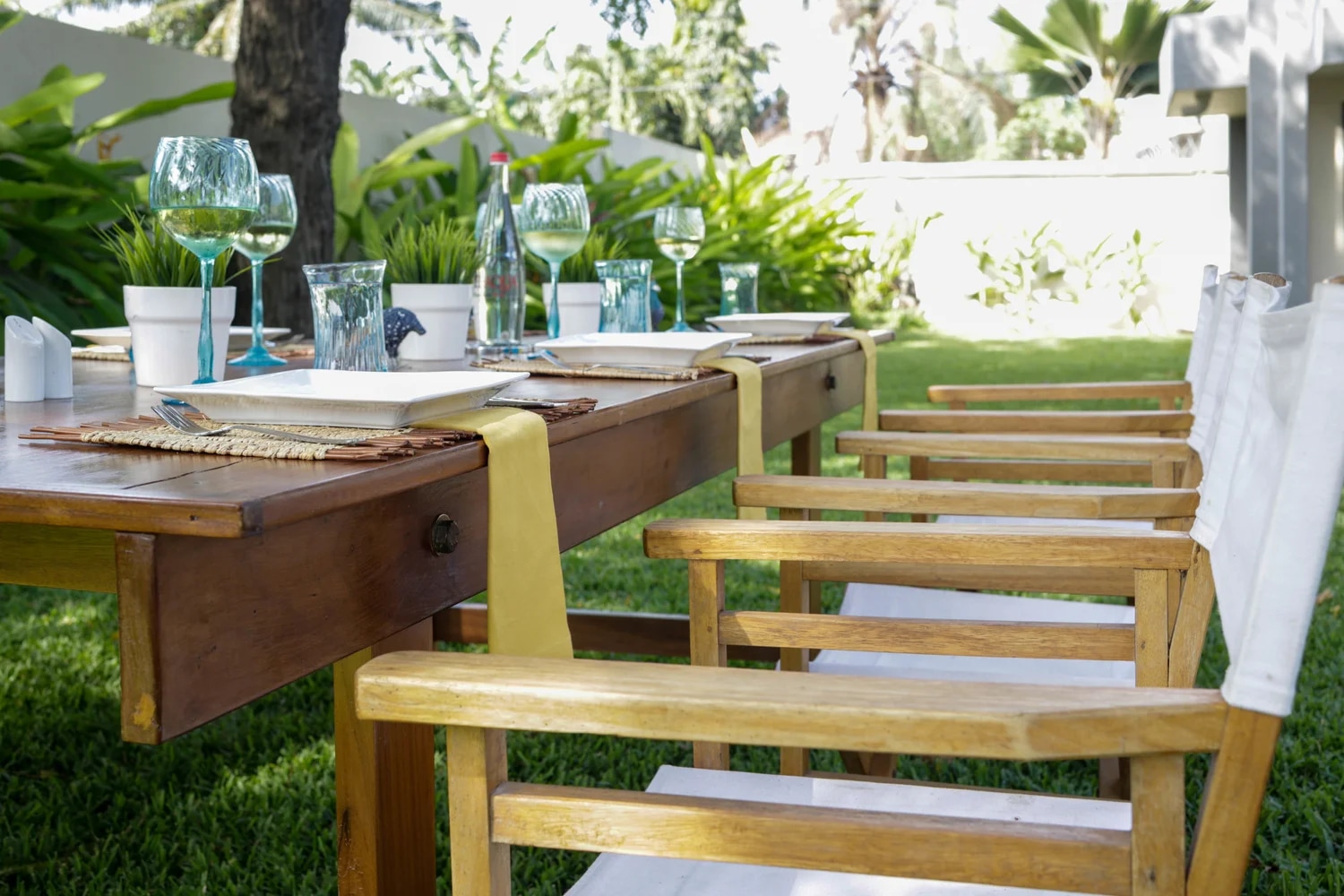
Midunu House supplies a particular setting for the experiment. In its garden photograph, pale yellow napkins hang over a wooden table's edge; turquoise-stemmed glasses stand above white plates. The restaurant describes indoor and outdoor spaces in a residential Accra neighborhood, furnished with African art, textiles and objects from Atadika's travels. It also states that the house is not rented as an independent venue: dining there comes with Midunu's food and team.[4] The surroundings belong to the hospitality, as much as the plates do.
The pleasure needs preparation
The nomadic FAQ links advance ticketing to knowing who will attend, buying fresh ingredients and limiting waste. It also asks guests to disclose dietary requirements when booking and repeat them to the host or server; modifications are not guaranteed.[1] These are practical limits on how much a small, composed meal can improvise at the table.
There is a culinary reason to keep that conversation specific. In a 2020 Nataal interview, Atadika described cooking that gives plants the greater share of the plate while allowing animal ingredients to contribute flavor. Smoked fish, for example, can season a pot of beans.[5] A dish that looks vegetable-centered may still depend on an ingredient a guest cannot eat.
That cooking also offers something more interesting to discuss than a procession of expensive proteins. The same interview identifies millet as a grain Atadika valued for its growing conditions and explains her attention to underused ingredients.[5] The conversation can begin with the substance of dinner: why this grain, why that seasoning, what a familiar ingredient can become in a different cook's hands.
Midunu's event record gives the drinks equal room in that exchange. Its Beneath the Baobab season, listed from October 2025 through February 2026, described six courses at one indoor communal table, accompanied by wines or juice infusions.[6] Giving the meal a considered nonalcoholic accompaniment allows another way to participate in its progression. The glass can keep pace with the plate without everyone making the same choice.
A table can change its shape
The historical record complicates any romantic idea that the long table was untouchable. For a March 2021 dinner, Midunu explicitly replaced its customary communal arrangement with seating by booking party under COVID-19 precautions.[6] The desire to gather survived a change in furniture and proximity.
That episode is useful evidence of priorities. If a seating plan is a means of caring for guests, changing it can preserve the purpose of the dinner. Insisting on the signature arrangement at all costs would turn the room into an exhibit of itself.
The current private-dining description makes another adjustment. Guests may request the same seasonal tasting menu in the same space without sharing it with unrelated diners, with more flexibility around starting time and the evening's flow. Off-site versions retain the seasonal menu, adjusting where location or equipment requires; their pricing reflects extra staffing, equipment and logistics.[7]
Read together, these formats reveal what changes when a group has the table to itself. The food can remain consistent while the social obligations shift. A private party can negotiate its own beginning; a public communal dinner must also protect the evening of the stranger in the next chair.
That is the appealing precision beneath Midunu's warmth. The invitation sounds effortless. Making it work requires a host to know when to hold a place, when to start serving, and when the table itself needs to change.
Sources
- Midunu, “Nomadic Dining — Frequently Asked Questions” — published rules on late arrival, advance ticketing and dietary requests; these describe the nomadic format, not a confirmed forthcoming event.
- Midunu, “Midunu Tasting Menu” — seasonal Thursday format and notice that public tastings are resting, with a return planned later in 2026; consulted September 22, 2026.
- Selassie Atadika, “The Table Which Brings Us Together,” June 22, 2025 — family invitation, communal meals and the encounter between previously unacquainted diners.
- Midunu, “Midunu House” — the Accra setting, indoor and outdoor spaces, furnishings and relationship between the house and its dining service; official photography.
- Nataal, “Selassie Atadika,” April 15, 2020 — interview on communal dining, millet, underused ingredients and the distinction between plant-forward and exclusively plant-based cooking.
- Midunu, “Nomadic Events” — historical listings for “Beneath the Baobab,” October 2025–February 2026, and “Ghana the First!,” March 20, 2021; menu structure, pairings and the temporary change in seating.
- Midunu, “On and Off Site Dining” — seasonal private dining, flexibility in timing, and the staffing and equipment involved in taking the menu off-site; consulted September 22, 2026.