On March 18, 2026, Vienna's fine-dining picture became easier to read. The Vienna Tourist Board's current Michelin overview says the city now has 18 restaurants holding a combined 26 stars, and that Austria's only two three-star restaurants are both in Vienna: Steirereck and Amador.[1] That sounds like a simple prestige fact. It is more useful as a style fact. Vienna's top end no longer revolves around one agreed luxury language. It now speaks at least three.
The three clearest accents are not hidden. Steirereck stages Austrian memory as polished civic modernity inside the Stadtpark.[2][3][4] Mraz & Sohn pushes Viennese tradition through surprise, irreverence, and family-chaos precision.[4][5] Amador turns the city's outer wine-country edge into a vault-like chamber for balance, concentration, and cellar-weighted seriousness.[6][7] Put differently, the question in Vienna is no longer "Where is the best expensive dinner?" The sharper question is: which version of Vienna do you want the meal to argue for?
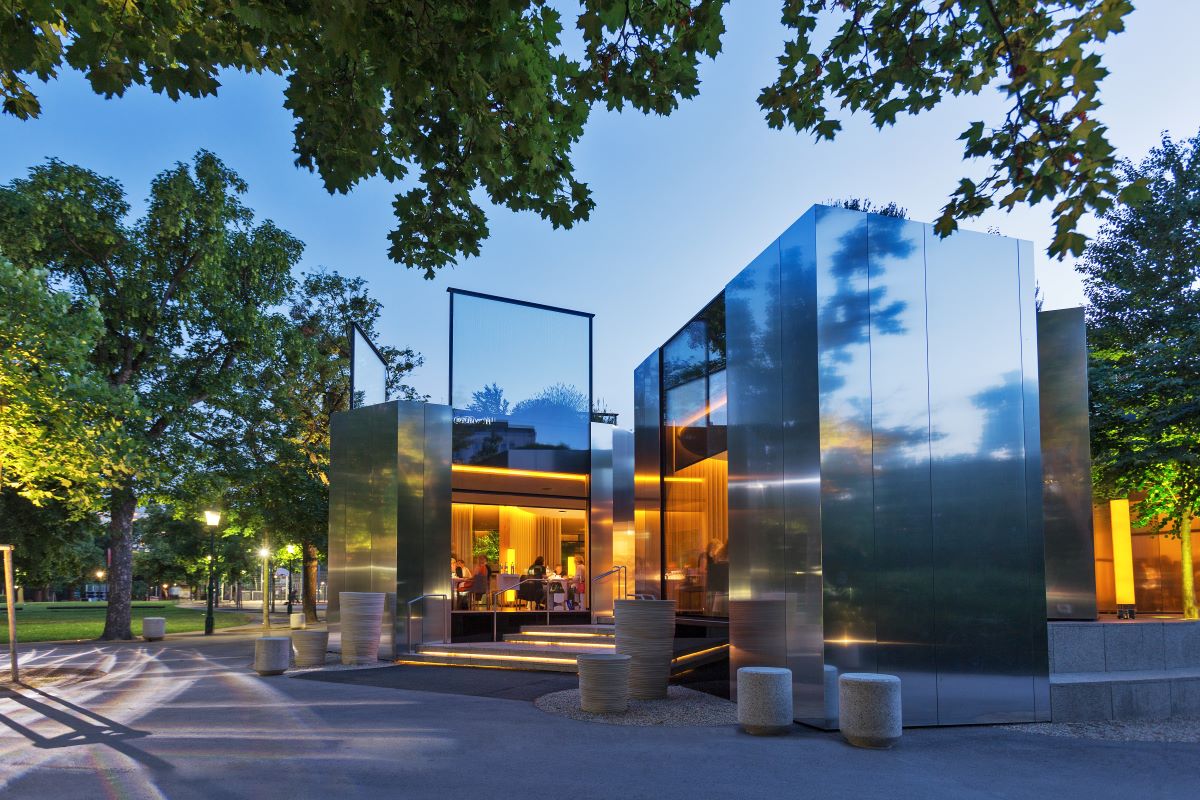
Image context: the lead image uses Michelin's exterior photograph of Steirereck because this article is about the city as much as the plates. The mirrored pavilion in the park shows one of Vienna's strongest dining ideas in architectural form: inherited cuisine can be re-staged as something open, contemporary, and exact rather than museum-bound.[3]
1. Steirereck makes Vienna feel like an archive that still cooks in the present tense
If you start with Steirereck, Vienna reads as a city that trusts memory enough to modernize it without apology. The restaurant's own page is direct about the house philosophy: contemporary Austrian cuisine built by combining tradition with new techniques, then feeding that method with rooftop herbs, citrus from the imperial orangery at Schönbrunn, forgotten native fruits and vegetables, and produce from the Reitbauer farm in Pogusch.[2] That is not a loose terroir slogan. It is a procurement-and-identity program.
The Vienna Tourist Board's modern-Viennese-cuisine essay pushes the same argument further. Heinz Reitbauer is described as a chef who knows the history and recipes of Viennese cuisine unusually deeply, owns one of the largest collections of historic cookbooks, and uses old dishes, nearly lost produce, and old cooking methods as material for new technique.[4] That matters because Steirereck's modernity does not come from pretending the past is dead weight. It comes from treating the past as usable inventory.
Michelin's long feature on Steirereck explains why that inventory feels so complete in service. The house now holds three stars, is run by Birgit and Heinz Reitbauer, sits in a mirrored pavilion in the Stadtpark, and manages to feel quiet and relaxed even with nearly 100 seats because the room is divided so intelligently.[3] Michelin's inspectors also keep returning to two things diners remember almost immediately: the bread trolley and the wine service. The bread cart is treated as nearly a performance in itself, while Birgit Reitbauer's front room and sommelier Rene Antrag's list make hospitality feel as researched as the cooking.[3]
This is why Steirereck still functions as Vienna's civic flagship rather than merely one more decorated luxury room. It does not ask diners to choose between local history and cosmopolitan polish. It gives them both at once. Old Viennese wedding soup, goulash, offal discipline, and the famous char in beeswax all point in the same direction: tradition is not being preserved in amber; it is being edited, re-sequenced, and made to move again.[3][4]
2. Mraz & Sohn treats Vienna as a source of jokes, risk, and delicious disrespect
If Steirereck is Vienna in its most composed register, Mraz & Sohn is Vienna with its collar open. Michelin calls it a true institution on the city's fine-dining scene and describes Markus Mraz and his son Lukas as running a surprise menu in which diners learn the ingredients in advance but not the finished sequence.[5] The meal currently unfolds through 13 small courses, and Michelin's own example is perfectly telling: kimchi borek built around sika venison, then lifted with Perigord truffle.[5] That is not heritage cuisine behaving politely. That is heritage being cross-wired on purpose.
The Vienna Tourist Board's account makes the house style even clearer. Lukas Mraz is framed as an enfant terrible, one of the younger chefs shaking up Austrian dining, and the restaurant is described as a place where fun and provocation travel alongside technique.[4] Guests may be shown ingredients in a supermarket shopping cart. Father and son are said to pull from tavern cooks, grandparents, chicken roasters, and kebab grillers, then send those references back out as Beuschel a la ceviche, Korean-style chanterelle goulash, or sharply reworked pastry classics.[4] That list is the point. Vienna here is not treated as a protected canon. It is treated as a live comic vocabulary with the right to collide with the wider world.
Michelin confirms that the looseness is not sloppiness. The room is chic, modern, and relaxed; the chef's table drops diners into the middle of the action; service is charming and highly professional; and the sommelier is credited with a terrific cellar and imaginative pairings.[5] That balance matters. A restaurant like this fails instantly if the rebellion is only theatrical. At Mraz & Sohn, the provocation works because the structure underneath it is stable.
So Mraz & Sohn offers a second Vienna language: not archive, but argument. Not civically polished memory, but memory made rowdy, bright, and difficult to flatten into postcard Austria. The house seems to insist that Viennese cuisine should not only be protected from disappearance. It should also survive contact with pickles, carts, kebab memory, and the pleasure of making serious diners laugh before they take another bite.[4][5]
3. Amador gives Vienna a cellar language built on distance, calm, and finish
Then there is Amador, which makes the city feel different again. If Steirereck belongs to the park and Mraz belongs to urban mischief, Amador belongs to the edge. Michelin places it on the outskirts in the Hajszan Neumann estate operated by winemaker Fritz Wieninger, then emphasizes the brick vaulted ceiling, the stylish interior, and a set menu that is described as modern, sophisticated, finely balanced, and consistently harmonious.[7] That string of adjectives sounds conventional until you compare it with the other two houses. In Vienna's current top end, Amador is the room that most clearly believes luxury should be compressed, darkened, and concentrated.
The restaurant's own "The Restaurant" page supports that reading. It describes the house as down-to-earth yet surprising, reduced to essentials, and staged so guests can relax while looking directly toward the barrel cellar and the kitchen brigade around Juan Amador.[6] That spatial choice matters. The room is not trying to feel domestic or comic. It is trying to make concentration visible.
Michelin's dish description then shows what concentration means on the plate. The guide singles out a red mullet course finished to a translucent point, joined by anchovy, piparras, tomato-olive emulsion, and Marcona almond cream.[7] The important thing is not the fish alone. It is the way the review keeps stressing firmness, balance, harmony, and aromatic control. Even the supporting notes point in the same direction: exceptional wine list, terrace, lounge, estate setting.[7] Everything is weighted toward refinement that has already been filtered.
This gives Vienna a third language: cellar formalism. Amador is not trying to sound like old Vienna or playful Vienna. It gives the city a more international, estate-like luxury syntax, but because it sits in Vienna and is one of the country's only three-star houses, that syntax now belongs to the city's self-image too.[1][7] Vienna, in other words, no longer needs all of its best restaurants to prove Austrian identity the same way.
Why the city matters more once these three rooms are read together
The useful thing about Vienna in 2026 is not that it has more stars than before. The useful thing is that the stars now illuminate difference.[1] Steirereck argues for a version of Vienna in which cookbook history, local produce, and public-park modernism can live in one polished civic flagship.[2][3][4] Mraz & Sohn argues for a Vienna that stays mischievous enough to drag tavern memory, family energy, and deliberate provocation back into the expensive room without losing finesse.[4][5] Amador argues for a Vienna confident enough to host a darker, more concentrated, more cellar-shaped form of luxury on its own terms.[6][7]
That is why the city feels stronger right now than older stereotypes allow. Vienna is still capable of courtly calm and formal service, of course. But its serious dining culture is no longer asking everyone to bow to one model of grandeur. It is letting multiple models compete: archive, mischief, and vault. For diners, that makes the city easier to choose from and harder to forget. The best meal may depend less on absolute rank than on which of those three languages you most want to hear spoken fluently over the course of one night.[1][3][5][7]
Sources
- Vienna Tourist Board, "Guide Michelin: Michelin Star restaurants in Vienna" - current overview stating that Vienna has 18 Michelin-starred restaurants with 26 stars in total, that Steirereck and Amador are Austria's only three-star restaurants, and that the latest Vienna stars were presented on March 18, 2026.
- Steirereck, official restaurant page - current public positioning of Steirereck as contemporary Austrian cuisine, with service hours, the Stadtpark address, rooftop herbs, citrus from Schonbrunn's orangery, forgotten native produce, and farm sourcing from Pogusch.
- MICHELIN Guide, "Steirereck in Vienna is Austria's New Three-MICHELIN Star Restaurant" - feature on the Reitbauers, the Stadtpark pavilion, nearly 100 seats, Birgit Reitbauer's service leadership, the wine program, the bread trolley, and signature dishes including char in beeswax.
- Vienna Tourist Board, "An alternative take on Viennese cuisine" - essay on modern Viennese fine dining, covering Steirereck's cookbook-and-produce logic and Mraz & Sohn's rebellious reinterpretation of Viennese traditions under Lukas Mraz.
- MICHELIN Guide, "Mraz & Sohn - Vienna - a MICHELIN Guide Restaurant" - current two-star listing covering the 13-course surprise format, Markus and Lukas Mraz, the chef's table, the sommelier's pairings, and the room's relaxed but highly professional service.
- Restaurant Amador, "The Restaurant" - official page describing the house as down-to-earth and surprising, reduced to the essential, with guests able to see the kitchen and barrel cellar inside a relaxed atmosphere.
- MICHELIN Guide, "Amador - Vienna - a MICHELIN Guide Restaurant" - current three-star listing covering the Hajszan Neumann estate setting, brick-vaulted room, balanced contemporary set menu, red mullet example, exceptional wine list, and terrace-lounge frame.