The easiest way to flatten Edulis is to call it charming and stop there. The little house on Niagara Street certainly is charming. The official site talks about being greeted like a friend, gathering around the table, and celebrating honesty, craft, and spectacular ingredients.[1] But charm is only the surface language. What keeps Edulis important in 2026 is that it has turned old-fashioned restaurant civility into an operating system. The room does not chase theater, algorithmic novelty, or status-signaling aggression. It stages a more difficult luxury: enough confidence to slow the guest down, enough discipline to make a small dining room feel personal rather than cramped, and enough kitchen judgment to let seafood, vegetables, and wild mushrooms carry the evening without ever feeling rustic by default.[1][2][3]
The public facts already point in that direction. As of April 29, 2026, the restaurant is openly taking reservations for Thursday, Friday, and Saturday dinner plus Sunday lunch, and all bookings are prepaid.[1] Michelin still lists Edulis as a One Star destination in Toronto and describes the cooking as Mediterranean-leaning, seafood-centered, and supported by indulgent sauces.[2] The World's 50 Best Discovery page adds another useful layer: husband-and-wife chef-owners Michael Caballo and Tobey Nemeth keep the menus changing daily, while the house mood stays convivial enough that European cider and easygoing service become part of the identity rather than an afterthought.[3] Put together, those details reveal a restaurant that is not trying to be everything. It knows exactly what kind of night it wants to host.
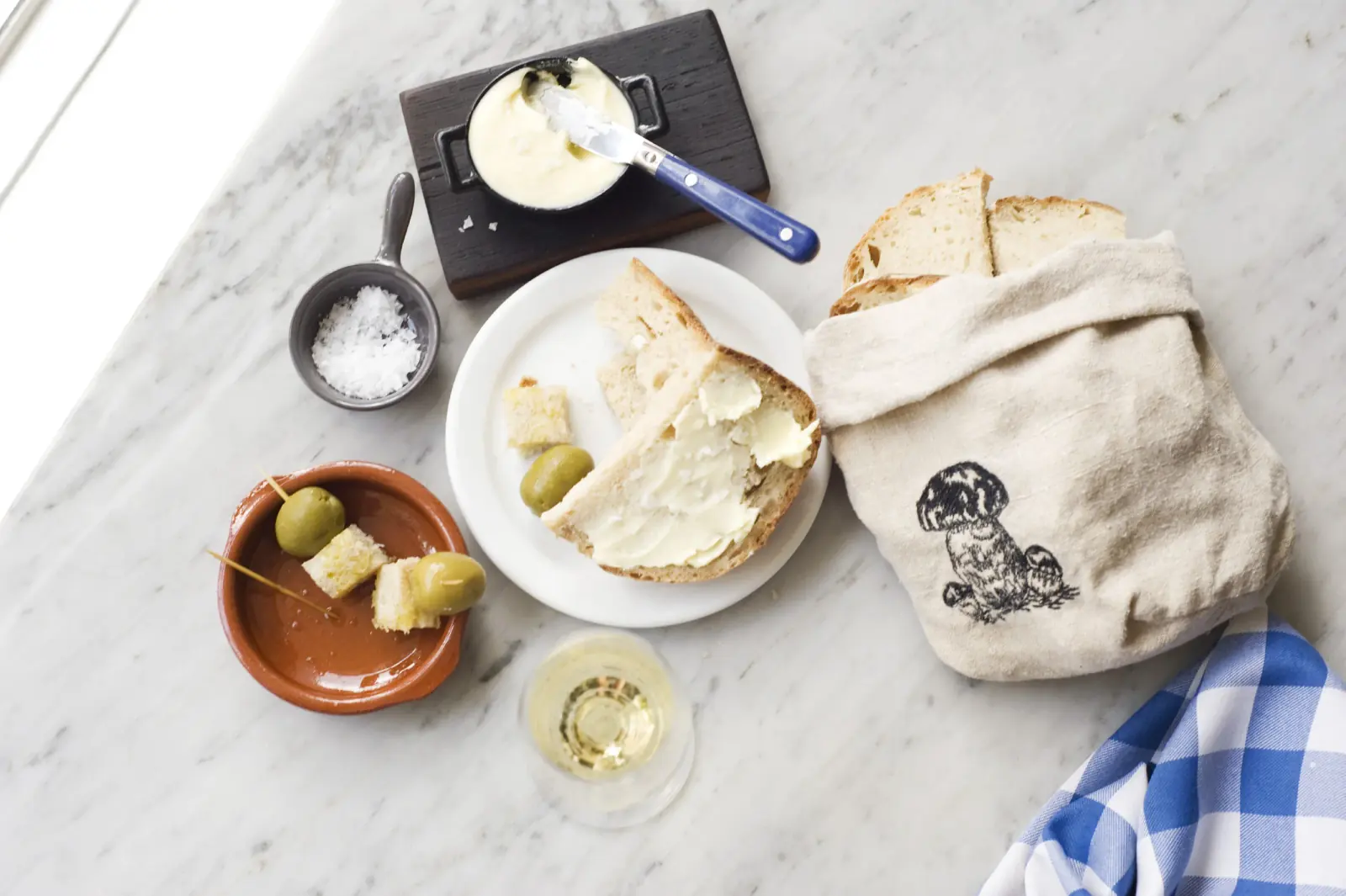
Image context: the lead image uses an official Edulis table photograph because this profile is about the restaurant's scale of pleasure before it is about any one plated dish. Bread, butter, olives, salt, and wine explain the house faster than a trophy close-up would. The restaurant's promise starts in that sequence of small attentions and then extends outward to the rest of the meal.[1]
The room works because it protects time instead of compressing it
Canada's 100 Best captured the essential point better than most rankings usually do. In its 2025 profile, the publication calls Edulis a destination restaurant disguised as a modest bistro, tells diners to put away the phone, and notes that the table is yours for the night.[5] That sentence is more revealing than any award placement. Plenty of restaurants sell scarcity; fewer sell duration. Edulis is built around the idea that a serious dinner becomes more persuasive when the guest no longer feels processed.
That philosophy is visible even in the basic language of the official site. Edulis speaks about feasting, conviviality, and sharing authentic dishes around the table.[1] None of that sounds radical until you set it against the current fine-dining environment, where the tempo often trends toward either polished velocity or concept-heavy performance. Edulis chooses a different rhythm. A prepaid reservation, a fixed service pattern spread over just four seatings a week, and a tasting-menu structure that removes most transactional choice all help create a night that feels hosted rather than managed.[1][3][5]
The deeper point is that slowness here is not laziness and nostalgia is not costume. Canada 100 Best describes the room as a kind of time warp, but the compliment lands because the kitchen is sharp enough to keep the old-world mood from turning soft.[5] Edulis does not preserve civility by sacrificing precision. It preserves civility by building precision into a dinner that refuses hurry.
Husband-and-wife authorship gives the house its specific warmth
The restaurant's emotional temperature makes more sense once you read the Michelin service-award interview with Nemeth and Caballo. Michelin describes them as a wife-and-husband ownership pair running an inviting room with a small team and a rare level of genuine hospitality.[4] The interview then fills in the biographical texture behind that description: they met in a Toronto kitchen, worked together in remote Haida Gwaii, Vancouver during the Olympics, Panama, and Italy, and eventually returned to Toronto when they learned that Niagara Street Cafe, where Michael had once worked, might be available.[4]
That history matters because Edulis does not feel like a chef ego project decorated by service. It feels like a long partnership translated into a dining room. Nemeth tells Michelin that the couple still work as each other's backstop after decades in kitchens together.[4] Canada 100 Best widens that picture by pointing to the warm, ultra-competent service staff led by Philip Shaw, which suggests that the house's hospitality is not confined to the owners' personalities alone. It has been taught outward into the team's behavior.[5]
Even Michelin's small details help. In the same interview, Nemeth talks about a nearby community garden plot and the privilege of living in a region with beautiful summer produce.[4] That is not only a farmer's-market anecdote. It reveals a restaurant whose care scale runs from soil and season up through service tone. The welcome at Edulis feels persuasive because the food and the room appear to arise from the same set of loyalties.
The cooking keeps old European memory alive without turning museum-like
Edulis's public descriptions are unusually coherent across sources, and that coherence is telling. Michelin says the set multicourse menu is largely inspired by the Mediterranean, especially Spain, while emphasizing excellent seafood, seasonal flavors, and rich sauces.[2] Discovery describes the cooking as seasonally driven, rustic yet refined, with inspiration drawn from Spain and France.[3] Canada 100 Best sharpens the image even more by noting that menus from great traditional Michelin-starred restaurants in Spain and France hang on the walls, and that the collective memory of those rooms has been successfully distilled into the meal.[5]
What Edulis seems to admire in that lineage is not grandeur for its own sake. It is clarity about what a feast is supposed to do. Seafood turns up everywhere in the public descriptions: Quebec snow crab, scallops, charcoal-grilled prawns, Dungeness crab, John Dory, and other wild fish and shellfish appear as recurring examples rather than fixed signatures.[2][3][5] Alongside them come the restaurant's other stated obsessions: vegetables and wild mushrooms.[1][3] The result is a luxury language that feels lush without becoming overbuilt.
That balance is why Edulis reads differently from many contemporary tasting rooms. The ingredients sound expensive when they need to, but the restaurant's vocabulary is never reduced to caviar and scarcity. It keeps circling back to texture, sauce, smoke, shellfish sweetness, mushrooms, and the kind of seasonal judgment that only becomes convincing when a kitchen changes the menu constantly enough to stay honest.[1][2][3] Even the extra details in Canada 100 Best help here: the publication mentions pate negra sliced with unusual care, poultry dishes with vin jaune, truffle, or paprika, and a tasting-menu-only format that relieves diners of the burden of choosing badly.[5] That is not maximalist abundance. It is edited abundance.
Why Edulis feels especially durable right now
Toronto has no shortage of ambitious dining rooms. What it has less of is a room this small that can make seriousness feel unforced. Edulis still feels current in 2026 because it protects forms of pleasure that many expensive restaurants quietly erode: time at the table, legible hospitality, and food that sounds pleasurable before it sounds strategic.
The accolades confirm that the room still carries serious weight. Michelin continues to star it.[2] Discovery continues to place it in its global network.[3] Canada's 100 Best placed it at No. 4 in 2025.[5] But those signals are useful mainly because they support a narrower claim. Edulis is not compelling because it keeps winning approval. It is compelling because all of those institutions are, in effect, rewarding a restaurant that has chosen restraint in how it stages excellence.
For diners, that means the fit question is refreshingly clear. Book Edulis if you want a dinner that behaves like a hosted feast and trusts the old vocabulary of bistro warmth, shellfish, mushrooms, and sauce to do serious modern work. Book it if the promise of keeping the table all night sounds like part of the luxury rather than an inconvenience.[5] Think twice only if you want maximum spectacle, menu gamification, or a room whose prestige is obvious from the first glance. Edulis asks for a more attentive appetite than that. In return, it offers one of the rarest things in contemporary fine dining: a little house that still knows how to make slowness feel expensive.[1][2][5]
Sources
- Edulis official website - philosophy, service days, prepaid reservations, ingredient focus, and official image context.
- MICHELIN Guide, "Edulis - Toronto - a MICHELIN Guide Restaurant" - current star status, Mediterranean orientation, and menu-style description.
- 50 Best Discovery, "Edulis - Toronto - Restaurant" - husband-and-wife ownership, daily-changing set menus, seafood and mushroom emphasis, and convivial service.
- MICHELIN Guide, "Tobey Nemeth and Michael Caballo, MICHELIN Guide Toronto 2022 Service Award Winners" - background on the owners, the small-team hospitality model, and their return to Toronto.
- Canada's 100 Best, "Edulis | Toronto | Canada's 100 Best" - 2025 ranking, table-for-the-night framing, service detail, and Spain-and-France lineage context.