The easiest way to misread Don Julio in 2026 is to treat it as a famous Buenos Aires steakhouse that happened to become a ranking magnet. That is the public headline, but it is too thin for what the restaurant has actually built. Don Julio matters because it has turned a parrilla into an unusually complete Argentine system: cattle selection and regenerative farming on one end, in-house butchery and aging in the middle, a grill engineered to protect flavor instead of merely dramatize it, and a wine-and-service culture that makes the room feel bigger than a single neighborhood meat temple.[2][3][4][5]
The current public record points in the same direction from several angles at once. The official site gives the basic operating frame: Guatemala 4699 in Palermo Viejo, open every day from 11:30 to 16:00 and 19:00 to 1:00.[1] The 50 Best Discovery profile describes a house built out of Rivero's family story, with bottle-lined walls, a vast grill, and the kind of hospitality that makes even a wait feel staged as part of dinner rather than as dead time.[2] The Latin America's 50 Best 2025 page pushes deeper into the supply side, arguing that nearly everything on the menu is tied back to the restaurant's own farm, its in-house butchery and aging, and a wine cellar that stretches across Argentina with around 60,000 bottles.[3]
That is why Don Julio is worth reading as a restaurant profile instead of a steak recommendation. The useful question is not whether the meat is good. The useful question is how many separate disciplines have been made to work together so the meat can arrive with this much confidence.
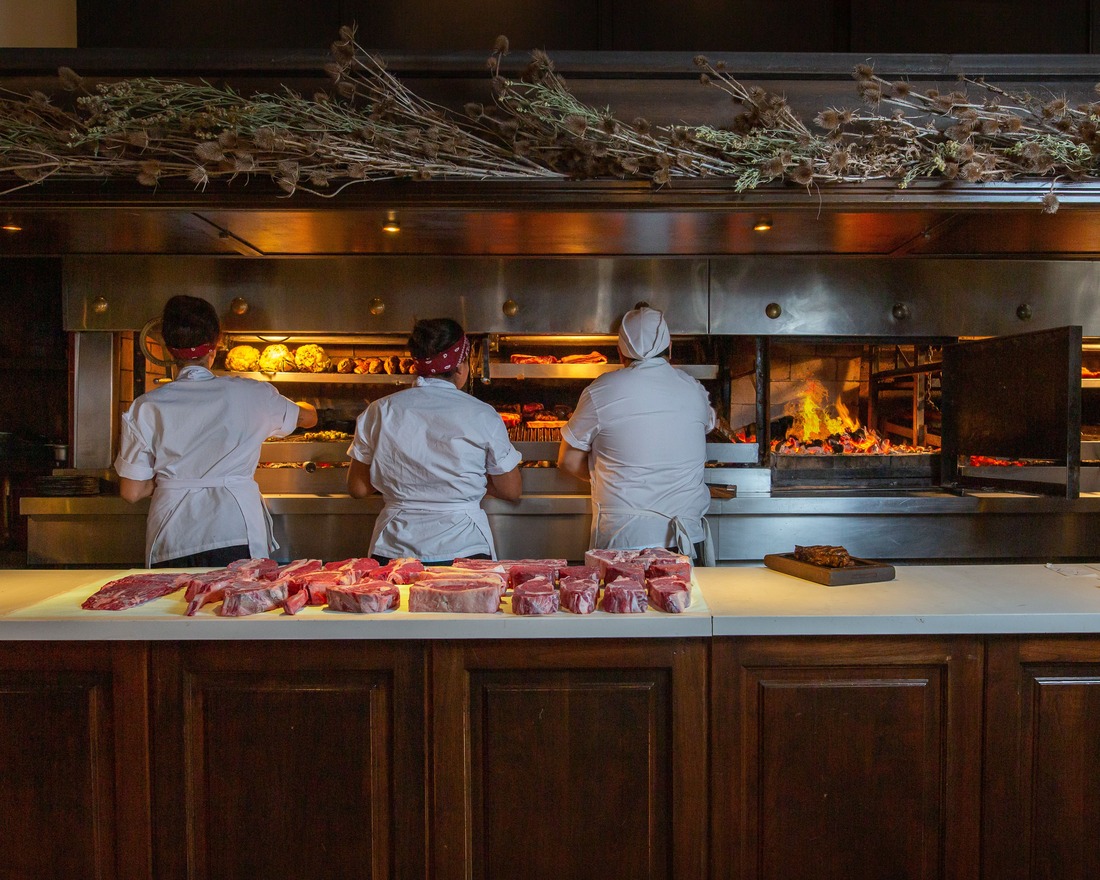
Image context: the lead image uses MICHELIN's photograph of Don Julio's grill in action because the article is about control inside abundance. Flames are part of the story, but so are the choices that keep fire from overwhelming the product.[5]
1. The room still begins with family, but family here has been professionalized into a house style
50 Best Discovery's short profile gives the clearest public shorthand for Don Julio's origin: Pablo Rivero grew up in a family of butchers and cattle herders, and the house itself is named after the property owner and beloved neighbor Don Julio.[2] That family origin could have remained a sentimental brand asset. What makes the restaurant stronger is that it did not stop there.
The Latin America's 50 Best 2025 profile now presents Don Julio as a family-run labour of love, with Rivero and Guido Tassi attached not only to the meat but to a broader statement about Argentine terroir, hospitality, and regenerative farming.[3] The older 50 Best winner's note from November 26, 2024 adds a useful human detail: Rivero is not only the owner behind the house but also someone who trained as a sommelier early in his career.[6] That matters because it helps explain why Don Julio never feels like a grill that added wine as a prestige accessory later. Wine literacy was already inside the project.
Seen that way, the restaurant's fame looks less accidental. Don Julio did not become globally visible by having one excellent steak and a lot of demand. It built a house style in which meat, wine, and hospitality were all granted equal authority.[2][3][6]
2. Regenerative farming and in-house aging are not side notes here; they are the center of the pitch
The most useful sentence on the 2025 Latin America's 50 Best page is also the simplest: nearly everything on the menu comes from the restaurant's own farm outside Buenos Aires.[3] That is a much stronger claim than generic farm-to-table romance. The page goes on to say that the Aberdeen Angus and Hereford cattle are farmed under regenerative practices, then butchered and aged entirely in-house.[3]
MICHELIN's current Don Julio listing sharpens that picture. The guide describes a house whose excellence depends on a mixed aging process, careful animal selection, and a sustainability philosophy explicitly tied to regenerative livestock farming.[4] The listing even reproduces Rivero's own framing about seed control, cattle raising, soil recovery, carbon capture, rational grazing, and holistic management.[4] Whether one arrives as a steak obsessive or as a diner interested in contemporary agriculture, the key point is the same: Don Julio wants the cut of beef to carry the logic of the whole chain behind it.
That supply logic also changes how the restaurant's vegetable and charcuterie material should be read. The 2025 50 Best page says seasonal vegetables, salads, and house-made products matter here alongside the famous beef cuts.[3] MICHELIN's Buenos Aires steakhouse feature adds more texture, pointing to house charcuterie, sweetbreads, dry-aged meats, and a menu where the grill touches mushrooms, peppers, and pumpkin as seriously as it touches beef.[5] Don Julio is still a steakhouse, but it no longer reads like a steakhouse that only trusts one ingredient category.
3. The V-shaped parrilla explains the difference between spectacle and discipline
Most famous grills use flame as theater. Don Julio's public documentation keeps returning to flame as engineering. The current MICHELIN listing is unusually specific on this point. It highlights the V-shaped grill, explaining that the shape keeps fat from dripping directly onto the embers and altering flavor with uncontrolled smoke from the white quebracho charcoal.[4] That sounds like a technical detail until you realize how much of steakhouse dining is built on managing exactly that boundary.
The same listing pairs that grill geometry with the meat display counter, the dry-aging logic, and the wine cellar as part of one coherent environment.[4] The 2025 MICHELIN steakhouse feature carries the argument further by describing the meats as dry-aged to enhance tenderness without masking the natural flavors of the Angus and Hereford breeds.[5] That sentence is the whole Don Julio philosophy in miniature. Fire is supposed to reveal the animal, not bury it.
This is where the restaurant separates itself from generic luxury parrillas. Don Julio is not chasing the darkest crust, the loudest smoke, or the most macho version of abundance. It is chasing a cleaner translation of product into fire. The grill is spectacular because it is disciplined, not because it is wild.[4][5]
4. The wine cellar is what turns Don Julio from a steakhouse into a national room
If the grill explains the cooking, the cellar explains the scale of the ambition. The 2025 Latin America's 50 Best page says the cellar holds about 60,000 bottles covering the length and breadth of Argentina, with aged vintages and award-winning labels, and it treats the cellar, butcher's shop, and biodynamic garden as parts of one extended ecosystem.[3] That is not a normal supporting wine list. It is a statement that Argentine dining culture cannot be reduced to red meat alone.
This is where Rivero's sommelier training becomes structurally important again.[6] Don Julio's reputation now sits on two different forms of national representation at once. One is cattle, breed, fat, fire, and grazing. The other is regional wine memory. Even the 50 Best Discovery profile, which spends most of its time on the room's atmosphere, makes the bottle-lined walls central to the visual identity of the house.[2] The walls are not decorative. They are a visible archive of repeat custom, but also of the way wine has been built into the restaurant's mythology.
Put differently, Don Julio does not ask diners to choose between parrilla authenticity and polished hospitality. It stages both together. The queue gets sparkling wine and empanadas, according to 50 Best's 2025 profile.[3] The dining room carries the casual authority of a neighborhood institution.[2] The cellar pushes the whole experience into national scale.[3][6]
Why Don Julio still matters
Don Julio still matters because it has found a way to make Argentine abundance legible instead of merely impressive. The meat is excellent, but the restaurant's deeper achievement lies in the system around it: regenerative cattle, in-house butchery and aging, smoke-aware grill design, vegetable seriousness, and a cellar vast enough to make the meal read like a map of the country.[2][3][4][5]
That is also why the rankings make sense only after the structure is clear. A lesser restaurant can become famous by turning scarcity into hype. Don Julio became durable by turning family memory into process and process into hospitality. The grill is still the visual center of the room. It is just no longer the whole story.[2][3][4][6]
Sources
- Parrilla Don Julio, official homepage - current address, opening hours, phone numbers, and booking entry point.
- 50 Best Discovery, "Don Julio - Buenos Aires - Restaurant." Current profile covering Pablo Rivero's family background, the bottle-lined room, the central grill, and the house's hospitality framing.
- Latin America's 50 Best Restaurants 2025, "Don Julio." Current ranking page covering the restaurant's own farm, regenerative cattle, in-house butchery and aging, 60,000-bottle cellar, biodynamic garden, and waiting-line hospitality.
- MICHELIN Guide, "Don Julio - Buenos Aires - a MICHELIN Guide Restaurant." Current listing covering the one-star distinction, regenerative livestock framing, mixed aging process, Hereford and Angus selection, the V-shaped grill, white quebracho charcoal, and the wine cellar.
- MICHELIN Guide, "The Best Steakhouses in Buenos Aires." Feature covering Don Julio's Green Star, dry-aged meats, wine-cellar emphasis, and the grill photograph used here as image provenance.
- The World's 50 Best Restaurants, "Don Julio is The Best Restaurant in Latin America 2024." Winner note covering Pablo Rivero's owner-sommelier identity and the restaurant's wider regional standing.