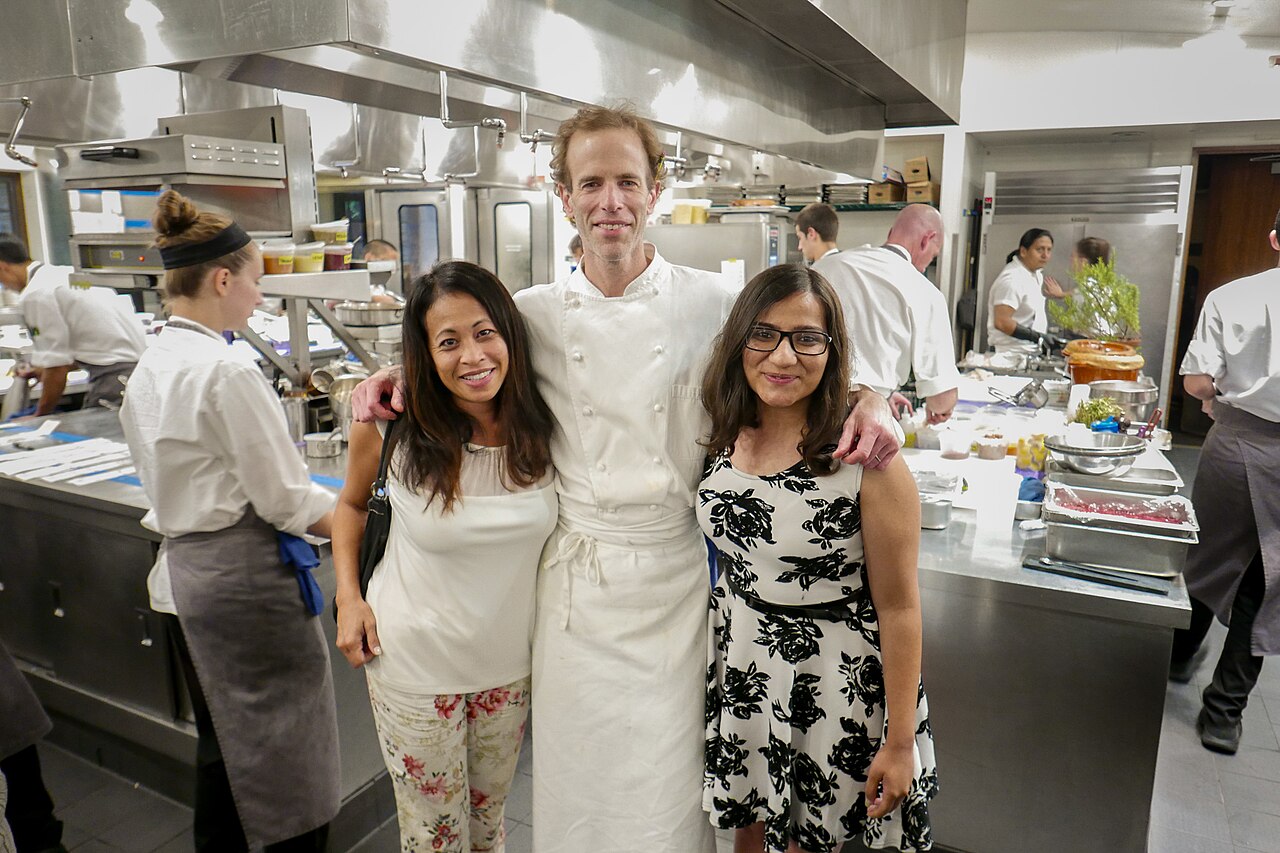
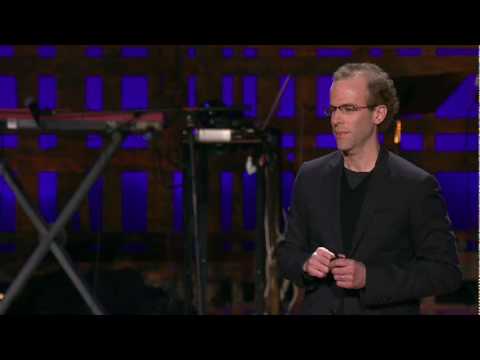
Dan Barber's TED talk about falling in love with a fish sounds, at first, like a charming chef story: a good ingredient disappoints him, another good ingredient rescues him, and a Spanish aquaculture site becomes the punchline to a search for seafood he can serve without apology. The better way to watch it is less sentimental. Barber is really asking what counts as evidence when a fine-dining menu claims to be responsible.
That question still matters because fine dining is unusually good at turning supply chains into language. "Local," "sustainable," "seasonal," and "farm-raised" can all become room-softening adjectives unless the restaurant can explain the mechanism behind them. Barber's example of Veta la Palma, the wetland and aquaculture system in Andalusia, Spain, gives chefs a harder test: not whether a product carries a comforting label, but whether the system producing it improves water, habitat, biodiversity, and flavor at the same time.[1][3][4]
Watch the talk less as a seafood recommendation than as a menu-design case study. The useful question is not "Should every chef buy this fish?" It is "What would a menu look like if a dish had to prove the health of the landscape that produced it?"
The talk's first move is to make a restaurant problem feel embarrassingly practical. Barber wants fish on the menu. He also knows that the old luxury grammar of seafood is compromised by depletion, feed conversion, and the way farmed fish can merely move pressure from one ecosystem to another. That is why the early anecdote about a supposedly sustainable fish matters. The fish was not rejected because it failed a romance test. It failed because the production story could not survive scrutiny once feed, inputs, and taste were put together.[1]
For a fine-dining kitchen, this is a serious warning. A chef can plate a fish beautifully, price it confidently, and explain it in soft language while the ingredient's upstream logic remains thin. Barber's point is that flavor is not separate from that upstream logic. If the fish is being fed in a way that makes the product taste like the wrong food chain, the sustainability claim becomes a culinary problem, not only an environmental one.
Around the middle of the talk, Veta la Palma enters as the counterexample. The site's force is that it does not behave like a conventional story of intensification. Grist's 2013 reporting describes Veta la Palma as reflooded marshland near the Guadalquivir River in southern Spain, with aquaculture built around natural filtration, restored wetlands, biodiversity, and even predator pressure.[3] That last detail is the one that sticks because it reverses the usual farm logic. Birds eating some of the fish are not treated only as loss. They become evidence that the system is alive enough to attract them.
The scientific literature gives the story a stricter frame. A 2018 aquaculture study describes the Veta la Palma farm-wetland complex as a commercially viable land-based integrated multitrophic aquaculture system, located on formerly drained Guadalquivir marshland that later became protected as part of the Donana Natural Park and UNESCO Biosphere Reserve.[4] The same paper emphasizes that the cultured species sit within a broader estuary food web and that the estate has recorded hundreds of bird species.[4] In other words, the restaurant story is not just "fish from a nice place." It is fish from a managed wetland where business, habitat, food webs, and water quality are tangled together.
That is where Barber's talk becomes useful for chefs beyond seafood. He is not offering a universal procurement hack. Veta la Palma is specific, spatially large, ecologically unusual, and not easily copied by a city restaurant with a narrow supplier list. The transferable lesson is a standard of proof. A fine-dining kitchen should be able to say what the ingredient's production rewards. Does the purchase reward monoculture, extraction, and hidden feed inputs? Or does it reward a more complex landscape whose byproducts are not all negative?
The Michelin Guide's later sustainability interview with Barber shows how this logic extends back into his own restaurants. Barber describes Blue Hill at Stone Barns as thinking less in fixed menus than in ingredient "playlists," with dishes assembled responsively around what the surrounding region can support on a given day.[2] Whether or not a diner buys every part of the Blue Hill mythology, the operational idea is important: the menu should not pretend that the land exists to execute the chef's fantasy on schedule. The menu has to bend toward what the system can honestly provide.
That does not make the chef passive. If anything, it makes the chef's job harder. The kitchen must translate ecological complexity into pleasure without turning dinner into homework. Barber's talk works because he keeps returning to taste. The fish has to be delicious. The system has to be legible. The story has to survive contact with the plate. Sustainability without flavor becomes a lecture; flavor without sourcing proof becomes luxury nostalgia with better vocabulary.
The detail to notice near the end is Barber's delight in being surprised by the farm's logic. He does not frame Veta la Palma as a perfect supplier to be worshiped. He frames it as a system that changed what he thought a good fish could mean.[1] That distinction is valuable. Fine dining often treats sourcing as a credential attached to a dish after it has been conceived. Barber is arguing for the reverse order: let the production system reshape the dish, the menu, and the chef's sense of what abundance looks like.
For diners, the practical takeaway is simple. When a restaurant leans heavily on responsible-sourcing language, ask what would count as proof. A farm name is not enough. A label is not enough. A beautiful plate is not enough. The stronger claim is a chain of evidence: feed, habitat, water, labor, species mix, season, waste, predator tolerance, and flavor all pointing in the same direction. Veta la Palma became memorable because the claim was not only that the fish was clean or ethical. The claim was that the fish belonged to a working ecology.
That is why this old talk has aged better than many chef manifestos. It does not tell restaurants to become purer. It tells them to become more specific. The best fine-dining menu is not the one with the most virtuous adjectives. It is the one where the ingredient's path to the table changes how the chef cooks, how the server explains, and how the diner understands pleasure.
Sources
- TED, "Dan Barber: How I fell in love with a fish" - YouTube video source for the embedded talk.
- Michael He, "Chef Dan Barber's Urgent Food Revolution," MICHELIN Guide - interview context on Blue Hill at Stone Barns, ingredient playlists, Green Star framing, and Barber's sustainability philosophy.
- Daniel Klein, "This fish farm gives a portion of its product to predators," Grist, 2013 - reporting on Veta la Palma's reflooded marshland, natural filtration, biodiversity, and predator-tolerance logic.
- M. Fernandez-Rodriguez et al., "Multivariate factor analysis reveals the key role of management in integrated multitrophic aquaculture of Veta la Palma (Spain)," Aquaculture, 2018 - scientific context for Veta la Palma as a farm-wetland IMTA system.
- Wikimedia Commons, "File:Dan Barber at Blue Hill at Stone Barns (36195506403).jpg" - Lou Stejskal's 2017 photographic image used as the article cover.