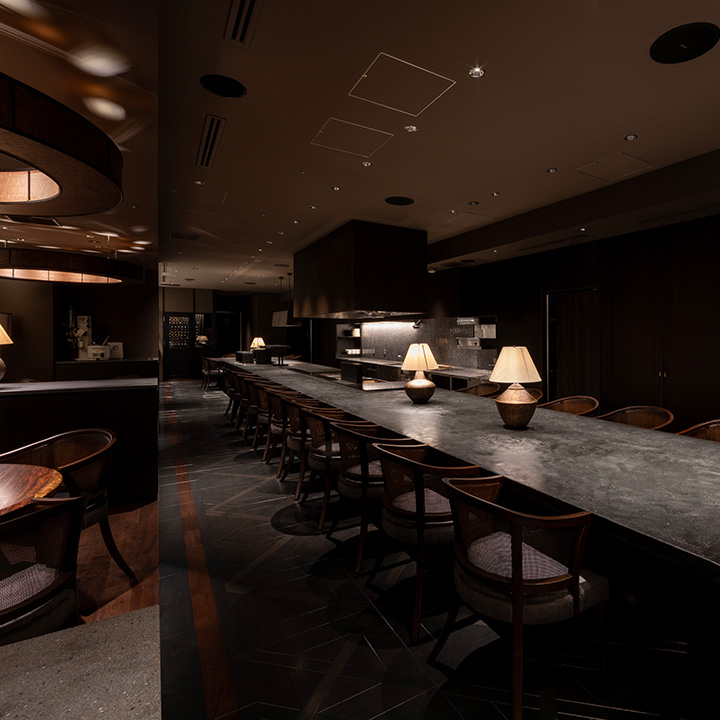
Florilege is usually introduced through its chef, its awards, and its French-Japanese vocabulary. That is fair, but incomplete. The more useful way to read Hiroyasu Kawate's Tokyo restaurant is as a service system whose central piece of equipment is not a combi oven, a rare ingredient, or a tasting-menu flourish. It is the table.
The long communal counter changes the promise of the meal. It does not simply give diners a view of the kitchen. It gives the kitchen a view of the diners, compressing cooking, pacing, explanation, plating, and guest reaction into one shared field. The World's 50 Best describes Florilege's current room as plush counter seating running around three sides of a large open kitchen, with guests able to watch preparation and interact with both front- and back-of-house teams through the meal.[3] Michelin's current listing reaches for a different analogy, comparing the long table to aristocratic European dining tables and noting that guests gather around one large table for a table d'hote style experience.[5]
Those two descriptions point to the same operational idea. Florilege is not using openness as spectacle alone. It is using openness as management. The room makes service less like delivery and more like choreography.
The Table Controls Pace
At a conventional tasting-menu restaurant, each table is a small island. The kitchen has to synchronize many private rhythms: late arrivals, slow eaters, photo pauses, dietary substitutions, wine-pairing delays, and servers moving between rooms. Florilege's shared-table format changes that geometry. The counter brings guests into a common tempo while keeping the kitchen in direct visual contact with the room.[3][5]
That does not mean the restaurant becomes casual. It means precision is redistributed. Instead of hiding the sequence behind a wall, the restaurant lets sequence become part of the value. A guest can see the pass, the plating station, the staff crossings, and the small gaps where the next course is being prepared. The room turns waiting time into legible time.
This matters because Kawate's food asks for attention to restraint. Florilege is known for contemporary French-accented cooking with a distinctive Japanese character, and 50 Best frames its current identity around sustainability, locally sourced ingredients where possible, and a commitment to less meat and seafood with more vegetables.[3] Plant-forward fine dining often has a pacing problem: if the menu is not managed carefully, restraint can register as thinness. Florilege's room gives that restraint a visible frame. The diner sees not absence, but calibration.
Policy Is Part Of The Meal
Service design starts before anyone sits down. Florilege's reservation page is unusually useful because it shows how much of the experience is operationally pre-shaped. The restaurant lists a lunch tasting menu, a dinner tasting menu, alcoholic and non-alcoholic pairings, expected durations of about two and a half hours for lunch and about three hours for dinner, and a main-course choice between "MEAT" and "VEGGIE" requested through the online form.[2]
The important detail is the boundary. Florilege lets a guest choose a veggie main, but it says that choice is not the same as a vegetarian or vegan course. The same page explains that the restaurant tries to accommodate dietary requirements in advance, while naming restrictions it may not be able to accept, including vegan meals, gluten-free requests, dairy allergies or lactose intolerance, and several stock or soy-related constraints.[2]
That language can sound severe if read as hospitality rhetoric. Operationally, it is a sign of a restaurant protecting the integrity of a highly sequenced room. A communal counter and open kitchen magnify exceptions. If one guest's course has to be rebuilt too far away from the menu logic, the change is not confined to a back table. It affects timing, mise en place, communication, and sometimes the shared visual rhythm of the counter. Florilege's policies make the promise more honest: the restaurant is not selling infinite customization. It is selling a composed sequence.
The same is true of table size. Florilege's current reservation notes cap parties at four guests, state that there are no private rooms, and say the restaurant does not accept seat requests.[2] Those are not incidental constraints. They preserve the table as a single working instrument. Large parties, private rooms, and seat preferences all fragment control. Florilege's format depends on resisting that fragmentation.
Sustainability Becomes A Service Question
Fine-dining sustainability often gets discussed as procurement: local sourcing, less meat, better seafood choices, waste reduction, and responsible farming. At Florilege, those questions are inseparable from service. A plant-forward menu changes what staff must explain, how pacing feels, and how the kitchen manages satisfaction without leaning on the old luxury grammar of caviar, foie gras, lobster, and beef as automatic emotional peaks.
50 Best's current list profile says Kawate and his team are committed to serving less meat and seafood and more vegetables, reflected in plant-forward tasting menus.[3] Michelin identifies Florilege as a Two Stars restaurant in the 2026 Japan guide and also connects the restaurant to plant-based cooking in its related editorial context, framing Kawate as a chef with an emphasis on sustainable practices.[5] The 50 Best Discovery profile, while carrying some legacy venue wording, is also useful because it describes the room as a family-style table around the kitchen, all eyes on the chefs.[4]
Put those claims together and the restaurant's logic becomes clearer. A plant-forward tasting menu needs guests to accept a different hierarchy of abundance. The communal table helps with that because it makes the room social. The diner is not only receiving a series of plates; the diner is watching a collective act of attention. Vegetables, broths, grains, fermented notes, herbs, seafood used sparingly, or meat treated as one possible accent can feel complete when the service environment makes care visible.
That is the quiet operational achievement. Sustainability is not a slogan placed above the kitchen. It is translated into a room where the guest can see labor, pace, and restraint carrying value.
The Move Clarified The System
Florilege opened in 2009, after Kawate worked in France and at Quintessence in Tokyo, and the current 50 Best profile notes that it relocated in autumn 2023 to Azabudai Hills.[3] The restaurant's own site now places it at Garden Plaza D, Azabudai Hills, in Toranomon, with lunch and dinner service hours listed in the footer and the reservation page.[1][2] Michelin's listing gives the same Azabudai Hills address and current two-star status.[5]
The move matters because a restaurant built around a table is unusually dependent on room clarity. A cramped open kitchen can feel like novelty. A grand open kitchen can become performance. Florilege's current room, as shown in the official photograph and described by guide profiles, sits between those extremes: dark counter, warm lamps, controlled sightlines, and enough space for the kitchen to be theatrical without becoming loud.[3][6]
The table therefore does double duty. It creates intimacy for the guest and control for the team. It lets staff move between explanation and execution without pretending those are separate jobs. It also keeps Kawate's biography from becoming the whole story. Yes, the chef's training matters. Yes, the Michelin stars, 50 Best ranking, and Asia recognition matter.[3][4][5] But the restaurant's continuing relevance comes from converting those credentials into a repeatable service shape.
Why It Works
The risk of this format is obvious. A communal counter can become coercive. An open kitchen can become self-conscious. A sustainability message can become moral homework. Florilege avoids those traps when the table feels less like a lecture hall and more like a dining machine: everyone close enough to sense the work, no one forced to decode every movement.
That is why Florilege is a useful model for contemporary fine dining. It does not abandon luxury; it changes where luxury is located. Luxury is in fewer private demands, fewer hidden corrections, fewer ornamental claims, and more trust in a room that has been organized well enough to make restraint pleasurable.
The meal's operating system is visible from the first glance. The counter gathers guests. The kitchen performs without disappearing. The reservation rules protect the sequence. The menu's plant-forward pressure gives the staff something harder than opulence to sell. In that sense, Florilege's table is not decor. It is the restaurant's discipline made physical.
Sources
- Florilege official homepage - current restaurant identity, chef framing, Azabudai Hills address, service hours, and official room photography context.
- Florilege official reservations page - current menus, pricing, service length, main-course choice, dietary-requirement boundaries, party-size limit, no-private-room policy, and reservation rules.
- The World's 50 Best Restaurants 2025, "Florilege" - current list profile covering rank, Hiroyasu Kawate, open-kitchen counter seating, Azabudai Hills relocation, sustainability, and plant-forward menu direction.
- The World's 50 Best Discovery, "Florilege - Tokyo - Restaurant" - venue profile covering the family-style kitchen-surrounding table, chef background, accolades, and dining-room format.
- MICHELIN Guide, "Florilege - Tokyo" - 2026 Japan listing covering Two Stars status, address, chef metadata, table d'hote description, cuisine type, and related sustainability context.
- Florilege official image asset, "imgtopconcept2_01.jpg" - source of the article's real photographic cover image.