At the pastry pass, vanilla can look like one clean gesture. A cook lays a glossy black pod on the board, runs a knife down its length, and scrapes a constellation of seeds into warm cream. The plate that follows may contain no visible evidence of a farm, an orchid, a pollinator, a cyclone, a curing box, or a sorting table. It just tastes rounder, warmer, more complete.
Nearly all the difficult work has already happened.
The flower that began that pod opened in the morning and had to be pollinated before it closed that afternoon. The fruit then remained on the vine for roughly eight to nine months. After harvest, a green capsule with little of the aroma diners recognize as vanilla had to be wilted, sweated, dried, conditioned, handled, and graded until its perfume emerged without mold or brittleness.[1][2][3][5]
This is why plain vanilla is such an upside-down phrase. Natural vanilla is familiar, but it is not simple. Its luxury lies less in the black flecks a diner can see than in a long chain of timing that the dining room usually hides.
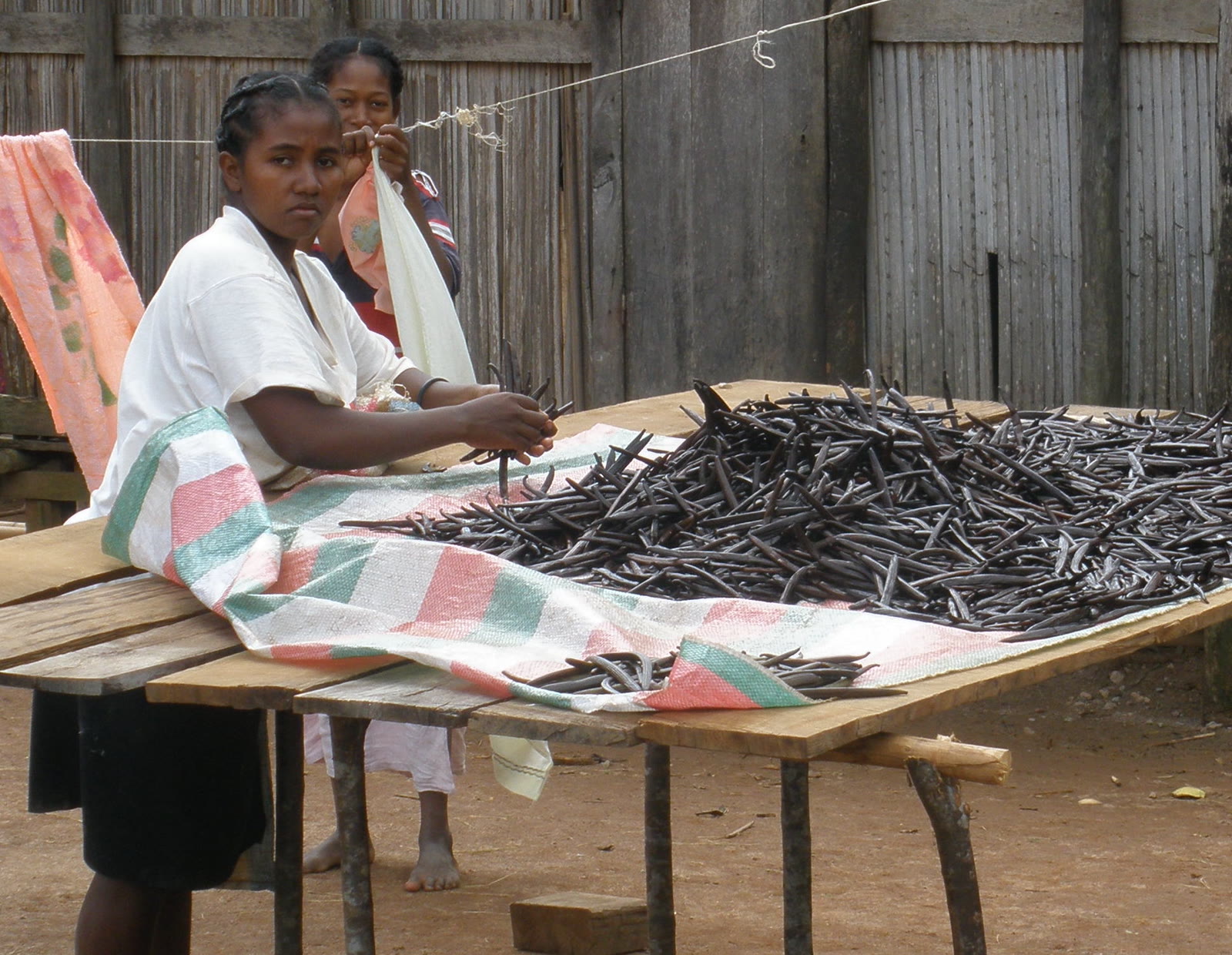
Image context: the cover is a real 2008 photograph from Sambava, in Madagascar's main vanilla-growing region. Two women sit behind a broad mound of cured pods, sorting them by hand. It shows the ingredient as agricultural work and judgment—not as generic pastry decoration.[8]
The first deadline lasts one day
Vanilla planifolia is self-compatible, but its flower does not conveniently fertilize itself. A small flap called the rostellum separates the pollen-bearing anther from the receptive stigma. Commercial production therefore depends on a person lifting that barrier and pressing the flower's reproductive parts together.[1]
The window is severe. A 2024 review of V. planifolia pollination describes flowers that open early, bloom for only one day, and must be worked before they close in the afternoon. The same paper cites field estimates of 1,000 to 2,000 flowers per trained worker per day and reports that hand pollination can account for as much as 40 percent of production costs.[1] Those figures are not a universal piece rate—farms, weather, vine density, and worker experience differ—but they reveal where the price begins: skilled attention compressed into a few morning hours.
This is labor with no useful pause button. A flower missed today cannot be added to tomorrow's batch. A damaged bloom does not become a smaller luxury bean; it becomes no bean at all. Even a successful pollination merely opens the next clock. A 2025 University of Florida extension guide places the optimum harvest stage eight to nine months after pollination.[3]
Fine dining often celebrates last-second precision: the fish rested correctly, the sauce mounted at the pass, the soufflé carried before it falls. Vanilla asks the kitchen to recognize an earlier version of the same discipline. Months before service, someone had to read a pale flower and act within hours.
The famous hand belonged to Edmond Albius
Vanilla's global geography was not inevitable. The Muséum national d'Histoire naturelle describes V. planifolia as Mesoamerican, with a probable original range extending across parts of southern Mexico, Guatemala, Belize, and Honduras. The plant travelled readily by cutting, but outside its home range it flowered far more easily than it fruited.[2]
The history of artificial pollination needs two distinct moments. In 1836, Belgian botanist Charles Morren obtained vanilla fruit through artificial fertilization in Liège. Paris greenhouse experiments followed, but results remained unreliable. In 1841 on the island then called Bourbon, now Réunion, Edmond Albius—an enslaved boy of twelve—developed the rapid flower-to-flower method that is still used.[2]
Compressing that story into “vanilla was discovered” erases both prior Mesoamerican knowledge and the power structure around the technique that made plantation production portable. Albius did not discover the plant or invent its flavor. He solved the field operation that let one morning's blossoms become a viable crop far from the orchid's origin.
That distinction matters at the table. “Bourbon vanilla” can sound like a soft-focus tasting note, or be confused with whiskey. It also carries the former name of Réunion and a history in which botanical circulation, colonial agriculture, and an enslaved child's exact observation changed where vanilla could be produced.[2] Provenance is not just an adjective for aroma. It is a route made by people.
A green pod does not yet smell like dessert
Fresh vanilla capsules are green and nearly odorless.[2] The recognizable aroma is not waiting at full volume inside them like perfume in a sealed vial. It has to be developed after harvest.
The Food and Agriculture Organization's post-harvest compendium explains the central chemistry. Mature green pods contain only trace vanillin. Much of the potential sits as glucovanillin, a bound precursor. During curing, enzymes hydrolyze that precursor and release vanillin; related bound compounds also contribute to the finished aroma. Drying matters, but simple water loss is not enough. Hydrolytic and oxidative changes are the more consequential work.[5]
Traditional curing is commonly described in four broad movements: killing or wilting, sweating, drying, and conditioning.[5]
- Killing or wilting stops the pod's ordinary vegetative life and begins breaking the cellular separation that kept enzymes and precursors apart.
- Sweating manages warmth and moisture so aroma-forming reactions can proceed.
- Drying lowers moisture gradually enough to protect the pod from mold without stripping away the very volatiles the cure is trying to build.
- Conditioning gives the darkened beans further time to settle and develop before final grading and sale.
Calling the whole sequence “drying” is like calling stock reduction “boiling.” It names the visible physical change and misses the transformation. The curer's problem is not to make a wet green bean dry. It is to trade moisture for stability while preserving suppleness and creating aroma.
This is also why premature harvest is so destructive. The FAO guide notes that immature pods do not develop full-bodied aroma and proper color during processing, while overripe fruit can split and lose aroma.[5] The harvest decision is a narrow bridge: late enough to accumulate potential, early enough to keep the capsule intact.
Sambava sorts time by hand
The cover photograph was made in Sambava in 2008. One woman holds a pod over a table piled high with dark beans; another sits just behind her. There is no marble counter, no gold-rimmed plate, no cloud of pastry-shop vanilla. There are pods, cloth, wood, hands, and selection.[8]
Sorting is where slow biological variation becomes a saleable lot. Beans differ in maturity, moisture, flexibility, length, damage, and aroma. A dining room may buy them as a uniform bundle, but uniformity is an achievement assembled from unequal fruit. The sorter is not cleaning up after the important transformation. Her judgment is one of the transformations that makes quality legible.
Yet a high menu price does not guarantee a stable life upstream. Fairtrade International's 2024 study interviewed 480 smallholder farmers in 16 villages across Madagascar's SAVA region, which includes Sambava. It recorded an average farmgate price for green vanilla of about €36 per kilogram in 2018 and only €2.20 in 2023. Most surveyed farmers reported negative net incomes from vanilla in 2023, and roughly half of the harvest was being withheld from sale, likely in hope of a better price.[7]
The report calculated a €10.20-per-kilogram living-income reference price for green vanilla under explicit assumptions, including a viable one-hectare farm producing 350 kilograms. That is a model, not a universal fair-price sticker, and it is a 2023 evidence base rather than a claim about the market today.[7] Its value is the gap it exposes. A commodity can remain luxurious in a restaurant while becoming ruinously cheap at the farm gate.
For a serious buyer, “Madagascar vanilla” is therefore only the first answer. Who grew it? Was the fruit allowed to mature? Who cured it, and by what method? How was quality rewarded when the market fell? A restaurant cannot repair a volatile global commodity by naming one farm on a menu. It can, however, stop treating country of origin as a complete sourcing policy.
Vanilla is a family of aromas, not one note
Vanillin is central, but it is not the whole pod. A 2024 molecular-aroma study compared V. planifolia, V. pompona, and V. tahitensis from several origins. Vanillin was the most important odor-active compound in the planifolia sample, while other compounds carried greater relative importance in pompona and some tahitensis samples. The researchers also found a geographically distinctive odorant pattern in their Ugandan planifolia material.[6]
The culinary implication is not that every country can be reduced to a tidy tasting-note card. It is the opposite. Species, origin, maturity, cure, storage, and extraction all shape what a chef receives. “Floral,” “creamy,” “woody,” and “anise-like” may be useful sensory observations after tasting a particular lot; they become marketing fog when pasted permanently onto a flag.
A good pastry kitchen should compare beans before writing the menu. It should ask whether a particular vanilla needs the quiet of milk and egg, the brightness of fruit, the bitterness of chocolate, or a savory frame. It should also decide whether natural vanilla's complexity will survive the chosen technique.
Natural is not automatically better in every application. Smithsonian's account of the vanilla trade notes that professional panels have sometimes struggled to distinguish natural from artificial vanilla in cookies and cakes, where heat can diminish ancillary aroma compounds.[4] That does not make the pod pointless. It argues against spending it as decoration. If a kitchen pays for a carefully matured and cured bean, the most convincing use is one in which its aromatic range remains available to the diner—not merely its photogenic seeds.
What the black flecks should mean
Visible vanilla seeds have become shorthand for authenticity. They can prove that somebody scraped a pod. They cannot prove that the pod was mature, well cured, distinctively aromatic, responsibly purchased, or even used where its complexity mattered.
The better luxury is harder to photograph. It is a flower pollinated during its one open day; a capsule allowed to remain on the vine; a curer balancing reaction, moisture, and mold risk; a sorter distinguishing one dark pod from another; a buyer willing to understand why price volatility can punish quality; and a cook restrained enough to let the result taste like more than sweetness.
That chain changes how a vanilla dessert should feel. The pod no longer arrives as the most ordinary flavor in the room. It arrives as stored time. The kitchen's last gesture—split, scrape, infuse—is elegant precisely because so many earlier gestures have already been completed.
Vanilla can still be comforting. It can still make cream taste fuller, fruit feel riper, chocolate seem darker, or a sauce linger after the spoon is down. Familiarity is part of its pleasure. But there is nothing plain about a flavor that begins with a one-day flower and reaches the table only after months of human attention.
Sources
- Sahar Van Dyk et al., “Vanilla planifolia: Artificial and Insect Pollination, Floral Guides and Volatiles.” Plants 13, no. 21 (2024) — flower timing, floral anatomy, hand-pollination method, worker throughput, and labor-cost estimates.
- Muséum national d'Histoire naturelle, “Vanille” — Mesoamerican range, fresh-pod condition, Morren's 1836 experiment, Edmond Albius's 1841 field method, and the spread of cultivated vanilla.
- Manuel Gastelbondo, Xingbo Wu, and Pamela Moon, Natural Vanilla Extract Production. University of Florida IFAS Extension, 2025 — hand-pollination anatomy, eight-to-nine-month harvest window, sorting, grading, curing, and extraction.
- Simran Sethi, “The Bittersweet Story of Vanilla.” Smithsonian Magazine, April 3, 2017 — cultivation and curing chain, natural-versus-synthetic flavor context, and the effect of high-heat applications on sensory distinction.
- Javier de la Cruz Medina, Guadalupe C. Rodríguez Jiménes, and Hugo S. García, Vanilla: Post-harvest Operations. Food and Agriculture Organization of the United Nations, 2009 — harvest maturity, glucovanillin conversion, curing stages, moisture control, grading, and storage.
- Thi Khanh Linh Tran et al., “Molecular Aroma Composition of Vanilla Beans from Different Origins.” Journal of Agricultural and Food Chemistry 72, no. 34 (2024) — odor-active compounds across three vanilla species and multiple geographic origins.
- Hendrik Hänke, 2024 Living Income Reference Price Update for Vanilla Sourced from Madagascar. Fairtrade International, 2024 — 480-farmer SAVA survey, farmgate-price collapse, income findings, model assumptions, and living-income reference price.
- Lemurbaby, “Woman sorting vanilla in Sambava Madagascar.” Wikimedia Commons, photographed June 3, 2008 — documentary photograph used as the article image.