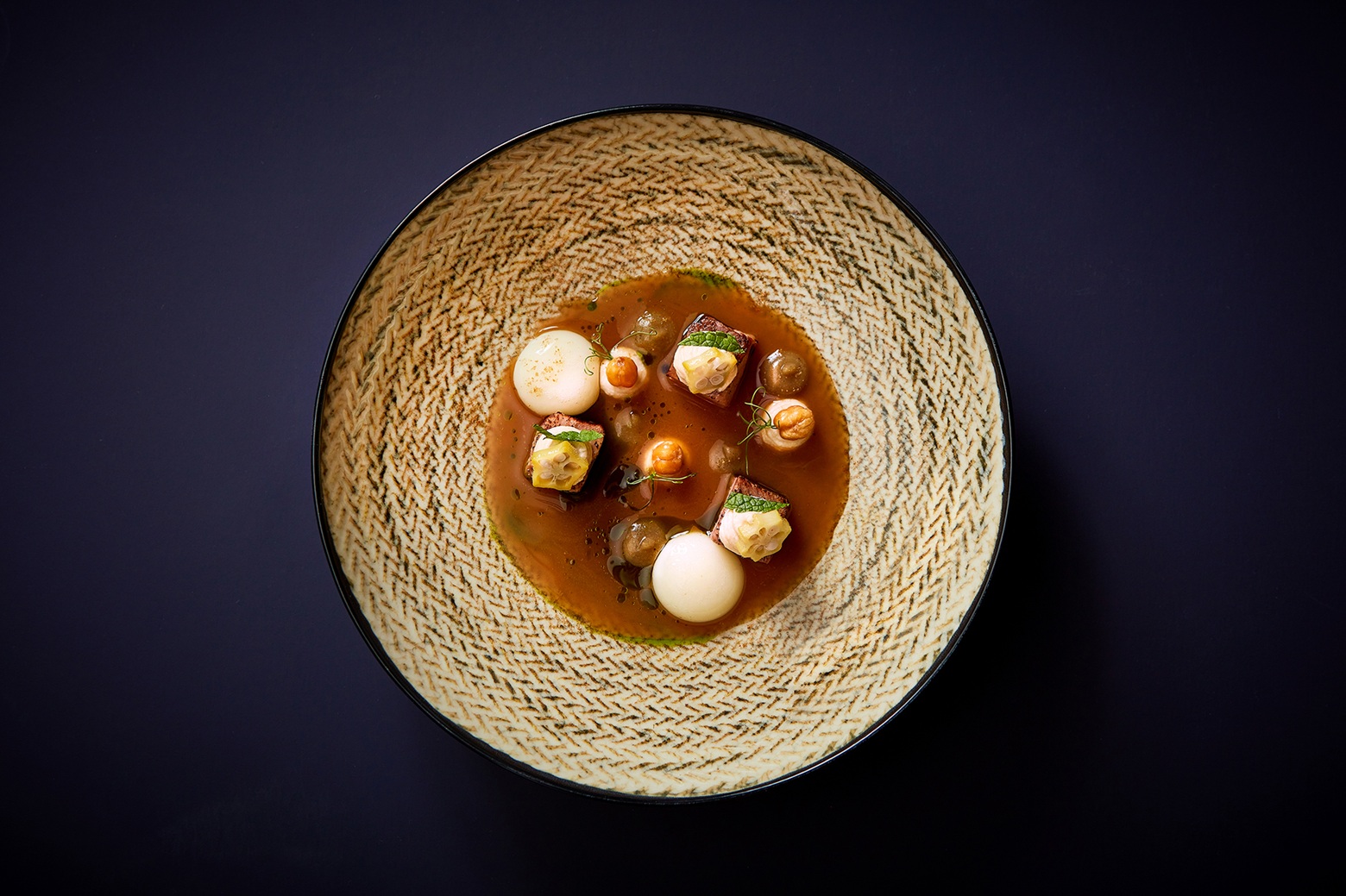
At first glance, the bowl looks less like soup than a constellation. Amber broth gathers in the center of a wide, dark-edged vessel. Chickpeas, cross-sections of okra, neat vegetable-and-meat forms, and two pale spheres hold their distance from one another. Even the cream glaze around them is marked with hundreds of fine brown strokes. The composition is called Etchmiadzin soup.[2][7]
This is Renommée in Yerevan, and the image contains the restaurant’s whole risk. Separation may reveal the shape, texture, and flavor of each element—or it may dismantle the warmth that made a lamb-and-vegetable soup worth remembering. Chef Karen Khachatryan’s more interesting project is to make an imported grammar of tasting menus, private lifts, frock-coat service, and precision tools answer to Armenia: its broths, fruit, herbs, dairy, long cooking, and sense of hospitality.
Renommée named the menu it introduced in spring 2025 The Fifth Season. The name could invite the usual luxury fog: a season outside ordinary time, available only after stepping into a 26-seat room. Yet the menu is most persuasive when the fifth season means something more exact. It is the moment when Armenia’s four natural seasons pass through memory and technique, then return to the table recognizably altered but not erased.[1]
This is a reported restaurant profile based on the venue’s published material, Khachatryan’s interviews, current independent reporting, and industry records—not a claim to have eaten the menu. That distinction matters here. Renommée’s concept is unusually legible; the consistency, pleasure, value, and pacing of any particular dinner can only be judged in the room.
Image context: the cover is a real photograph of Renommée’s Etchmiadzin soup, published with Alexey Dudin’s May 2026 interview with Khachatryan. It shows the actual course at the center of this profile’s argument, not a generic luxury still life.[7]
The lift changes the register
Renommée does not ease a diner into formality. A private lift delivers guests to two minimalist salons. There are 26 seats, evening service, advance reservations, and waiters in formal coats.[1][2] The restaurant’s French name means renown or reputation; even before the first course, its language says that Yerevan can sustain a room built to the familiar codes of European haute cuisine.
That declaration was sharper when Renommée opened in 2021. Khachatryan described an author-led set menu of 10 to 12 courses, long preparation sequences, and classical recipes reworked with the tools of molecular cooking. He had trained and worked abroad, including in Michelin-starred restaurants, but said the creation of the Yeremyan Academy of Culinary Arts and Hospitality pulled him back to Armenia. The restaurant gave him the kitchen format he had imagined elsewhere, now with the crucial difference that he could author it at home.[3]
There is an easy, unhelpful way to tell this story: international technique “elevates” Armenian food. That verb places the food at the bottom of a ladder and the imported format at the top. Renommée is more interesting when the traffic runs both ways. The lift may rise, but the cuisine should not have to leave Armenia behind when it reaches the dining room.
The formal shell therefore creates a useful pressure test. If the menu could be detached from Yerevan and served unchanged in any ambitious hotel dining room, the frock coats have won. If Armenian ingredients, dish structures, and habits of welcome actually determine what the techniques do, the shell has become a tool.
The fifth season is memory under pressure
The restaurant introduced The Fifth Season in spring 2025. Its own description folds spring’s awakening, summer’s heat, autumn’s abundance, and winter’s stillness into one sequence inspired by Armenia’s landscapes and ingredients.[1] That is lyrical menu language, not evidence of flavor. The concrete dishes reported in 2026 give it weight.
One course puts smoked sturgeon and caviar on a delicate cheesecake. Another takes apart etchmiadzin, a lamb-and-vegetable soup, placing chickpeas, okra, and eggplant apart from the broth. Honey-glazed quail arrives with black truffles from forests near Dilijan.[2][8] Read together, the dishes show three different relations to place.
The sturgeon course works by collision: fish, salinity, smoke, and the creamy architecture of a cheesecake meet on deliberately cosmopolitan ground. The quail works by concentration, pulling sweetness, game, and the dark perfume of a local forest into one small plate. The soup is the sternest test. Once broth and vegetables are separated, technical clarity can expose each component—but it can also dismantle the warmth and generosity that made the original dish coherent.
Deconstruction earns its keep only if reassembly happens in the mouth. A diner should be able to feel why the chickpea, okra, eggplant, lamb, and liquid once belonged together, not merely admire their new spacing. The old dish must remain the source of tension. Otherwise “etchmiadzin” becomes a label attached to an arrangement that no longer needs it.
Khachatryan draws almost exactly that boundary. In a May 2026 interview, he described modern Armenian cooking as preserving the character of a flavor while expressing it through contemporary technique and presentation. Traditional preparations that take a long time, he argued, should be reorganized for restaurant service without rushing away their depth or structure.[7] The photographed soup makes that principle testable rather than abstract.
This is why fifth season is a better idea than it first appears. Memory does not preserve food under glass. It edits: one aroma becomes louder, a texture moves forward, a family-sized pot contracts into a composed course. Khachatryan’s menu can claim an extra season when that editing reveals a relationship already present in the food. It cannot manufacture one by adding smoke or caviar after the fact.
Imported tools, Armenian authorship
Khachatryan’s original menu was called The Way of Taste. In his 2021 account, traditional recipes passed through long technical processes and molecular methods; Armenian and foreign products could occupy the same course. His stated ambition was not just to open a polished restaurant, but to make Renommée a culinary visiting card for Armenia.[3]
The phrase “visiting card” can produce timid cooking—a national sampler designed to be instantly understood by outsiders. The Fifth Season suggests a more confident move. It does not need every course to carry a flag. It needs the menu’s decisions to come from an Armenian center of gravity.
That distinction is visible in the best documented examples. A truffle is not interesting merely because it is expensive; its origin near Dilijan gives the quail a forested address. Smoke is not automatically local; it becomes meaningful when the fuel, ingredient, aroma, and service gesture tell the same story. Caviar does not certify seriousness. Paired with smoked sturgeon, it can extend the fish’s salinity and smoke—or overwhelm it with a symbol of luxury.[2]
The restaurant’s task is therefore harder than authenticity theater. It must be fluent in global fine-dining technique without letting fluency flatten accent. Every immaculate course faces a simple question: could this plate exist exactly this way somewhere else? If the answer is yes, the menu has produced international style. If the answer is no because its internal logic depends on an Armenian broth, landscape, preservation habit, ingredient, or memory, Renommée has produced authorship.
The academy is the restaurant’s second dining room
Khachatryan is not only Renommée’s chef. He leads the culinary-arts program at Yeremyan Academy, founded in 2019 to train professionals for Armenia’s hospitality industry. Its current courses join theory and kitchen practice: taste perception, food chemistry, hygiene systems, recipe design, team communication, and contemporary equipment all sit in the same curriculum.[1][5][6]
That second job changes the scale of the profile. A 26-seat restaurant can create rare experiences; an academy can make technique reproducible. One depends on a chef’s presence, the other on whether knowledge can leave his hands without becoming a pale copy. If Renommée aims to be a national visiting card, the teaching program is arguably more important than the card’s gold lettering.
The parent company supplies another layer of infrastructure. Yeremyan Projects began developing a “From Seed to Table” agricultural system before Renommée opened, including livestock and dairy production intended to give its restaurant group more control over ingredient quality.[6] That does not prove that every item on The Fifth Season is local, or that ownership automatically produces better flavor. It does show that the restaurant sits inside a larger attempt to connect farms, professional education, production, and dining rooms rather than treating haute cuisine as an isolated performance.
The strongest version of Renommée is thus not a lone auteur importing a finished model. It is a small public stage above a deeper system: growers and processors making ingredients dependable, an academy teaching cooks and service professionals, and a dining room showing what those capabilities can become at maximum concentration. The fifth season is institutional as well as culinary. It is the extra time created when skills survive one menu.
An award is a spotlight, not a verdict
In February 2026, WHERETOEAT Armenia ranked Renommée first in its national top ten and named Khachatryan Chef of the Year. A few months later, Condé Nast Traveller Middle East called it Yerevan’s prime fine-dining venue and documented the current dishes, room, and service.[2][4] Together, those notices explain why the restaurant matters now: a concept launched in 2021 has moved from declaring its ambition to receiving current outside attention for a more mature menu.
Neither source settles the experience. An industry ranking compresses many judgments into an ordered list; a travel guide offers one writer’s visit. Renommée’s own site and its parent company provide the richest account of philosophy and infrastructure, but they are interested parties.[1][6] None of these sources can establish night-to-night consistency, whether each technical reveal tastes as good as it looks, or whether a long procession remains pleasurable after the novelty of the first surprise.
The boundary is productive. It keeps the profile focused on what can be supported: Renommée has a distinctive small-room format, a chef who returned to cook and teach in Armenia, a live menu whose courses continue a seasonal national argument, and a business ecosystem capable of training people and controlling parts of its supply. The final verdict still belongs to dinner.
What a visiting card should reveal
A visiting card normally reduces a person to polished essentials: name, title, address. Renommée is trying to make one for a cuisine that resists reduction. Armenia appears here not as a parade of canonical dishes, but as broth separated and remembered, fish carried through smoke, forest truffle against honeyed bird, and professional knowledge returned from abroad to a Yerevan classroom.
In the photograph, broth pools between ingredients that a traditional pot would let mingle. The arrangement is beautiful, but beauty is the beginning of the question, not its answer. Does the separation make lamb, chickpea, okra, and eggplant more vivid? Does the first spoonful put their relationships back together? Does the dish still offer the emotional legibility Khachatryan says good cooking should possess?[7]
That is the standard The Fifth Season sets for itself. Renommée does not need to prove that Armenia can imitate an established fine-dining world. Its more exciting possibility is the reverse: to make that world’s lift, tasting sequence, technical equipment, and tableside theater speak with an Armenian accent they could not have acquired anywhere else.
Sources
- Renommée, “Exceptional Flavors of Armenian Products in Haute Cuisine” — the spring 2025 Fifth Season concept, 26-seat format, evening service, chef biography, and academy role.
- John Brunton, “A guide to the best restaurants in Yerevan.” Condé Nast Traveller Middle East, June 22, 2026 — independent room, service, and dish observations.
- Mediamax/Gastrovino, “Karen Khachatryan: Our team seeks to make ‘Renommée’ Armenia’s visiting card,” October 18, 2021 — the chef’s return, original menu format, technical approach, and national ambition.
- WHERETOEAT, “WHERETOEAT ARMENIA 2026: Results,” February 26, 2026 — national restaurant ranking and Chef of the Year result.
- Yeremyan Academy, “Culinary Arts” — current course structure, theory-and-practice model, hygiene, communication, recipe design, and contemporary kitchen techniques.
- Armenpress, “Seed to Table: Yeremyan Projects—Armenia’s top restaurant company introduces its innovative concept,” January 29, 2020 — agricultural strategy, academy context, and ingredient-control rationale for the restaurant group.
- Alexey Dudin, “Technique, Aesthetics, and Emotion.” WHERETOEAT, May 29, 2026 — Khachatryan on modern Armenian cuisine, adapting long preparations, teaching, current recognition, and the source of the Etchmiadzin soup photograph.
- Renommée, current menu — live course list confirming Etchmiadzin soup, smoked sturgeon cheesecake, quail, truffle, Armenian greens, and the wider sequence (accessed July 17, 2026).