At Forum, the dangerous sentence is “While we are here, we should also try…” It can turn a poised Cantonese meal into a parade of expensive nouns: abalone, lobster, grouper, crab, fish maw, bird's nest, perhaps one more luxury from the next page. The round table fills. Every dish is prestigious. Nothing gets to be the point.
The point should be one abalone.
Forum has occupied Hong Kong's fine-dining imagination since Yeung Koon-yat co-founded the restaurant in 1977 and made dried abalone his life's specialty. The restaurant now sits in Sino Plaza in Causeway Bay, and the Michelin Guide still identifies Yeung's Ah Yat braised abalone as the dish that draws diners from far beyond the city.[5] Current chef Adam Wong Lung-to has been explicit about continuity: the abalone, Forum fried rice, and dried-mandarin-peel sweet-and-sour pork remain because guests come for those signatures, not for novelty pasted over them.[7]
That gives a first-time diner a useful rule. Choose the format before choosing the dishes. Then let the abalone set the meal's gravity. Everything else should either sharpen it, lighten it, or carry away the last of its sauce.
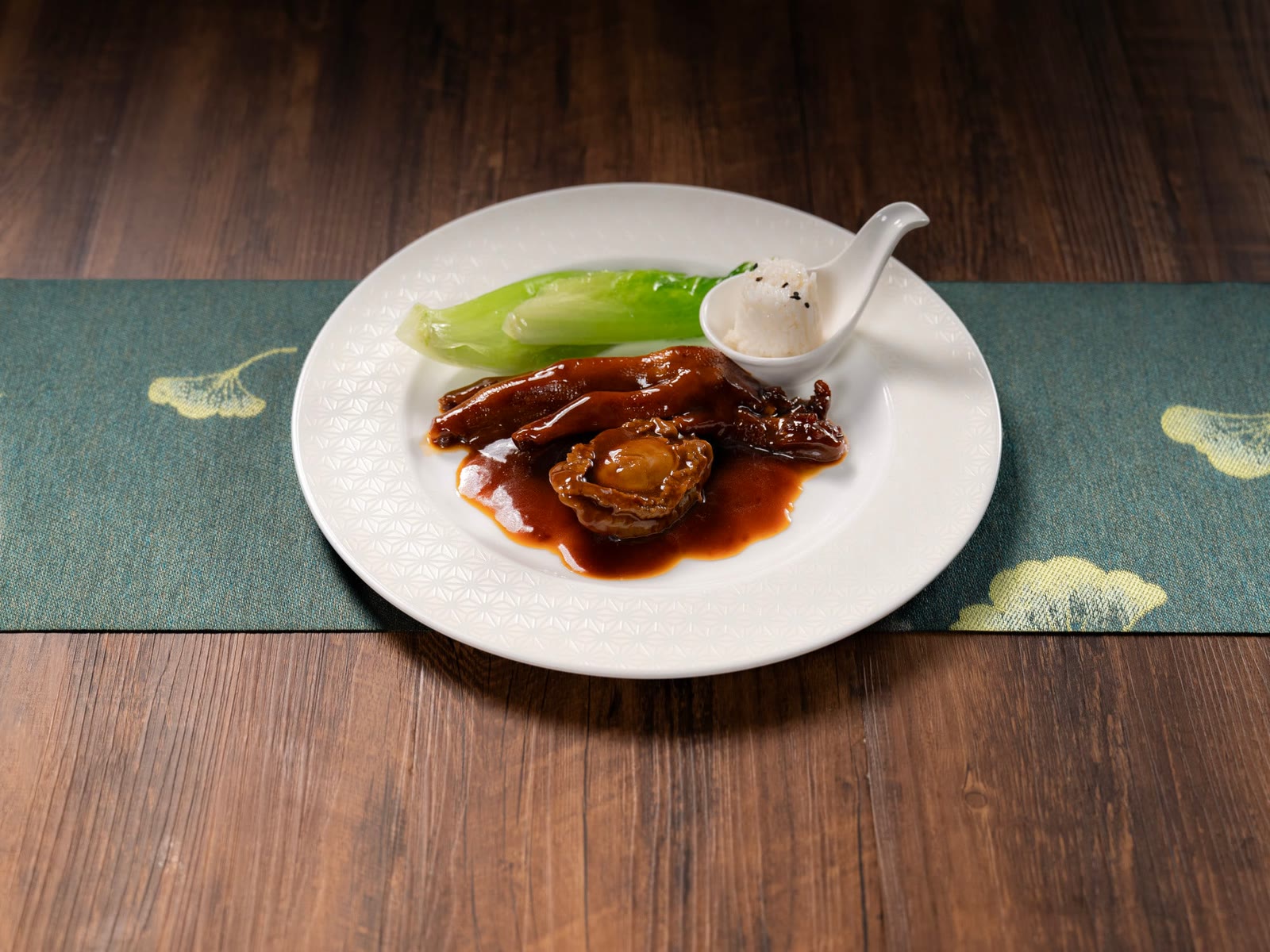
Image context: the cover is a genuine Forum dish photograph, not a generated luxury still. The abalone is glossy and almost austere at the center; goose web, green vegetables, and a deliberately tiny ball of rice sit around it. That small starch is the photograph's best ordering advice: save room, but waste none of the sauce.[7]
First choose lunch, à la carte, or the trophy set
Forum's own menu hub currently labels both its à la carte menu and its set-and-banquet menus as requiring pre-order.[1] Treat that as more than a logistical footnote. This is a restaurant where the reservation call is the first act of ordering. Say that it is your first visit, say that the abalone is the reason, give the party size and dietary boundaries, and ask which menu can deliver the house signatures without unnecessary duplication.
For a first visit, the weekday business lunch is the cleanest edited route. The set menu posted in March 2026 is HK$1,200 per person, plus 10 percent service, and is offered Monday through Friday at lunch except public holidays. It moves through a dim sum trio and slow-boiled soup before a Japanese Yoshihama dried abalone identified on the menu as 38 pieces per catty. Baked sea whelk with Portuguese curry, soy-scented chicken, fish-maw vermicelli in abalone sauce, sweet soup, and petits fours complete the sequence.[2]
This is not the cheapest possible way into Forum, and it is not a miniature tasting menu pretending to be dinner. It is useful because it gives the signature mollusc a complete Cantonese frame: steamed dough and filling, clear broth, long braise, baked richness, poultry, slippery vermicelli, then sweetness. The abalone remains the hinge rather than one luxury among eight.
The current Michelin three-star set, by contrast, is HK$2,880 per person before service. Its 38-piece-per-catty abalone can be upgraded to a larger 28-piece grade for another HK$1,200. Around it come lobster toast, shark-fin soup, bird's nest with egg white, crab and caviar, grouper, stuffed poultry, fish-maw vermicelli, and dessert.[2] Order that menu if this exact register of banquet luxury is what the table wants. Do not order it merely because the name makes it sound like the safest route to understanding the restaurant. It is the widest prestige statement, not necessarily the clearest portrait.
À la carte is the best dinner choice for four or more diners who enjoy editing together. It offers the most control, but only if the table refuses completionism. Pre-order the abalone, then build three or four contrasts around it. If the group cannot agree on what to leave out, the set lunch is the wiser piece of hospitality.
Give the abalone its own silence
Forum's signature page describes a sauce architecture involving shiitake mushroom, premium ham, rich chicken stock, sea cucumber, and goose foot around the abalone.[4] The exact pleasure is not simply softness. Properly braised dried abalone should retain enough resilience to make the bite feel substantial while carrying a sauce with the depth and cling of a reduction. Michelin's current listing pairs the words “tender” and “flavourful”; the cover photograph explains why both matter. A tender ingredient without structure would disappear beneath that glaze. A firm one without absorption would leave sauce and mollusc tasting like strangers.[5][7]
Order one portion per diner rather than treating it as a token for the table to dissect. This is the expensive exception to the guide's share-everything instinct. A whole piece lets each person feel the outside, the denser center, the sauce, the goose web, and the small rice accompaniment in a deliberate order. Passing one sliced specimen around may prove that everyone tasted it, but it weakens the course's rhythm.
Do not rush to compare grades as if a lower pieces-per-catty number automatically buys a proportionally better experience. The current menus show that size carries a steep premium.[2] Size changes thickness, mouthfeel, and ceremony; it does not rescue a table that has already ordered too much. For a first visit, the included 38-piece grade in the business lunch is a coherent baseline. Upgrade only if abalone size itself is the evening's subject and the price has been confirmed at booking.
Build contrast, not an inventory
After the braise, the meal needs edges. Forum's own signature collection provides two excellent ones. Its crispy chicken is dried for hours, marinated, then repeatedly bathed in boiling oil so the skin tightens while the meat stays juicy. Its sweet-and-sour pork uses dried mandarin peel to put fragrance and bitterness behind the glaze.[4] The 2026 edition of 100 Top Tables also singles out the chicken, the pork, and a shrimp-stuffed chicken wing alongside the abalone.[6]
For four diners, choose the chicken or the pork, not automatically both. Pick chicken when the table wants clean crackle and relatively direct seasoning after the dark braise. Pick the pork when it wants a brighter, stickier course whose citrus peel can interrupt the abalone sauce's long bass note. With six diners, both become reasonable because each can land as a contrast instead of a second main event.
Next, choose one further seafood idea. Michelin points to pan-seared leopard coral grouper and baked stuffed crab shell.[5] The crab is the richer path—sweet meat, shell presentation, baked top. The grouper is the cleaner path, especially if the table has already chosen sweet-and-sour pork. Ordering lobster, crab, grouper, and abalone together may sound celebratory, but it converts distinct textures into expensive background traffic.
Finish the savory order with a green vegetable and one starch. Forum fried rice has become a signature in its own right under Wong's stewardship, while the business lunch uses vermicelli to extend the abalone sauce.[6][7] Choose rice if the table wants a dry, fragrant finish; choose vermicelli if it wants the braise to echo. There is rarely a reason to order both on a first visit.
Tea deserves the same restraint. The current dim sum list offers aged pu'er, Tie Guan Yin, jasmine, Longjing, chrysanthemum, and Shou Mei at HK$30 per person.[3] Aged pu'er is a natural choice for a rich, long meal, but this is preference rather than doctrine. The practical move is to choose one tea for the table before opening the wine discussion. Forum has a serious wine list, yet a bottle should serve the order you actually made—not the prestige of the room.
Use dim sum as an opening, not a second meal
Lunch creates another temptation: the four-page dim sum list. It includes Forum's shrimp dumpling with pork, fish-soup turnip cake, rice rolls, an abalone pancake with chicken, pork and mushroom, and several dumplings served in supreme soup.[3] These are not filler. They can also erase appetite before the course that justified the booking.
If taking the business lunch, accept its three-piece dim sum opening and stop there on a first pass. If ordering à la carte at lunch with four people, choose two contrasting items rather than a survey—one steamed dumpling and one pan-fried or rice-roll preparation. The abalone pancake is clever but redundant when a whole braised abalone is coming. It turns the signature into a preview when the meal needs anticipation.
A dim sum-only visit is valid if the purpose is specifically lunch craft or a lower-commitment return. It is not the clearest introduction to Forum's identity. Both Michelin and the restaurant's recent profiles keep returning to the dried abalone, then to a small circle of poultry, pork, seafood, and rice signatures.[5][6][7] Believe that repetition.
What to skip
Skip any fixed menu whose ingredients you would rather not eat. The currently posted luxury sets include shark fin and bird's nest, while Forum says pre-ordering is required.[1][2] Raise dietary, ethical, allergy, and texture boundaries before the day of the meal; do not arrive expecting a tightly composed banquet menu to become a different menu without consequence.
Skip the larger abalone upgrade if the table is already wavering at the base price. A bigger piece is a sensory choice, not an admission ticket to the “real” Forum.
Skip stacking the crispy chicken, sweet-and-sour pork, stuffed chicken wing, lobster, crab shell, grouper, fried rice, and extra dim sum just because each appears on a best-of list. A restaurant can have several signatures. A single table does not need to hold all of them at once.
And skip treating the sauce as collateral. The small rice ball in Forum's own abalone photograph is almost comic beside the glossy mollusc, but it carries the final lesson.[7] Luxury is not proved by leaving abundance behind. Take the last sauce seriously.
The clean first order
For two diners on a weekday, book the business lunch, confirm the current price and composition, disclose restrictions, and ask whether the posted abalone grade remains the one being served. Take the included dim sum trio, choose tea, and resist adding à la carte dishes before the menu begins.[1][2][3]
For four diners at dinner, pre-order one braised dried abalone per person. Add either crispy chicken or dried-mandarin-peel sweet-and-sour pork; either stuffed crab shell or pan-seared grouper; one green vegetable; and either Forum fried rice or vermicelli in abalone sauce.[4][5][6] If the party grows to six, add the second crisp meat before adding a third luxury seafood.
That order leaves space for the room to feel generous rather than congested. More importantly, it makes Forum legible. Yeung Koon-yat built the restaurant's reputation by concentrating on one difficult ingredient, and Wong has preserved that center rather than disguising it as nostalgia.[6][7] The best first meal should show the same confidence.
One abalone. A few deliberate contrasts. Enough rice for the sauce. Then stop.
Sources
- Forum Restaurant, “Menu” — official menu hub identifying current à la carte, set, seasonal, dim sum, takeaway, wine, and tea lists, including the pre-order requirement.
- Forum Restaurant, Set Menu, posted March 2026 — current business-lunch and luxury-set compositions, prices, service charge, abalone grades, and weekday availability.
- Forum Restaurant, Dim Sum Menu, posted March 2026 — current steamed, fried, rice-roll, specialty, dessert, and tea selections with prices.
- Forum Restaurant, “Signature Dish” — official descriptions of the abalone, crispy chicken, dried-mandarin-peel sweet-and-sour pork, oxtail, and fried rice.
- The MICHELIN Guide, “Forum — Hong Kong” — current restaurant listing, hours, three-star status, Ah Yat abalone, grouper, crab-shell, and wine-list notes.
- South China Morning Post, “100 Top Tables 2026: Forum Restaurant” — current service, menu, signature-dish, private-room, and price-per-head context.
- Winnie Chung, “Celebrating Hong Kong's ‘abalone king’ Yeung Koon-yat, chef Adam Wong recalls his mentor.” South China Morning Post, July 26, 2024 — succession, signature continuity, and the Forum-supplied abalone photograph used as the article image.