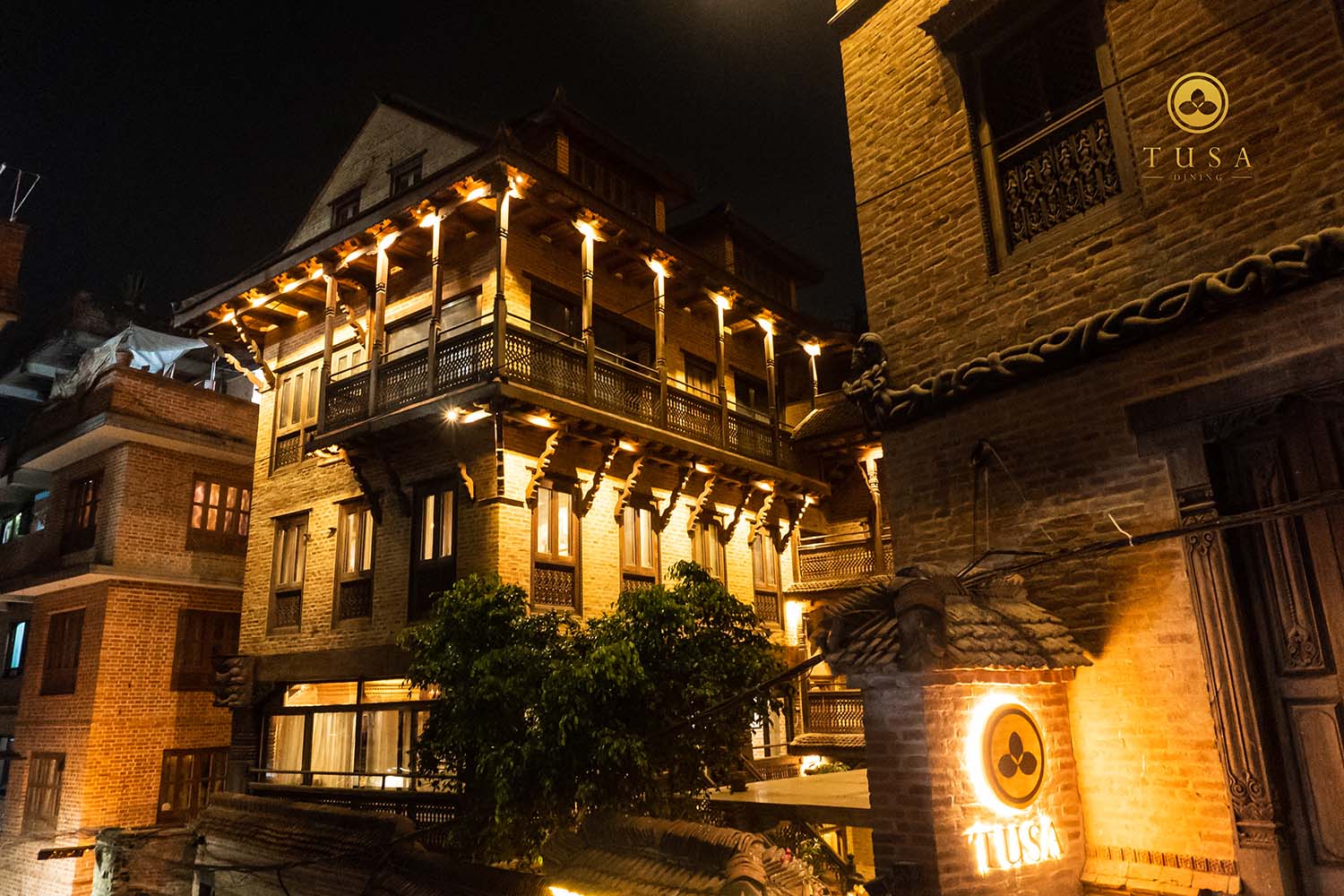
In a 2026 photograph, Tusa glows at the end of a Bhaktapur lane: carved timber, red brick, a small gold sign and warm light held against the night.[3] The image makes the restaurant look settled into its heritage building. Its price history is less serene.
When Nepali Times reported on Tusa just after it opened in April 2024, the tasting menu cost NPR 3,500. Tusa’s current reservation page lists its dining experience at NPR 7,500 per person, including VAT.[1][4] That is an increase of NPR 4,000, or 114.3 percent in nominal rupees. The advertised ticket has more than doubled.
The arithmetic is clean. Almost every tempting inference from it is not.
It does not prove that Tusa’s profit margin doubled. It does not show that the present meal is overpriced, that the opening meal was underpriced, or that general inflation explains the difference. The two published prices do not even describe identical products: the opening report recorded six courses plus surprises, while the current restaurant page promises seven courses over about ninety minutes.[1][4] The old report does not specify whether its figure included tax, how long dinner took or whether NPR 3,500 was intended as a launch price.
This is therefore not a review pretending to have eaten the difference. It is a source-led value audit: what the current NPR 7,500 definitely buys, what changed in the public description, and where the evidence runs out.
First, keep four numbers apart
Price is the number Tusa publishes. Value is what a particular diner receives relative to the money and constraints. Cost is what the restaurant spends to produce the experience. Margin is what remains after relevant costs. Only the first is fully visible here.
Even the 114.3 percent figure needs its full label: it is a nominal comparison between a price reported near opening in 2024 and a live advertised price checked on September 4, 2026. Calling it a 114.3 percent increase in “value” would assume the meal stood still. Calling it a 114.3 percent increase in margin would assume the costs stood still too. Neither assumption is supported.
Dividing each price by its stated course count would add false precision. “Six courses, plus surprises” has no reliable denominator, and a course is not a standard unit of food, labor or pleasure.[4] A bite shaped around a preserved ingredient and a composed main may each count as one while consuming radically different resources. Course arithmetic can describe menu structure; it cannot normalize unlike dinners.
What can be said is narrower and more useful: the financial threshold to enter Tusa’s base experience is now 2.14 times the reported opening ticket. A diner can decide whether the current offer clears that threshold without inventing a story about why management set it.
There was at least one step between those endpoints. A Buddha Air food guide published in 2025 described a seven-course, roughly ninety-minute Tusa experience at NPR 4,500.[5] The current ticket is 66.7 percent higher than that intervening figure. This is a closer comparison of advertised formats, but still not an identical-product test: the 2025 account does not state its tax basis or disclose portions and ingredient costs. More importantly, it shows that NPR 3,500 to NPR 7,500 should not be narrated as one documented overnight increase. The sources provide snapshots, not a complete price ledger.
NPR 7,500 buys a disclosed envelope
Tusa currently promises a seven-course surprise menu lasting approximately one and a half hours for lunch or dinner. The price includes VAT. The restaurant recommends reserving at least twenty-four hours ahead, requires a 50 percent advance payment and says cancellations within twelve hours attract a 25 percent charge. Outside beverages are not permitted.[1]
Those details define more of the purchase than a gallery of old dishes does. For one diner at the listed base price, 50 percent is NPR 3,750; confirm the payment amount and refund mechanics with Tusa. The time commitment is compact by tasting-menu standards, at least on the restaurant’s estimate. The kitchen controls the sequence. The guest accepts seasonality and surprise.
Some important edges remain blurry. The cancellation page does not say what the 25 percent is calculated from or how that charge interacts with the advance payment. It offers rescheduling subject to availability but does not publish complete refund mechanics.[1] Those are not reasons to assume the worst. They are reasons to clarify the terms before transferring money, especially for a traveler whose plans depend on traffic or flights.
Tusa also lists NPR 12,000 per person “with wine.” The difference from the base experience is NPR 4,500, equal to 60 percent of the base ticket. Yet the same page does not state how many wines are served, their pour sizes, regions or whether VAT is included in that total.[1] Without those details, NPR 12,000 is a clear listed figure but not an analyzable wine value. Ask what “with wine” contains; do not promote it in your head into a documented pairing.
Surprise transfers one kind of risk to the diner
Tusa explicitly says it does not follow a fixed menu. Seasonal availability and the chefs’ choices determine the meal.[1] A June 2026 profile in The Kathmandu Post reported that the menu changes roughly four times a year and described recent ideas involving sisno, chyakhla and rhododendron.[3] The opening story two years earlier recorded fermented potato-and-millet roti, charred fish in broth and batuk chukauni among a much longer procession.[4]
These dishes reveal a method, not an order sheet. The old and newer examples show the chefs using fermentation, live fire and contemporary restaurant technique to reconsider ingredients and preparations found across Nepal.[3][4] None is guaranteed on the night of a future reservation.
That distinction creates a simple value test. Tusa is a better fit if discovery itself is part of what you want to buy: seven decisions made by the kitchen, explained in person, with no need to secure one famous plate. It is a weaker fit if the entire trip is organized around tasting the sisno cake seen in an article, if à la carte control matters, or if ninety minutes sounds compressed rather than focused. Surprise does not add or subtract value by itself. It changes who bears the risk of mismatch.
The current description is strong on format and weak on exact content by design. A prudent guest should disclose allergies and restrictions before paying and ask whether the day’s menu can accommodate them. The public page’s silence on a particular substitution is not a promise that the kitchen can make it.
The operation has a cost story, but not a cost sheet
The public record offers plausible reasons why Tusa is not pricing only raw ingredients. At opening, Nepali Times reported that founders Parashuram Pathak, Rupesh Bohara and Sagar Shrestha had spent five years traveling through Nepal for menu research. It described a 28-seat restaurant with a live kitchen, locally made furniture, ceramics and grill, plus equipment for sous-vide cooking, dehydration and fermentation.[4] Tusa’s own account places the operation across three levels of Basuki Ghar, with a café, bar and terrace below, an open wood-fire grill above and production space in the basement.[2]
The 2026 Kathmandu Post profile extends that visible story. It reports research trips to places including Dolpa, Jiri, Jhapa, Ilam and Sankhuwasabha, and it describes the difficulty of obtaining some local and ethnically specific ingredients through dependable commercial channels. Chefs brief diners on the stories behind courses, so explanation is part of the service rather than text left on a menu.[3]
Research time, small-scale sourcing, skilled labor, equipment, fire, preservation and a low seat count can all be expensive. That sentence is still not an income statement. None of the cited sources discloses current payroll, rent, food cost, wastage, research budgets, covers, capital repayment or owner compensation. The reports do not show which expense—if any—accounts for the NPR 4,000 increase. Nor do they reveal whether the restaurant’s margin expanded, contracted or stayed similar.
It would be equally careless to dismiss the fieldwork as marketing and to declare that every extra rupee reaches a remote producer. The first claim ignores reported activity; the second invents a flow of money no source traces. The honest middle is that Tusa has built a labor- and research-intensive public proposition, while the price alone cannot verify how that proposition is financed.
Do not charge the restaurant for the wrong category
There is another complication in calling NPR 7,500 a fine-dining price. Tusa’s founders told The Kathmandu Post that they prefer “modern-progressive” Nepali food and do not themselves regard the restaurant as fine dining; in their view, Nepal’s scene is still early in that journey.[3] This article belongs to a fine-dining series because Tusa uses the tasting-menu form, reservation controls, course narration and internationally trained technique associated with that market. The category is an editorial lens, not a title the founders claimed.
That matters to value. A diner expecting a local replica of an established European luxury code may be evaluating a product Tusa has not promised. The more relevant questions are whether the seasonal sequence is coherent, whether the ingredient stories carry real specificity, whether technique clarifies rather than erases the food, and whether ninety minutes allows service to make those connections. Documents cannot answer those questions about execution. They can show that the questions are central to the offer.
The booking verdict
At NPR 7,500, Tusa sells a clearly bounded base experience: seven surprise courses, roughly ninety minutes, VAT included, with advance payment and restrictive beverage terms.[1] That is enough information to test personal fit. It is not enough to grade dinner before it happens.
The opening price is useful as history, not as a verdict. It proves that the advertised threshold has risen sharply while the documented format has also changed. It should prompt questions about the current product; it cannot answer questions about profit.
Book if the seasonal unknown is an attraction, the compact duration suits the evening and the restaurant’s research-led account of Nepali ingredients is the reason for going. Pause if one archived dish, flexible ordering, outside wine or forgiving cancellation terms is essential. If considering the NPR 12,000 wine experience, obtain the missing details first.
Tusa’s price has more than doubled. That fact deserves to be stated without euphemism. Its margin remains invisible. That limit deserves equal prominence, because honest value analysis begins where easy arithmetic stops.
Sources
- Tusa Nepal, “Reservation Form” (accessed September 4, 2026) — current official price, VAT language, seven-course duration, surprise-menu policy, advance payment, cancellation, wine and outside-beverage terms.
- Tusa Nepal, “Our Story” (accessed September 4, 2026) — the restaurant’s official account of Basuki Ghar, its kitchens, research framing and ingredient vocabulary.
- Mokshyada Thapa, “From sisno to sorbet: Inside Tusa’s effort to reimagine Nepali food,” The Kathmandu Post (June 12, 2026) — reporting on seasonal menu changes, sourcing constraints, research travel, course narration, the founders’ “modern-progressive” framing and the Axis Studio photograph.
- Vishad Raj Onta, “The return of the natives,” Nepali Times (April 20, 2024) — opening report used for the NPR 3,500 price, six-course-plus-surprises format, founders’ fieldwork, seat count, kitchen and equipment.
- Buddha Air, “Delicious Nepal: Best Nepali Cuisines” (December 12, 2025) — an intervening report of Tusa’s NPR 4,500 price, seven-course format, approximate ninety-minute duration and reservation terms.