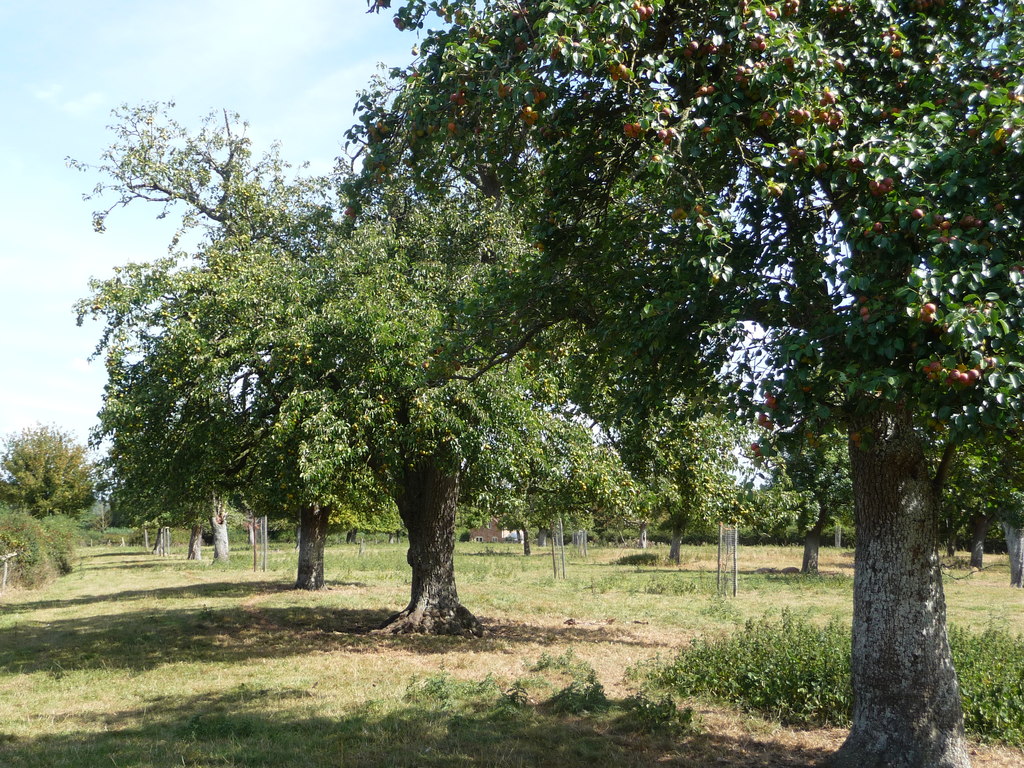
The trees are the first surprise. In Richard Greenwood's photograph of the perry pear orchard at Wick Court, they stand tall enough to make the grass beneath them feel like a room. Their trunks are irregular, their crowns meet overhead, and nothing about the scene resembles the quick turnover of a restaurant bar.[7]
Then the drink arrives: pale gold, perhaps still, perhaps sparkling, often carrying a soft suggestion of sweetness even when the maker has fermented it dry. Say “pear” at the table and many guests will mentally send the glass to dessert. Say “cider” and they may expect an apple drink with added pear flavor. Traditional perry is more interesting than either shortcut. Its useful pairing vocabulary is acid, tannin, sweetness, aroma and pressure—the same structural language a sommelier already uses for wine.
That makes perry unusually well suited to the awkward passages of a tasting menu: the opening bite that needs lift but not Champagne grandeur; the green or lactic course that makes a conventional white wine feel obvious; the move from shellfish toward poultry; even the cheese course that needs freshness more than weight. The trick is to stop pairing the word pear and start pairing the liquid in the glass.
Dry is not the opposite of sweet
Perry's most useful complication begins with sorbitol. Perry pears contain this sweet-tasting sugar alcohol, and ordinary wine yeasts generally leave it behind. The Beer Judge Certification Program's technical guide describes sorbitol as a reason even a fully fermented perry can retain an impression of sweetness.[2] The protected specification for Traditional Welsh Perry makes the same sensory point from a different direction: pear fruit and natural sweetness can sit alongside citrus acidity, tannic body and either a crisp-dry or predominantly sweet finish.[1]
This does not mean every perry is sweet, or that the word “dry” on a list is meaningless. Residual fermentable sugar, sorbitol, acid, tannin, alcohol and carbonation contribute different signals. A wine-style dry perry can finish cleanly while still feeling rounder than its fermentable-sugar analysis might lead a guest to expect. A keeved, bottle-conditioned perry may preserve actual fruit sugar as well. Those are different drinks and should not be sold under one foggy description.
The range is visible in the Welsh specification. Traditional Welsh Perry can be still, bottle-conditioned or bottle-fermented. Bottle conditioning produces a gentler 1.5 to 3 bar of pressure at 0°C in the specification, while bottle fermentation reaches 4 to 6 bar and ferments the added sugar used for the second fermentation to dryness. Within this protected specification, the permitted range is 3.00% to 8.49% ABV.[1] A still 6% perry and a dry, fully sparkling 8% perry may share fruit, yet they will pace a plate very differently.
One experimental study offers another boundary. Researchers making sparkling perry from small Abate Fétel pears found that changing the yeast-inoculation procedure altered which sensory words consumers chose—among them pear, floral, fermented, bitter and sparkling—even though all three primary fermentations reached 6% alcohol and the finished treatments received similar overall liking scores. Sorbitol did not decrease in the preliminary single-strain fermentations and did not differ among the three finished treatments.[4] It was one trial using a dessert cultivar, acidified must and controlled inoculation—not a traditional-perry-pear trial or a map of all perry. Its value here is narrower: fermentation choices can change the glass enough that “made from pears” is not a pairing instruction.
Let the first glass carry both fruit and edge
The opening course is where perry can escape the dessert trap most elegantly. A dry, bottle-fermented version can bring brisk bubbles, citrus-shaped acidity and a faint fruit softness without automatically importing Champagne's prestige script. The aim is not to impersonate sparkling wine. It is to use a different balance of familiar forces.
Imagine a crab custard with green apple and celery leaf, a raw scallop with a restrained chile oil, or a crisp vegetable tart with fresh goat cheese. The perry's acid can keep creaminess from lingering; its bubbles can interrupt a soft texture; a small amount of perceived sweetness can soften bitterness or heat. These are pairing proposals inferred from the drink's documented structure, not universal rules. The kitchen still has to taste the chosen bottle with the finished dish.
There is practical evidence for keeping the possibilities broad. Finnriver, which grows traditional perry varieties in Washington's Chimacum Valley, describes its current semi-dry perry as balancing sweetness with high tannin and acid, then recommends it with clam pasta, spicy young greens and antipasti rather than pudding.[5] That producer's bottle cannot stand in for the category. It does, however, puncture the lazy assumption that fermented pear belongs only beside pastry.
A Herefordshire pairing dinner at Newton Court made the same move in service. Its four-course program placed Black Mountain Perry with the introductory savory bites—pork scratchings with maple and apple glaze, or a beetroot-salted vegetarian version—before moving through other ciders with asparagus, roast pork or spiced cauliflower, and panna cotta.[6] The interesting detail is positional: perry occupied the introductory savory pairing. It was not held back as a sweet exclamation mark.
Tannin gives the middle of the menu somewhere to go
Fine-dining pairings often lose energy in the middle. The bright opening wines have done their work; the red is not yet welcome; a procession of increasingly serious whites can begin to feel like cellar hierarchy rather than attention to food. A still or lightly sparkling perry can occupy that hinge.
Purpose-grown perry pears are not simply dessert pears diverted into a fermenter. CAMRA notes that these varieties are selected for acid, tannin and aromatic properties, and that their names—Hendre Huffcap, Butt, Stinking Bishop—belong to a long, highly local history. The fruit can be awkward to process: pear pulp is often watery and may rest after crushing before it is pressed.[3] What seems delicate in the glass can therefore begin with fruit too astringent to enjoy at the table.
That tannin is the middle course's tool. In the right measure, it can give a pale drink enough grip for roast poultry skin, pork fat, mushrooms, toasted nuts or a firm cheese. Acidity keeps the pairing from settling into brown richness; pear aroma keeps it lifted; modest alcohol can prevent the menu's center from becoming a fatigue contest. A more delicate, low-tannin perry should stay with quieter food. A forceful bittersharp bottling can erase a subtle broth as efficiently as an overextracted red wine.
The best kitchen trial is therefore comparative. Pour a still perry, a gently conditioned one and a fully sparkling one beside the same savory plate. Taste them blind at service temperature. Ask which element changes: does the sauce feel cleaner, does bitterness stack, does the aroma disappear, does the bubble make a crisp garnish seem coarser? “Perry with poultry” is a category match. “This lightly conditioned perry lets the browned skin stay savory while lifting the cultured-cream sauce” is a pairing.
Do not make the cheese course inevitable
Pear, cheese and walnuts form such an intuitive trio that a sommelier can reach for it without tasting. Sometimes the match is lovely. Salt and fat can welcome sweetness; blue or washed-rind cheese can use the drink's acid; tannin can give a soft cheese a firmer outline. But an echo is not automatically a conversation. A pear garnish, pear-named drink and fruit-forward cheese accompaniment can turn one agreeable flavor into a theme repeated three times.
The more useful question is what the course lacks. A dense blue cheese may want an off-dry perry with enough sweetness to meet salt. A young goat cheese with herbs may prefer a drier, sharper bottle. A mature hard cheese may expose a very delicate perry as thin, while a high-tannin version may make both drink and rind feel severe. If the menu has already used perry with shellfish or poultry, there is no obligation to reprise it just because the trolley has arrived.
Dessert presents the same test. Sweet perry can work when it is at least as sweet as the dish and still carries sufficient acid. Dry perry beside a sugary pear tart is more likely to taste stripped and sour. The article's argument is not that perry should never finish a meal. It is that fruit origin does not assign course position. Structure does.
The list needs more than one word
Good service can rescue perry from two bad categories at once: novelty cider and inexpensive sparkling-wine substitute. The list should name the producer, place, pear variety or blend when known, sweetness level, carbonation method, vintage if relevant and bottle size. “Traditional perry, semi-dry, lightly sparkling” gives a guest a useful expectation. “Pear cider” does not.
Pouring needs similar care. A bottle-conditioned perry may carry yeast sediment and can cloud if handled roughly; the Welsh specification explicitly notes the need for a careful opening and pour.[1] That is not a defect to conceal, nor a tableside lecture to prolong. Stand the bottle, chill it enough to keep the fruit and pressure composed, use a clean wine glass rather than a pint vessel, and explain the sediment before the guest mistakes it for a service error.
Small pours suit the drink. They leave room to change style across a menu and acknowledge that bottle-fermented examples can sit at the upper end of the protected Welsh specification's 3.00% to 8.49% ABV range.[1] They also make a perry interlude feel deliberate rather than promotional. The server's introduction should take one sentence: what style it is, why it is here, what to notice in the next bite.
The orchard story can follow, because it is worth telling. Some traditional pear trees live and fruit for centuries, while new plantings can take years to become productive.[2][3] CAMRA reports that certain old varieties are now represented by only a handful of known trees.[3] That is serious context, but it must not become a scarcity surcharge without substance. Naming a variety matters only if the bottle lets the guest taste why its acid, tannin or aroma deserved preservation.
Greenwood's orchard photograph is a better ending than a glamour shot of a bottle.[7] It shows time held in trunks, grass and uneven branches—the agricultural patience behind one pale pour. Perry earns a place in fine dining when the room carries that patience forward with equal precision: identify the style, taste its structure, give it a clear job, and pour it where the food needs it. The word dry names only one part of what the glass will do.
Sources
- UK Department for Environment, Food & Rural Affairs, Traditional Welsh Perry product specification — protected-method definition, sensory description, ABV range and the distinctions among still, bottle-conditioned and bottle-fermented perry.
- Beer Judge Certification Program, “Cider Apples and Perry Pears” — technical guide covering slow-growing traditional trees, acid-and-tannin classifications and sorbitol that can remain perceptibly sweet after fermentation.
- Campaign for Real Ale, “Perry pear varieties” — heritage varieties, processing differences, long-lived trees and the precarious survival of several named pears.
- Simona Guerrini et al., “Effects of Saccharomyces cerevisiae and Starmerella bacillaris on the physicochemical and sensory characteristics of sparkling pear cider (Perry),” European Food Research and Technology 249 (2023) — controlled fermentation and consumer sensory study.
- Finnriver Farm & Cidery, “Perry” — current producer notes on variety, acid-tannin-sweetness balance, serving temperature and savory pairing suggestions.
- Newton Court Cider, “Cider and Food Pairing Feast” — a published four-course menu showing perry used with the opening savory bites rather than reserved for dessert.
- Richard Greenwood, “Perry Pear Orchard, Wick Court,” August 22, 2011, Wikimedia Commons — source page for the documentary orchard photograph used as the hero image, CC BY-SA 2.0.