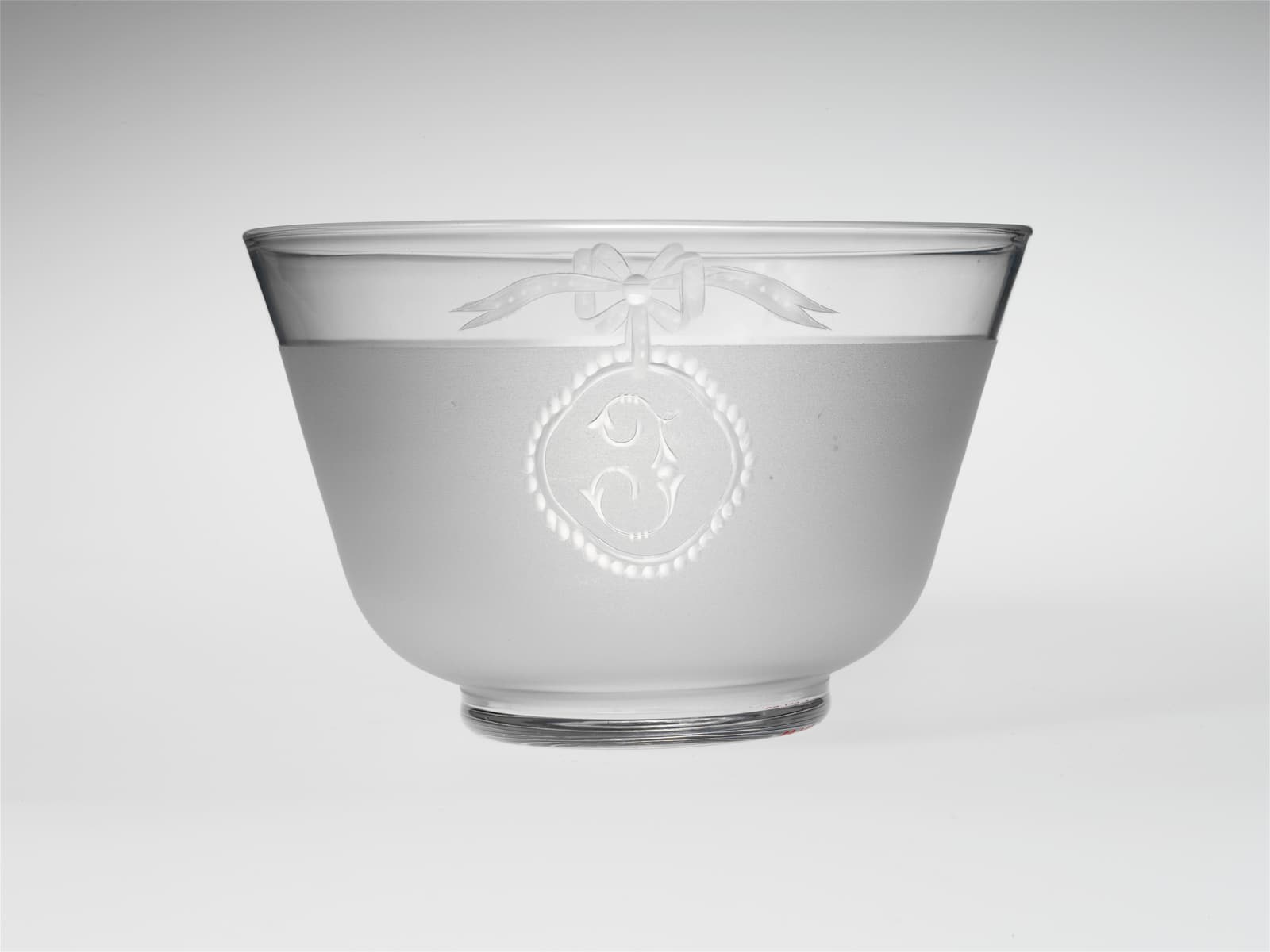
The bowl is shallow, frosted and almost theatrical in its uselessness. It was not made for soup. It is too broad for a drinking glass and too precious for a sink. A clear medallion interrupts its icy surface: the letter J, suspended beneath a bow.
The Metropolitan Museum of Art dates it to 1830–70 and identifies its owner as John Taylor Johnston, the museum’s first president. At 8.6 centimeters high and 13.7 across, it is a small object made large by personalization. The same monogram survives on a goblet in the collection.[1] Even empty, the bowl announces that water, glass and ownership once arrived at dinner as a set.
That is the finger bowl’s real fascination. It appears to be about clean hands, yet it has often done more social work than its few inches of water can explain. It can close a course eaten by touch, cue a change of plates, reassure an uncertain guest, display a household’s glass, occupy a server and expose who receives care. Across different tables, it has been practical equipment, elite punctuation, colonial furniture and an ordinary courtesy.
There is no honest single line from an ancient wash basin to the modern restaurant bowl. The objects, names and hand-rinsing customs overlap without becoming identical. The useful history is therefore not “who invented it?” but what kind of room did each bowl make visible?
Before the name settled, the water was already moving
A blue glass bowl in the Smithsonian’s National Museum of American History was likely used in George and Martha Washington’s formal dinner service, first in the presidential mansion in Philadelphia and later at Mount Vernon. The museum places it inside the Washingtons’ attempt to create a public style that felt dignified without looking royal.[2] That tension sits neatly inside the object: ceremony for a republic, private glass used to perform public standing.
The Museum of Fine Arts, Houston supplies a revealing vocabulary. Its early-nineteenth-century lead-glass example is called a finger bowl now, but the museum says citations beginning in 1750 used names such as “wash-hand” glass or basin; “finger cup” followed, and the term “finger bowl” dates to the 1810s. The form existed before usage became widespread. In the 1830s, British actor Fanny Kemble could complain that a New York dinner was ill served partly because it offered neither water glasses nor finger glasses—even though, she noted, she did not eat with her fingers.[3]
That last detail breaks the easy functional story. The bowl’s presence could certify the quality of service even when the diner had little visible need to rinse. Its absence meant that the room had failed a code. Cleanliness mattered, but so did the ability to anticipate, purchase, carry, place and remove another piece of glass.
Johnston’s monogrammed bowl sharpens the point.[1] A tap and a basin can clean many people. A named bowl individualizes water at the table. The luxury lies not in the liquid but in the short supply chain of attention around it: someone fills it, someone keeps the rim spotless, someone knows its place in the sequence, and someone clears it before the next act.
Emily Post hid a course change inside the bowl
By 1922, Emily Post’s Etiquette in Society, in Business, in Politics, and at Home could treat the finger bowl not as a curiosity but as a piece of service engineering. She described two systems. In the “hotel method,” ice cream arrived on china; afterward, a fruit plate replaced it with a finger bowl, doily, fruit knife and fork. In the “private house” method, a matching glass plate and bowl were stacked on the fruit plate. The guest lifted off the bowl, ate ice cream from the glass plate, and left the china beneath for fruit.[4]
The arrangement sounds fussy because it was fussy. Yet it solved a real sequencing problem: how to move from a soft dessert to fruit while keeping every place composed and minimizing plate changes. Post even anticipated the failure mode. If a guest lifted both bowl and glass plate, a servant was expected to notice and quietly replace what the mistaken move had disrupted.[4] The etiquette belonged to the staff as much as to the diner.
Her measurements make the ritual tactile. The doily was roughly five or six inches across. The bowl held less than half its capacity in cold water. Violets, sweet peas or a gardenia might float there; lemon, in Post’s telling, belonged to the chop house, where food eaten with the fingers could leave grease.[4] What looks in a still-life photograph like decoration was actually a timed bundle of water, linen, glass, cutlery, dessert and observation.
This is why the finger bowl should not be dismissed as merely absurd. It was a tiny switchyard. It told the guest where one course ended, told the server which objects should move and restored a clean visual field for fruit. The absurdity was elsewhere: a modest rinse had become proof that a room possessed enough objects and labor to make simplicity complicated.
Touch changes the meal before water changes the hand
Modern fine dining has rediscovered food eaten directly from the hand: a tart balanced on two fingers, a leaf folded around a warm filling, shellfish opened at the table, bread dragged through the last streak of sauce. Touch is not a gimmick by definition. It changes how temperature, surface, weight and fragility reach the diner before the bite.
Charles Spence’s 2022 review of eating with the hands argues for a careful boundary. Culture, habit, the food itself and the tactile or proprioceptive qualities of eating all shape the experience; no utensil or hand technique makes food universally better. He also notes that much of the historical literature behind Western cutlery narratives rests on Anglo-Saxon sources.[5] In other words, a chef cannot declare touch “more natural” and erase the diner’s learned fluency—or treat knife and fork as the neutral default against which every other practice is exotic.
A finger bowl can be a thoughtful response to a tactile course. It lets the restaurant say: we designed this bite for your hand, and we planned the transition afterward. But it is a rinse, not a miniature wash station. The CDC’s public guidance favors washing with soap and clean running water; by that standard, water sitting in a basin is not an equivalent hygiene system.[6] A dining room still owes guests an accessible place to wash properly.
That distinction frees the bowl to do the job it can actually perform. It can remove a little butter, fruit juice or sauce from fingertips. It can keep residue off a wine glass. It can close one texture before the next course begins. Asking it to certify sanitation turns a service gesture into hygiene theater.
The same bowl does not tell the same story everywhere
The Asian Civilisations Museum in Singapore holds an early-Republican-period Chinese porcelain finger bowl catalogued in a Peranakan dining context. Its collection note begins from a practical fact: Peranakans traditionally ate with their fingers, so water at the table was essential. It also places such bowls within larger dining sets, many since dispersed as heirlooms and habits changed.[7] Here, the object belongs to a specific material world of hand eating, porcelain and family service—not merely to an imported Western rulebook.
India offers a different, contested afterlife. In a history for Eater, Meher Varma cautions that finger bowls have moved through British, American and Indian settings with changing meanings. Her account traces them through colonial clubs, elite households and upscale Indian restaurants, then into more ordinary establishments. By the late 1970s they were familiar in many high-end Indian dining rooms; in later decades, stainless-steel bowls could also appear in modest restaurants where eating with the hand remained ordinary.[8]
That movement did not simply drain status from the object. It rearranged it. In one room, a flower floating in warm water might tell the guest they had entered the expensive category. In another, a bowl might be the practical finish to bread and curry. In a third, it might spare the operator from providing something more necessary. Varma’s account keeps class and caste in view and resists treating “hygiene” as an innocent explanation for every use.[8]
Read beside the Peranakan bowl, the Indian history also warns against a lazy colonial plot. A European service object could travel through empire while meeting societies with their own deep practices of eating and rinsing by hand. Adoption is not proof of an empty table waiting for etiquette to arrive. Objects migrate into existing systems; those systems alter what the objects mean.
What a modern dining room owes the bowl
The finger bowl earns a return only when the course earns it first. If nothing has been touched, peeled, cracked, folded or pulled from a bone, the bowl is costume. If a bite deliberately leaves the fingers fragrant or slick, the restaurant should plan a graceful exit from the sensation rather than hand the guest an unexplained prop.
The service should be legible without becoming a test. Place the bowl consistently. Give every diner who ate the course the same option. A short gesture or plain sentence is enough; nobody should be turned into the evening’s entertainment for mistaking the object. The water should arrive clean, the vessel stable, the towel or napkin obvious, and the whole setup should disappear before it cools into clutter.
Most importantly, the bowl should never be used to sort guests into those presumed to know and those expected to be taught, nor should it imply that a hand-eaten cuisine becomes refined only after a luxury room supplies water. Fine dining is at its best when it anticipates bodies without ranking them.
The Met’s photograph leaves Johnston’s bowl empty.[1] That makes its engraving unusually clear, but it also reveals the limit of studying dining objects alone. The bowl acquires meaning only when water enters, a course has just ended, a hand moves toward it and another person is waiting to clear it.
The best modern version need not revive the whole Victorian apparatus. It only needs to understand the old object better than nostalgia does. A finger bowl can offer a precise, generous reset after food designed for touch. It can even make a transition beautiful. What it cannot do is rinse away the history of who carried the water, who received the bowl and whose way of eating the room considered civilized.
Sources
- The Metropolitan Museum of Art, “Finger Bowl” (1830–70) — object record, dimensions, Johnston provenance, matching monogram and public-domain photograph used as the article image.
- Smithsonian National Museum of American History, “Finger bowl from George and Martha Washington’s formal dinner service” — likely use in the presidential mansion and at Mount Vernon, and the Washingtons’ social-service context.
- Museum of Fine Arts, Houston, “Finger Bowl” (c. 1812–27) — early object record, naming chronology, spread of the form and Fanny Kemble’s 1830s account.
- Emily Post, Etiquette in Society, in Business, in Politics, and at Home (1922), Project Gutenberg — hotel and private-house dessert service, plate changes, doilies, water level, flowers and lemon.
- Charles Spence, “Interacting with food: Tasting with the hands,” International Journal of Gastronomy and Food Science 30 (2022), 100620 — review of touch, utensils, culture, familiarity and multisensory eating.
- US Centers for Disease Control and Prevention, “Hand Hygiene Frequently Asked Questions” — current public guidance on soap, clean running water and the contamination risk of shared basin water.
- Asian Civilisations Museum, “Finger bowl” (early Republican period, 1911–30), Roots Singapore — Peranakan hand-eating context, porcelain form and dispersed dining sets.
- Meher Varma, “The Finger Bowl Is an Old Dining Etiquette Tradition That Could Soon Disappear,” Eater (October 28, 2020) — contested genealogies and changing class, caste, colonial and restaurant meanings in Britain, the United States and India.