The easiest way to misread La Colombe is to treat it as a room that wins by atmosphere first. The setting does plenty of work. The World's 50 Best still describes the restaurant as a gastronomic voyage in a treehouse-like dining room high on the Silvermist Wine Estate, with serene valley views and warm, impeccably choreographed service.[2] Their 2025 extended-list note keeps the same outline: Constantia Nek at the top of the hill, sea-facing views, James Gaag's team, and a house style grounded in French technique with Asian accents.[3]
That description is accurate, though it leaves out the sharper point. La Colombe's current public menu reads like a descent through Cape textures. The official page prices the chef's menu at R2395 p.p., then lays out a route that starts with Silvermist Vegetable Garden, Herb Garden Extraction, Smoked Tomato Buenuelo, Garden Tartlet, and a cluster of wild-boar snacks before passing through Tuna 'La Colombe', a choice between False Bay market fish with caviar and nahm jim or Namibian red crab with tamarind curry, then Salted Agave, Coal Fired Lamb, Broccoli, Smoked Neck, and desserts built around spring strawberries, matcha, lemon verbena, and rose.[1] That is not a luxury checklist. It is a sequence with slope.
What keeps the meal fun in 2026 is that the slope stays readable. Smoke, shellfish, garden imagery, signature theater, sweet-sour tightening, and a final floral lift all appear in the right order, so the tasting menu feels like movement instead of accumulation.[1][2][3]
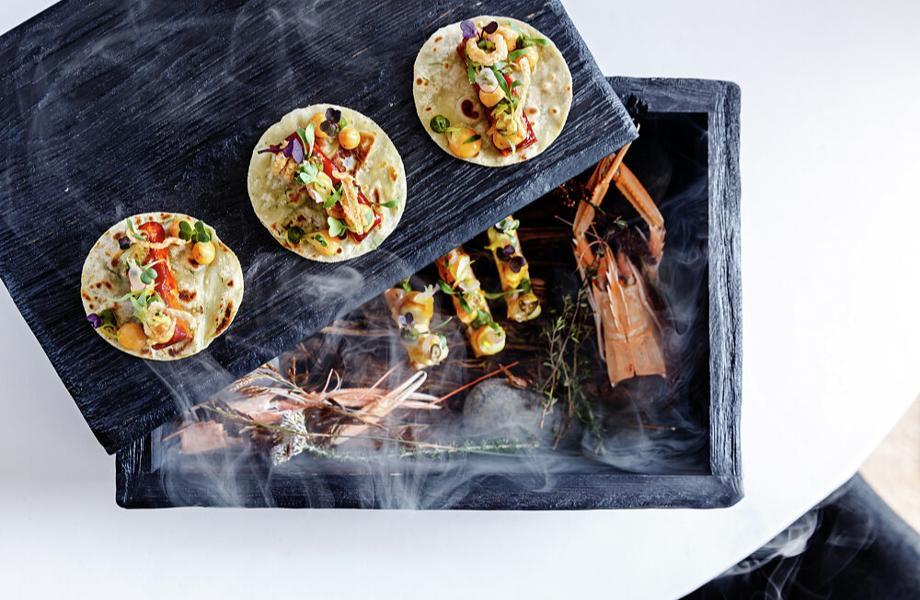
Image context: the cover uses 50 Best Discovery's photograph of La Colombe's smoked snack presentation rather than a dining-room shot because this walkthrough turns on sequence. The image shows the restaurant's first move clearly: miniatures, smoke, and local flavor presented with enough drama to wake the table up without exhausting it.[2]
The first act maps the mountain in miniatures
The official menu starts by telling you where you are before it tells you how grand the restaurant is. Silvermist Vegetable Garden and Herb Garden Extraction are not merely pretty opening phrases.[1] They frame the estate itself as the first ingredient, then compress it into a form small enough to eat in two bites. La Colombe has played with this kind of garden imagery for years; Eat Out's earlier Cape Town write-up remembered snacks that resembled a garden scape and used the phrase "refined, sometimes quirky" for James Gaag's handling of local flavor.[5] The current menu keeps that instinct alive, only cleaner.
Then the opening gets darker and warmer. Smoked Tomato Buenuelo, Garden Tartlet, Wild Boar Snacks, Smoked Boar Broth, Wild Boar, Kimchi, Crackling, and Bacon Chawanmushi move the table away from pastoral prettiness and into a heavier register of smoke, fat, fermentation, and comfort.[1] This is where the menu becomes distinctly Cape rather than generically luxurious. The 50 Best Discovery description of "smoking Cape Malay snacks" captures the feeling well enough: La Colombe wants the meal to begin with aroma and motion, not with silent tweezers and fragile reverence.[2]
That is also why the lead image suits the article. The opening course is designed to arrive as a scene, then dissolve into hand-held eating. It gives you smoke and shell-on crustaceans, but it also gives you flatbread, color, and casual bite-size scale. La Colombe's theater works because the table is invited to participate immediately.[2]
The signature tuna is the hinge, not the whole plot
Many restaurants have one famous dish that ends up freezing the rest of the meal in place. La Colombe's tuna "La Colombe" does something more useful. It acts as the hinge between the playful opening and the more linear middle stretch.[1][2][5] The World's 50 Best still calls it the restaurant's miniature tinned yellowfin creation with micro herbs, avocado puree, and broth, which says a lot about its endurance.[2] The 2025 extended-list note keeps it in the public memory too, even while summarizing the broader house style.[3]
Why does that matter in a walkthrough? Because the tuna is the point where the menu gathers itself. Up to that course, La Colombe can feel happily centrifugal: garden references, smoke, wild boar, broth, chawanmushi, truffle butter, and a lot of surfaces arriving in quick succession.[1] The tuna can takes that scattered energy and turns it into one emblematic act of control. The dish is still playful, though it is also compact, lucid, and easy to remember. It resets the room.
That reset helps the rest of the menu read more clearly. Once the tuna lands, the meal can move into fish or crab, acidity, and lamb without feeling as though it is changing restaurants halfway through.[1]
The middle of the menu narrows the frame on sea, acid, and heat
After the tuna, La Colombe's public chef's menu gives diners a fork in the road: False Bay market fish, caviar, nahm jim or Namibian red crab, tamarind curry.[1] This is a good example of how the restaurant's French-and-Asian line is best understood as pressure rather than fusion for its own sake. The fish route brings caviar and Thai-leaning sharpness; the crab route brings sweetness and a darker, more enveloping curry logic.[1][3] Either way, the menu tightens from spectacle into flavor direction.
Then comes Salted Agave.[1] On paper it looks almost too minimal, the sort of palate cleanser name that can disappear from memory. In sequence, it does the opposite. After boar, butter, tuna broth, caviar or crab, and tamarind or nahm jim, a salted agave course reads like a deliberate narrowing of the palate. The restaurant is telling you that sweetness is now going to carry mineral and herbal edges, not just relief.
That makes the main course feel earned rather than obligatory. Coal Fired Lamb, Broccoli, Smoked Neck is a strong closing savory move because the menu has already done the work of building smoke and salt earlier.[1] The lamb does not need to invent gravitas from scratch. It inherits it.
The back end keeps memory light on its feet
One of the most useful recent sources on La Colombe is not a ranking notice but Eat Out's 2025 dish feature on the restaurant's charcuterie board. In that interview, James Gaag describes the cooking as "creative and bold," says the ideal result is something guests remember weeks and months later, and notes that the charcuterie work took trial, error, custom pieces, and eight weeks before the first slices were ready.[4] That matters because it explains why La Colombe's menu rarely feels casual beneath the showmanship. The room likes flourish; the kitchen likes iteration.
You can feel that discipline in the meal's landing. Spring Strawberries, Matcha, Lemon Verbena and then Rose are light-footed endings after lamb and smoke, but they do not read as generic freshness.[1] Matcha adds a dry green note, lemon verbena keeps the fruit from turning sticky, and rose closes the arc with fragrance rather than weight. The meal ends above the table rather than buried under it.
This is also where the restaurant's service reputation makes structural sense. Eat Out's 2024 report on La Colombe's return to the World’s 50 Best list emphasized impeccable service, strong food, and the Constantia views, alongside the restaurant's Best Restaurant in Africa award in 2024.[5] That kind of recognition is easy to flatten into prestige language. In practice, it matches the meal. A menu with this much smoke, choreography, table-side reveal, and tonal shifting needs service that can keep motion graceful instead of frantic.[2][5]
What you are really booking in 2026
La Colombe's current page says a 13.5% discretionary service charge applies, menus and pricing can change, children under eight are not admitted, and diners cannot bring their own wine.[1] Those details are useful because they clarify what kind of night the restaurant believes it is hosting. This is not a casual scenic splurge hidden inside a famous address. It is a tightly managed performance with a clear house tempo.
That is why the tasting menu still feels current. The estate, the views, and the international rankings matter, though the real accomplishment sits in sequence. La Colombe begins with mountain garden imagery, moves through smoke and shellfish, uses the tuna can as a signature hinge, sharpens the palate with fish or crab and agave, grounds the back half in coal-fired lamb, then lets herbs, tea bitterness, and rose perfume lift the ending clear.[1][2][3][4][5]
Plenty of fine-dining restaurants can do luxury, and plenty can do theater. La Colombe's stronger move is to make theater directional. The meal keeps moving downhill, and that is why it stays memorable.
Sources
- La Colombe official restaurant page, including the current chef's-menu price, public course sequence, service-charge note, booking conditions, and house policies.
- 50 Best Discovery, "La Colombe - Cape Town - Restaurant," on the Silvermist setting, treehouse-like room, smoking Cape Malay snacks, signature tuna, Karoo lamb, and choreographed service.
- The World's 50 Best Restaurants 2025: 51-100 list, entry for No. 55 La Colombe, on Constantia Nek, valley views, James Gaag, and the restaurant's French-technique-with-Asian-flourishes style.
- Leigh Champanis King, "Star flavours: how La Colombe elevated the charcuterie board." Eat Out, on James Gaag's memory-first cooking goal, eight-week development cycle, and no-waste use of trimmings.
- Tessa Purdon, "Eat Out Woolworths Restaurant of the Year has been ranked 49th in the World." Eat Out, on La Colombe's 2024 Best Restaurant in Africa award, impeccable service, food quality, and Constantia Valley views.