The obvious Tuju story on April 15, 2026 is prestige. Michelin's new Brazil selection made Tuju and Evvai the first Three MICHELIN Star restaurants not only in Brazil but in all of Latin America.[1] That is the headline, and it is a real one. The more useful story sits a level lower, in operations. Tuju makes sense at three stars because it does not behave like a single room with a talented kitchen attached. It behaves like a house with a sequence.
The Michelin inspector text on the current restaurant page describes that sequence with unusual clarity. Tuju occupies an elegant three-story building devoted entirely to the meal: on the ground floor, the experience begins with small appetizers, a wine cellar, and an internal garden; on the second floor, the dining room is organized around a large open kitchen; on the third floor, there is a large bar with views.[3] Read beside Michelin's 2026 press release and 50 Best Discovery's current profile, the point becomes hard to miss. Tuju's new status is not only about Ivan Ralston's food. It is about how architecture, research, beverage, and pacing have been made to agree.[1][2][3]
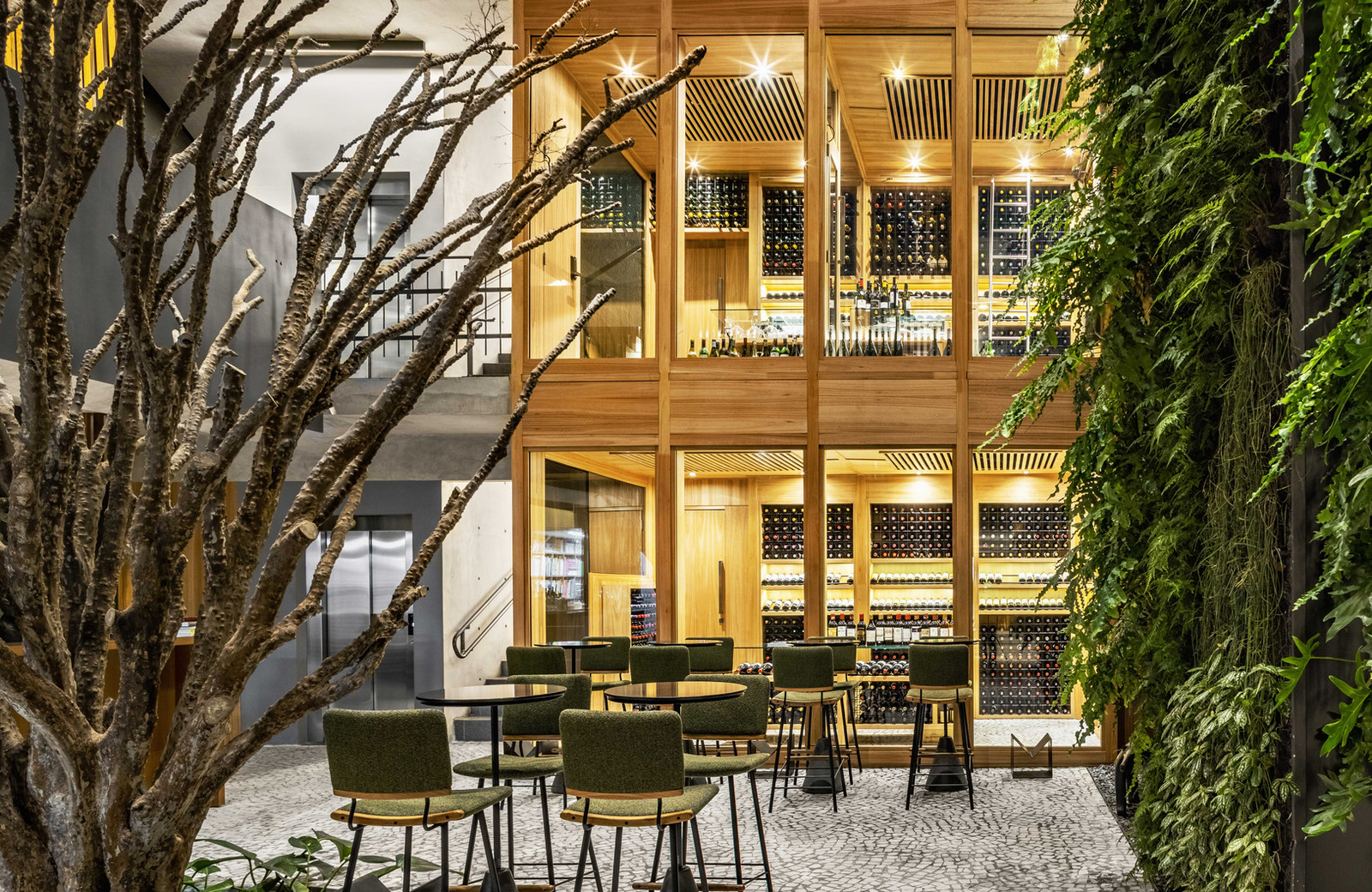
Image context: the lead image uses Tuju's official courtyard photograph from the restaurant's Ambiente page rather than a plated course. That choice fits the argument because Tuju's luxury begins with circulation. The cellar wall, garden, and low tables show a restaurant that wants to choreograph the guest's attention before the main tasting menu even begins.[5]
1. The first floor tells you this is a route, not a lobby
Most luxury restaurants still treat arrival as dead time. You check in, maybe take a drink, and wait to be escorted into the "real" experience. Tuju's first floor sounds like a different proposition. Michelin says this level already contains the meal's opening grammar: appetizers, cellar, garden.[3] The house is telling you that orientation matters.
That matters because a three-floor restaurant can easily feel scattered. Tuju avoids that by making the lower level a pressure release instead of a holding pen. The official courtyard photograph on the Ambiente page shows exactly the kind of room that supports this reading: wood, greenery, bottle walls, and enough calm that the first few minutes can reset the pace of the city outside.[5] São Paulo is dense, loud, vertical, and fast. Tuju's answer is not to deny that context but to create a first threshold against it.
The 50 Best Discovery profile strengthens the operational picture. Discovery lists the restaurant as serving a tasting menu from $370, with lunch on Saturday and dinner Tuesday through Saturday.[2] Those details matter less as consumer information than as pacing signals. Tuju is not trying to maximize casual frequency. It is protecting a rhythm. A guest enters the building, descends into the garden-and-cellar mood, then moves upward into the more concentrated core of the meal. The house teaches the diner how to read it before the main courses arrive.[2][3][5]
2. The second floor turns research into something the diner can witness
The strongest sentence on Michelin's current Tuju page may be the simplest one: the second floor is a dining room built around a large open kitchen surrounded by tables.[3] This matters because Tuju's reputation has always involved research-heavy cooking. Many restaurants claim that. Fewer know how to stage it without turning dinner into a laboratory tour.
Ivan Ralston's official biography helps explain why the open-kitchen format suits him. The Tuju team page says he studied gastronomy at Escuela de Hosteleria Hofmann in Barcelona and music at Berklee College of Music in Boston, then worked in the kitchens of El Celler de Can Roca, Mugaritz, and RyuGin before opening Tuju in 2014.[4] That is an unusually hybrid formation: classical restaurant lineage, avant-garde research culture, and musical training alongside it. The result at Tuju does not read like research for its own sake. It reads like composition. The open kitchen makes diners sit inside that compositional process rather than merely consume its finished surface.
Discovery's profile gives the food side of that process in current terms: foraged ingredients, sustainably sourced seafood, reimagined meat dishes, and desserts built around native fruits.[2] The point is not that Tuju has many ideas. Plenty of ambitious restaurants do. The point is that the room lets the guest see those ideas being translated in real time. Open-kitchen dining can easily collapse into noisy theater. Here it seems to function more like evidence. If Tuju asks the guest to trust a climate-driven, research-heavy tasting menu, the room makes the work legible enough to earn that trust.[2][3][4]
3. The climate clock is the smartest operating rule in the building
Many ingredient-driven restaurants talk about seasonality as if it were a moral slogan. Tuju's Michelin text is more precise, and therefore more interesting. The page says that each season, with its patterns of humidity, rain, wind, and dryness, defines the tasting menu.[3] That is a much stronger operating idea than a generic promise to cook "what is fresh."
It means the menu is not only rewritten by ingredient availability. It is rewritten by atmosphere. Climate becomes a scheduling device, a sequencing device, and a mood device. That helps explain why Tuju's three-floor structure feels coherent rather than ornamental. The first floor softens the guest into a slower register, the second floor concentrates attention around the kitchen, and the bar above gives the house a place to exhale. The whole building is arranged around movement through changing intensity.
Discovery's beverage note fits that same reading. The wine list is described as heavy on biodynamic and natural options, and the cocktails use local herbs and spices.[2] Those are not random luxury accessories. They let the drinks program stay inside the same environmental vocabulary as the food. The bar is not there merely to monetize waiting time. It gives the house a final register where the tasting menu's climatic logic can either begin or loosen without breaking.
This is also where front-of-house authorship matters. On the official team page, restauratrice Katherina Cordas describes hospitality as making each person feel seen and leave the restaurant feeling better than when they arrived.[4] That is not decorative language at Tuju. It explains why a vertically complex restaurant does not have to feel intimidating. The building is a machine, but the machine is meant to hold people gently.
4. Why the three-star moment feels earned rather than sudden
The 2026 Michelin press release calls Tuju's promotion a historic milestone for Brazil and for Latin America.[1] That is true. But Michelin's own restaurant page suggests why the result feels earned rather than abrupt. The inspector description is not about one canonical signature dish. It is about a complete house: a building with three distinct levels, a large mostly female kitchen team, modern technique, Brazilian seasonal products, and a tasting menu organized by climatic change.[3]
The earlier signal was already there in 50 Best Discovery's No. 8 ranking in Latin America's 50 Best Restaurants 2025.[2] That kind of recognition often tells you a restaurant has become legible before the top guide catches up in full. Tuju's new three-star status looks like that kind of consolidation. The service model is clear enough to hold the research. The architecture is expressive without becoming a gimmick. The beverage program has its own job. The chef's biography explains the seriousness, while the hospitality language explains why the seriousness does not harden into chill.[2][3][4]
That is why Tuju feels more convincing as a service and operations story than as a generic victory lap. Three stars can sometimes flatten a restaurant into myth. Tuju resists that flattening because the thing Michelin has effectively rewarded is coordination. The lower floor, middle floor, and upper floor do different kinds of work. The menu moves with weather rather than static fame. The people running the room and the bar are named as part of the argument, not as anonymous support staff.[3][4]
In other words, Tuju's new prestige makes sense because the restaurant has built something rarer than talent. It has built agreement. The building agrees with the menu. The menu agrees with the climate. The climate agrees with the drinks. And the service agrees to make all of that feel calm. In Sao Paulo, that is a serious luxury.[1][2][3][4][5]
Sources
- Michelin, "The new MICHELIN Guide Rio de Janeiro & Sao Paulo 2026 selection: two new Three MICHELIN Star restaurants shine" (April 15, 2026).
- 50 Best Discovery, "Tuju - Sao Paulo - Restaurant" - current profile covering the 2025 Latin America's 50 Best ranking, tasting-menu service window, drinks framing, and the restaurant's ingredient approach.
- MICHELIN Guide, "Tuju - Sao Paulo - um Restaurante do Guia MICHELIN" - current restaurant page covering the three-floor layout, open kitchen, climate-defined tasting menu, and Ivan Ralston's approach.
- Tuju, "Equipe" - official team page covering Ivan Ralston's training and kitchen path, Katherina Cordas's hospitality philosophy, and the current room-and-bar leadership.
- Tuju, "Ambiente" - official gallery page and image source for the first-floor courtyard and wine-cellar photograph used in this article.