A lot of ambitious restaurants can tell you what techniques they use. Fewer can tell you why the room, the address, and the city's ingredients are necessary to those techniques. Gaa becomes interesting in 2026 because it has crossed that threshold. It no longer reads like a chef trying to prove that Indian food belongs inside fine dining. It reads like a Bangkok house with its own weather: Indian methods, Thai produce, wood fire, fermentation, polished service, and deliberately domestic architecture all pulling in the same direction.[1][2][3]
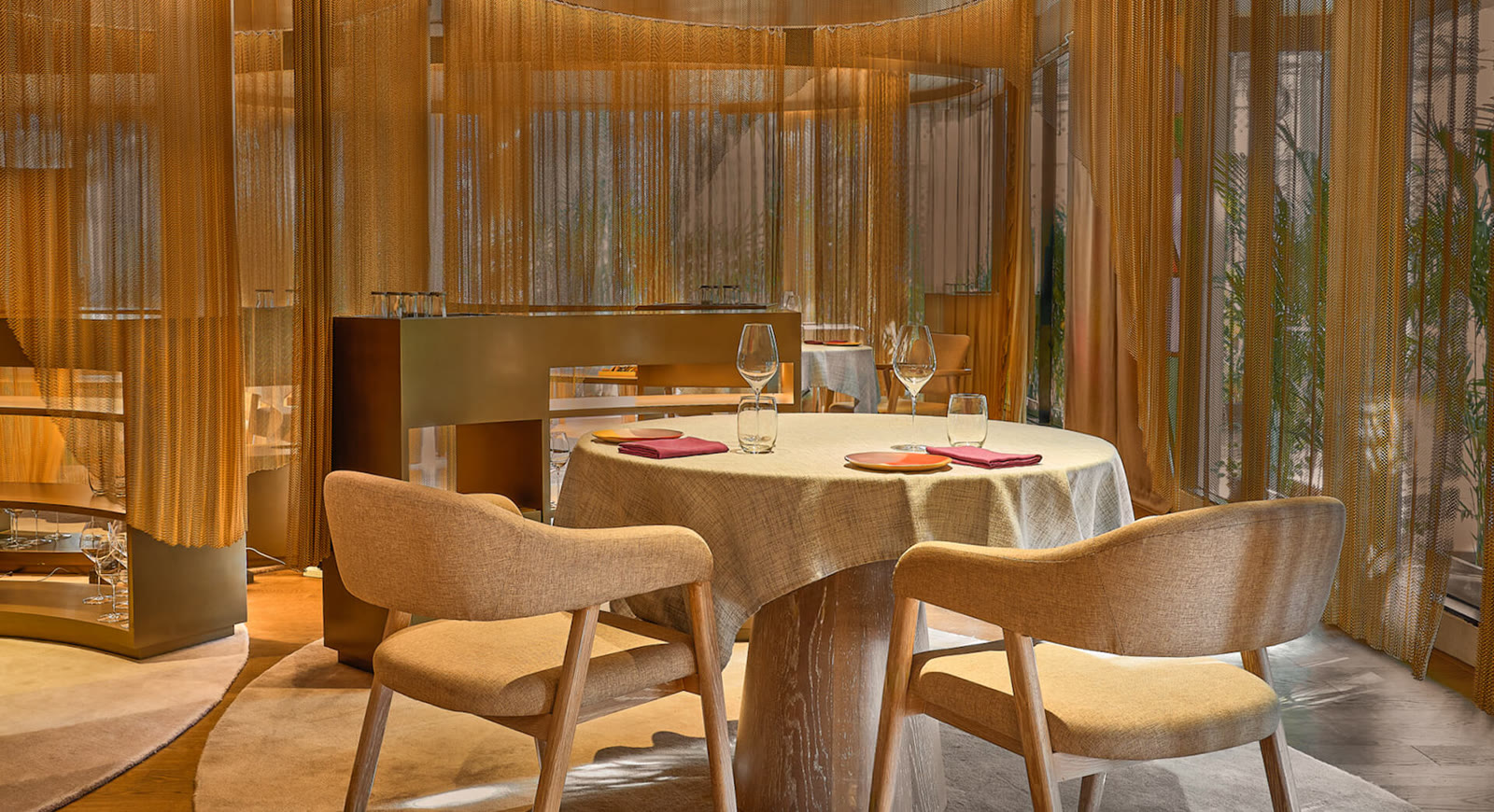
As of April 15, 2026, the official site gives the public version of that system in unusually clear terms. Gaa is serving its Signature Tasting Menu at THB 5,200++, dinner daily from 5:30pm, with lunch and afternoon tea on weekends, inside a transformed 60-year-old traditional Thai house on Sukhumvit 53.[1] The same page splits the space into two emotional registers: the upper-level Baan Ruen Thai Dining Room with curved ceilings and a white string installation inspired by Sai Sin, and the lower-level Garden Room, where metallic curtains turn each table into a private golden cocoon near the kitchen.[1] That spatial distinction matters because Gaa's main achievement is one of containment. Garima Arora is cooking a style of modern Indian food that could easily become overexplained, overdecorated, or overmuscular. The house gives it rhythm instead.
Image context: the lead image uses Gaa's official photograph of the Garden Room rather than a hero shot of a single dish. That choice fits the argument because the restaurant's signature is larger than one plate. The suspended golden curtains, muted table setting, and softly enclosed room show how Gaa turns technical cooking into an atmosphere of focus and ease.[1]
1. The Thai house is the first course
The official description of the restaurant keeps returning to structure before spectacle. Gaa is said to bring tradition and innovation together, but the line becomes believable only when you read it beside the physical setup.[1] The Baan Ruen Thai room and the Garden Room are two different ways of managing attention. Upstairs, the Sai Sin reference gives the dining room a ritual frame, linking gathering and eating through Thai symbolic language.[1] Downstairs, the metallic curtains strip away visual noise and make each table feel temporarily staged inside its own chamber.[1]
That matters because modern Indian tasting menus carry a recurring burden. They are often asked to represent a national cuisine, innovate beyond cliché, and satisfy international ideas of contemporary fine dining all at once. Gaa solves part of that problem architecturally. The house cools the discourse down. The restaurant can be intellectually busy on the plate because the room is calm, measured, and local in its bones.[1][2]
The 50 Best Discovery profile sharpens the point from the outside. It describes the restaurant as Indian fine dining inside a traditional Thai house from the 1960s, with subtle nods to Thai ingredients and front-of-house warmth that matches the kitchen's precision.[2] Precision alone would make Gaa admirable. Warmth inside this particular house makes it persuasive.
2. Bangkok is the method, not just the location
Arora's career story matters because it explains why Gaa does not feel like a transplanted European tasting menu wearing Indian vocabulary. CNA Luxury traces the arc cleanly: Mumbai childhood, a brief period as a journalist, Le Cordon Bleu in Paris, two years at Noma, then Bangkok, where she fell for the city's produce and stayed.[3] The useful part is not biography as prestige accumulation. It is the decision that followed. Arora told CNA she could not imagine a better backdrop for modern Indian cooking than Bangkok because of the deep connections between the two countries in ingredients, language, and religion.[3]
The MICHELIN Guide's 2024 feature pushes that logic further. After Gaa received its second star, Arora described planning research around the Malvan coastal region of Maharashtra, drawn partly by its seafood culture and by a biodiversity overlap with coastal Thailand.[4] That is a revealing detail. It shows the restaurant is not using Thailand as a pantry annex for Indian cuisine. It is using Thailand as a comparative field. The Bangkok setting lets Arora test how Indian techniques behave when routed through neighboring climates, crops, and taste memories.[3][4]
That is why Gaa avoids the dead feel of fusion-for-fusion's-sake. The MICHELIN Guide's roundup of starred Indian restaurants describes the menu as an imaginative expression of Arora's heritage inside a transformed Thai house.[5] Heritage is there, but it does not arrive as freeze-dried authenticity. It arrives as a live grammar being revised in public.
3. Fire, fermentation, and curry are doing structural work
Once the restaurant's geographic logic is clear, the cooking becomes easier to read. CNA's profile names the technical cluster directly: charcoal, tandoor, fermentation, pickling, and layered curries.[3] Discovery then gives concrete plate examples, from the spicy-uni Bombay Sandwich with Kashmiri morel paniyaram to crab with warm macadamia milk curry, plus desserts that bring together caviar, coconut bread, and cashew ice cream.[2] These details could sound eclectic if you saw them as a scatterplot. At Gaa, they read more like a pattern of transfer.
Arora's explanation of curry in the CNA story is the hinge. Speaking about the warm crab and macadamia milk curry, she frames the dish through layered flavor transmission rather than brute richness.[3] That is a useful way to understand the whole restaurant. Fire is there to move aroma. Fermentation is there to deepen and sharpen. Thai ingredients enter the menu as living material, not as tourism garnish. Each technique is being used to move flavor through a dish with more control.[2][3][5]
That is also why Gaa feels more mature than restaurants that advertise innovation through a parade of shocks. The official site's language about a one-of-a-kind dining experience would be empty in many places.[1] Here it lands because the underlying methods are coherent. Indian cooking supplies a huge archive of roasting, smoking, dairy balance, spice layering, pickling, and bread logic. Bangkok supplies produce, herbs, seafood, and a house idiom that keeps the meal from hardening into abstract chef talk.[1][3][4][5]
4. Why Gaa feels fully formed right now
There is a difference between a famous restaurant and a settled one. Gaa looks settled in 2026. The official page presents the menu, rooms, beverage pairings, hours, and reservation rules with almost relaxed clarity.[1] The cellar holds more than 2,000 bottles across 300-plus labels, but the restaurant also foregrounds homemade non-alcoholic pairings, which keeps the experience broader than old wine-first luxury.[1] Discovery notes weekend afternoon tea and the way service matches technical detail with genuine warmth.[2] Those are signals of a house that knows where its edges are.
The awards matter too, but mainly as confirmation of maturity. Gaa opened in 2017, won its first MICHELIN star in 2018, and gained a second in 2024, making Arora the first female Indian chef to reach that level.[1][4][5] That is significant on its own. More important, it suggests the restaurant has survived long enough to move past announcement-stage identity. The question is no longer whether modern Indian fine dining can work in Bangkok. The question is what kind of room it becomes when it does.
Gaa's answer is unusually elegant. It becomes a house where Indian cooking can stretch without losing intimacy. The Thai architecture absorbs ambition. The service removes stiffness. The menu lets research show, but never lets research become homework. Plenty of high-end restaurants can make a diner feel impressed. Gaa makes something harder: it makes a dense, transnational idea feel settled enough to host you.[1][2][3][4][5]
Sources
- Restaurant Gaa, official website - current source for the restaurant's address, opening hours, THB 5,200++ signature tasting menu, Thai-house setting, Garden Room and Baan Ruen Thai descriptions, cellar note, and official interior photography.
- The World's 50 Best Discovery, "Gaa - Bangkok - Restaurant" - overview of the restaurant's traditional Thai house, Thai-ingredient framing, signature dishes, afternoon tea, and front-of-house warmth.
- CNA Luxury, "In Bangkok, the first female Indian chef to receive a Michelin star" - profile of Garima Arora's path from Mumbai and Le Cordon Bleu to Noma and Bangkok, plus her explanation of why Thai ingredients suit modern Indian cooking and how Gaa uses charcoal, tandoor, fermentation, pickling, and layered curry logic.
- The MICHELIN Guide, "Garima Arora Makes Culinary History: Secures Two MICHELIN Stars while Navigating Motherhood at Gaa" - 2024 feature on Gaa's second star and Arora's plan to use research in India's Malvan region to shape a new menu through parallels with coastal Thailand.
- The MICHELIN Guide, "Where to Eat MICHELIN-Starred Indian Cuisine in London, Dubai and Beyond" - roundup describing Gaa as an imaginative tasting menu reflecting Arora's Indian heritage inside a transformed traditional Thai house.