
Esmé is easy to misread if you approach it through the most obvious vocabulary first.[1][2][3] The restaurant's own language invites the words: art, collaboration, creativity, gallery, Michelin-starred tasting menu.[2][3] Those words are not false. Chef Jenner Tomaska and Katrina Bravo opened the Lincoln Park restaurant in August 2021, and the official site still presents it as a mission-driven house where each new collaboration reshapes the meal through dishes, music, and hand-crafted service pieces.[2] But Eater's 20-minute, 27-second video is useful because it shows what that public language has to survive.[1] A full dining room does not care whether a concept sounds beautiful in a deck. It cares whether the sequence lands.
That is the video's real value. Rather than treating Esmé as a soft-focus art project, it keeps returning to labor: stations responsible for opening bites, a rabbit consommé placed inside a ceramic egg vessel, a partridge course baked in clay, a crab course carried under a watermelon lid, bread service treated like a house signature, and a salad whose plateware is tied directly to the current artist collaboration.[1] The official site sharpens the institutional frame behind those moments. Esmé says each collaboration produces a new experience every 12 weeks, and that the restaurant aims to tell a cohesive story through composed dishes, music, and service pieces.[2] The Creative Partners page makes the local emphasis explicit by listing painters, cartoonists, and multimedia artists from Chicago with whom the restaurant has worked.[3]
Read together, those sources suggest a narrower and more interesting claim. Esmé's success does not come from making food look like art. Plenty of fine-dining rooms can stage a beautiful plate for two minutes. The harder move is making a collaboration legible after mise en place, pickup, dining-room timing, and ingredient variability start exerting pressure. Esmé works when art survives service.
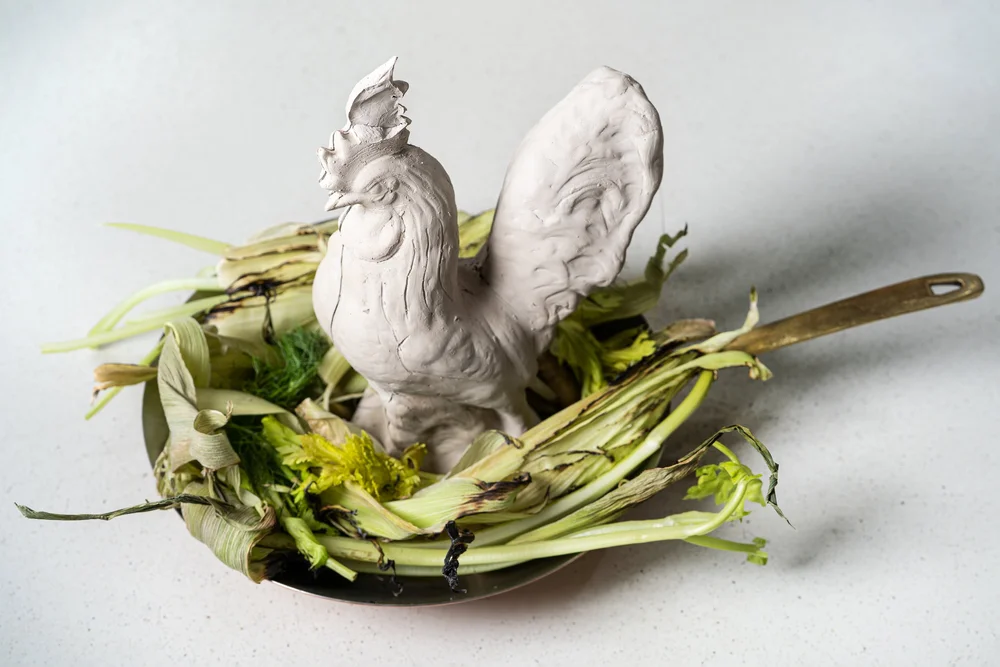
Image context: the cover uses an official Esmé menu-preview photograph showing a ceramic rooster vessel set among vegetables in a pan. It belongs here because the article's argument is about translation rather than decoration. At Esmé, the object holding the course matters almost as much as the food itself; serviceware becomes part of how the restaurant carries an artist-residency idea into the room.[5]
The opening bites matter because the meal starts as installation, then immediately becomes kitchen traffic
The first minute sets the terms better than any mission statement.[1] Before guests fully settle, the staff explains that four different bites are already on the table, each station contributing part of the opening spread, and the first thing served is a rabbit consommé inside a ceramic egg.[1] That sequence is revealing because it tells you Esmé does not think of "art" as a final garnish applied at the pass. The meal begins with objects, textures, and staging. But it also begins with station discipline and division of labor.
That balance is the whole restaurant in miniature. The official homepage promises a cohesive story told through dishes, music, and service pieces.[2] The Eater clip shows why cohesion is the operative word. These opening bites are varied enough to feel like an exhibition's first room, yet organized enough that the diner reads them as one beginning rather than as a pile of clever snacks.[1] Inference from the video and Esmé's own language: the restaurant's aesthetic ambition only works because it is routed through a highly edited opening grammar. Esmé is not improvising vibes at the table. It is staging an arrival sequence.
Around the two-minute mark, the clay-baked partridge shows that signature theater still has to behave like repeatable craft
The next decisive section comes with the partridge-and-clay course.[1] In the video, the kitchen calls it one of the team's favorite dishes, says the restaurant has become known for baking proteins in clay, and notes that earlier versions used duck, pig, and squab before the current partridge iteration.[1] That matters because it moves Esmé away from the lazy assumption that artist-driven fine dining must always chase novelty. Some parts of the house have already hardened into recurring technique.
StarChefs helps anchor that impression with a more static snapshot. Its July 2024 profile lists Clay-Roasted Partridge, Morel Sausage, Endive, Bitter Greens, Chestnut, Cherry among Esmé's featured dishes, alongside Dover sole and Dungeness crab preparations.[4] Put beside the Eater video, the clay course starts reading less like a one-night prop and more like a house method: dramatic enough to register, disciplined enough to repeat, and physical enough that the dining room can feel the labor behind it.[1][4]
That is a meaningful distinction in contemporary fine dining. Lots of restaurants borrow the language of craft while the real attraction remains visual surprise. Esmé seems to run the risk in reverse. The visual frame is strong, but the clay section shows that the restaurant knows spectacle must still answer to execution. The bird has to cook properly, hold together on the way to the table, and survive being done multiple times in one night.[1] The artfulness here is inseparable from logistics.
The middle of the video reveals the stronger idea: Esmé is a translation machine between artists, farmers, and serviceware
The most valuable passage arrives around the ten-minute mark.[1] A staff member explains that every four months the restaurant collaborates with a local artist, brings that work into the space, and effectively turns the room into a gallery.[1] The current collaborator in the video is described as local Chicago artist Megan Bora, with the team using custom plateware and serviceware for the salad course.[1] The artist then explains that the chef sent the color palette of the dressings first, and those colors helped determine the imagery and palette of the painted work.[1]
This is the section that makes Esmé more interesting than a standard "art x food" concept. The official site uses slightly different calendar wording, saying a new experience emerges every 12 weeks, but the conceptual spine is the same: local creative partners help reshape the room, and the story is carried not only by plated food but by music and hand-built objects.[2][3] The video goes further by showing how that collaboration gets metabolized. The salad is not simply set on an artist's plate for branding effect. The visual palette of the course and the visual language of the serviceware are designed to answer each other.[1]
Then the kitchen adds another layer. The same segment ties the salad to whatever herbs and flowers the local farmer brings in that day or week, with the team assembling the course around what is actually available.[1] That detail matters because it stops the art program from becoming sealed-off concept design. Esmé is not only translating an artist into dinner. It is translating artist, farmer, and serviceware into a course that can still flex with produce reality. That is why "translation machine" feels like the right term. The restaurant is constantly converting one medium into another without pretending the frictions disappear.
By the end, Tomaska gives the cleanest possible boundary: the restaurant is an extension of the artist, not a replacement for one
The final minutes rescue the whole project from grandiosity.[1] Tomaska says he does not really want to call himself an artist, that doing so would feel odd and uncomfortable, and that the team is better understood as an extension of the artists they are trying to highlight.[1] That is an unusually useful boundary for a restaurant like this. It keeps the kitchen from claiming art-world authority it does not need, while still allowing the meal to operate in conversation with visual culture.
That line also clarifies why the restaurant holds together. If Esmé claimed that food simply is art, the pressure to make every course perform as a masterpiece would become exhausting very quickly. The stronger position is humbler and more operational. Food is the extension; the room is the extension; the objects are the extension. The restaurant's job is not to replace painting or sculpture. Its job is to make a temporary edible argument around them.[1][2][3]
That is why this video is worth embedding now. Esmé's public language can sound lofty when read quickly, but the Eater film gives it a workable shape.[1] Opening bites organize the guest's first look. Clay turns signature drama into repeatable technique. Artist collaborations become plateware and serviceware rather than vague mood. Farmers force the courses back into daily reality. And the chef finally names the right limit: the restaurant is trying to extend another artist's world through dinner, not conquer it.[1][2][3][4] In fine dining, that kind of limit is often what allows ambition to become legible.
Sources
- Eater, "Inside Michelin-Starred Esmé's Wildly Creative Menu — Mise En Place," YouTube video, published October 23, 2024.
- Esmé, official homepage - on the restaurant's August 2021 opening in Chicago's Lincoln Park, the mission-driven tasting menu, and the claim that each collaboration reshapes dishes, music, and service pieces.
- Esmé, "Meet Our Creative Partners" - on collaborations with local Chicago painters, cartoonists, and multimedia artists.
- StarChefs, "Chef Jenner Tomaska of Esmé | Chicago" - July 2024 profile listing featured dishes including Dungeness crab and clay-roasted partridge.
- Esmé official image asset used as this article's lead photograph.