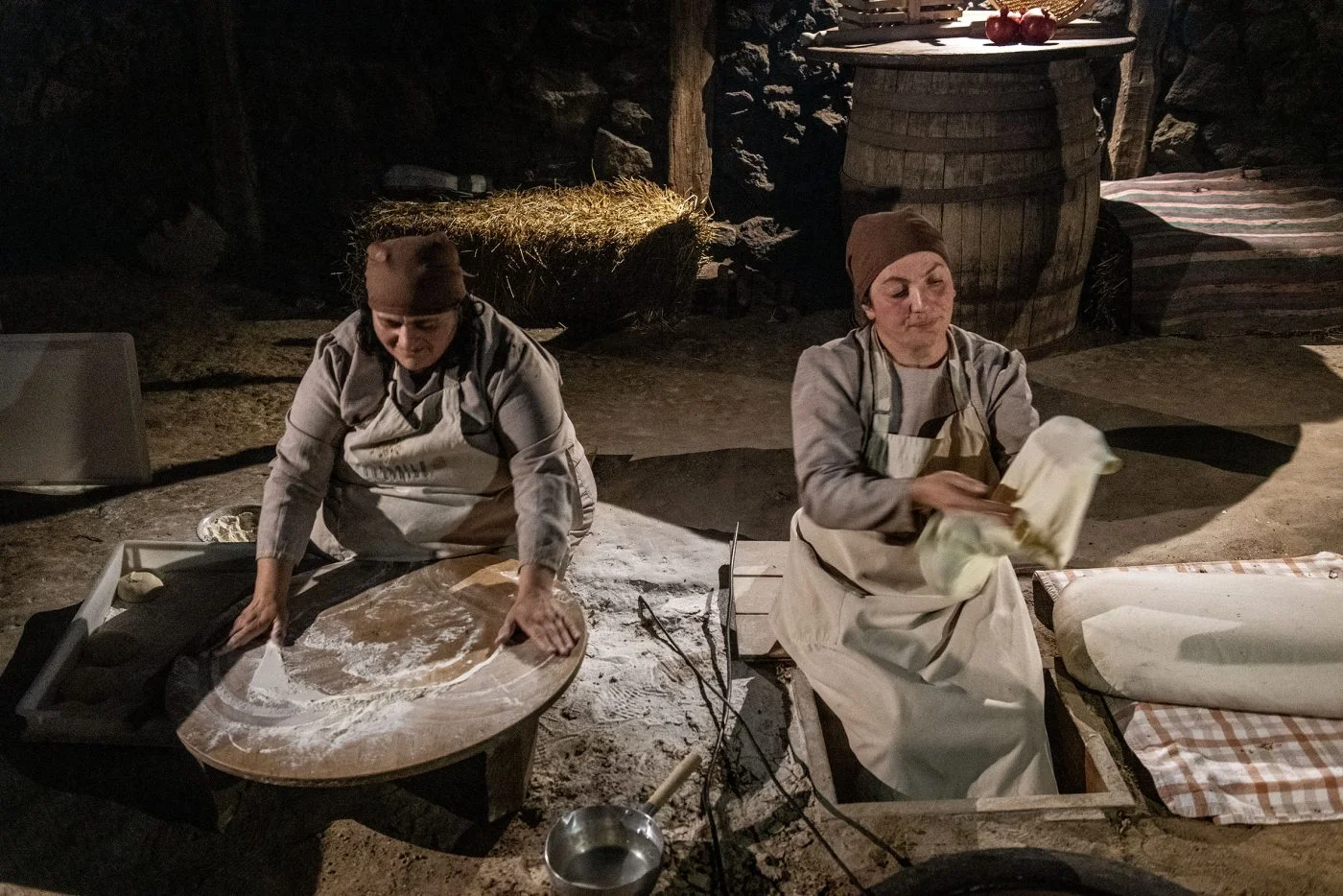
The first thing to notice is the flour on the floor.
It lies in handprints and pale drifts around a low rolling board. Two women sit close to the ground in a dark stone room: one presses a circle of dough outward; the other opens a nearly translucent sheet between her hands. The rim of the tonir enters at the lower edge. Nothing in Martin Wiktor Palm's photograph resembles the hushed finality of a plated bread course. This is bread as motion, repetition and shared timing.[2]
That image contains the best argument for Tsaghkunk Restaurant & Glkhatun. The restaurant, opened in 2021 in an Armenian village near Lake Sevan, does not keep its bakery behind a service door. Its set experience begins in a contemporary dining room, sends guests on a short walk to the glkhatun to see—and, if they wish, attempt—lavash making, serves food there, and only then returns them to chef Arevik Martirosyan's seven-course menu.[1][3] The journey reverses fine dining's normal reveal. Process is not the secret explained after the polished plate; process is the first course.
Tsaghkunk's 2026 news is a new guide entry, not a debut. In July, 50 Best Discovery expanded into Armenia for the first time, and the platform now carries a dedicated Tsaghkunk listing.[3][7] That is a useful reason to look closely, but not a verdict to borrow. Discovery is not a ranked list, and an international accolade cannot prove what dinner tastes or feels like on any given night. This is a reported restaurant profile, not a review based on a visit. The interesting, documentable question is what the restaurant has built its sequence to value.
A meal that changes rooms before it changes courses
Tsaghkunk sits roughly an hour by road from Yerevan. Its official experience starts with a signature drink at the restaurant, then moves about a minute away to the glkhatun, where local artisans demonstrate lavash baking. Guests are offered cheeses, cured meats and other local foods; panrkhash—lavash layered with melted cheese and onion—is prepared in the tonir. The party then returns to the main restaurant for seven servings. At publication, the restaurant lists that complete experience at 28,000 Armenian dram per person.[1]
The walking minute matters more than it sounds. A dining room usually compresses distance. Fish arrives without the lake, herbs without the hillside, bread without the bakehouse. Service makes those absences feel effortless. Tsaghkunk instead introduces a seam: finish the drink, stand up, go outside, enter another building, adjust to lower light and the flour-marked floor, meet the people doing the baking. The guest has to cross some of the space that dinner normally erases.
That does not make the meal unmediated village life. It is a designed hospitality sequence, sold at a set price to visitors. The contemporary room, cocktail bar and seven-course rhythm belong to a destination restaurant, not a household kitchen; 50 Best describes the contrast between the modern interior and the traditional food explicitly.[3] What makes the design intelligent is not a claim of purity. It is the refusal to pretend that refinement begins only after craft has disappeared backstage.
The glkhatun also changes the cast. In a conventional chef profile, every technique is pulled toward one celebrated name. Here, Martirosyan remains the menu's author, but the restaurant names the lavash artisans Anna and Gohar in its own account.[1] The first visible act of cooking therefore has more than one pair of hands. That is a small editorial decision with a large effect: it makes collaboration part of the meal before the chef's plates begin.
Lavash is work before it becomes heritage
Lavash is exceptionally vulnerable to becoming a symbol with no labor attached. Its dramatic shape, the heat of the tonir and its 2014 inscription on UNESCO's Representative List make it easy material for restaurant theater. UNESCO's record is more useful when read as a process description. A small group traditionally divides the tasks: dough is kneaded and portioned, rolled thin, stretched over an oval cushion, slapped against the oven wall, then pulled free after roughly 30 seconds to one minute. The record emphasizes coordination, experience and the way skills pass through group work.[6]
Palm's photograph restores that grammar. One baker cannot occupy both positions at once. The left side of the frame is pressure: palms flattening dough against wood. The right side is air: a sheet held open without tearing. Flour marks the route between them. With only the tonir's rim at the edge, the bread is already visibly collective.[2]
That distinction sets a boundary for guest participation. Trying the motion can give a visitor respect for its difficulty; it cannot confer mastery in an afternoon. Nor does UNESCO recognition certify a restaurant's demonstration as “authentic.” The inscription concerns a living practice and the communities that sustain it, not a branded experience.[6] Tsaghkunk is at its most convincing when participation remains an encounter with skilled work—not an invitation to imagine that one photogenic turn beside the oven has transferred the tradition.
The same applies to the old room. Tsaghkunk's own homepage describes the glkhatun in one passage as a house built as early as the 11th century and elsewhere as dating to the end of the 18th. Condé Nast Traveler likewise reports an excavated 18th-century stone home with two tonirs now protected behind glass.[1][5] The public record does not provide enough detail to reconcile those claims, so a profile should not sand them into one neat origin story. The restaurant does not need a perfectly marketable century to make its point. The surviving stone, the ovens and the resumed act of baking already give the room a material history that a themed interior could only imitate.
Arevik Martirosyan keeps the pantry legible
After the heat and rough surfaces of the glkhatun, Martirosyan's food moves the restaurant into a different register. Published accounts describe a former Soviet farm-workers' canteen remade as a bright contemporary dining room, with dishes that keep Armenian names and ingredients in view rather than dissolving them into a generic “Caucasian” tasting menu.[4]
The examples are unusually tactile. Vogue's 2024 profile noted wild sorrel with fruit lavash and walnuts; crisp-fried chechil string cheese with buttermilk; and sig fish with sea buckthorn. It also reported that Martirosyan's farmer husband supplies seasonal organic fruit, vegetables, grains and legumes.[4] The restaurant's current account widens that local vocabulary to Lake Sevan fish, meat, wild herbs and berries, while its wine list favors Armenian, mainly family-owned producers.[1]
These details matter because “local” can otherwise become a halo word. Sorrel is sour and leafy; chechil pulls into fibers; sea buckthorn brings a sharp orange tang; whitefish ties the menu to an actual body of water. None proves that every ingredient is always gathered next door, and the restaurant does not publish the procurement records needed to audit its sourcing claims. Together, though, the named ingredients make the kitchen's stated radius testable in a way that “inspired by the land” is not.
Panrkhash is the hinge between the two rooms. 50 Best summarizes it as lavash with melted cheese and onion; Tsaghkunk places it in the tonir portion of the visit.[1][3] It is not a tiny teaser that politely leaves room for the real menu. Bread absorbs fat, onion brings sweetness, cheese brings weight. Served before seven more courses, it makes appetite part of the design problem. The restaurant's answer appears to be cultural hierarchy over tasting-menu orthodoxy: if a generous bread dish belongs at the beginning, the later menu must adapt to it rather than shrinking it into a crisp garnish.
That is a more consequential kind of modernization than simply plating an old recipe with tweezers. Martirosyan's task is to let the dishes stay recognizable while controlling the contrasts around them: smoke and brightness, melted richness and delicate fish, handmade bread and composed servings. The modern work happens in pacing and adjacency as much as in technique.
The village cannot be reduced to atmosphere
Tsaghkunk presents itself as part of the wider Gagarin Project and describes its mission in terms of supporting rural communities, local farmers and traditional foodways.[1][2] The location makes that promise visually powerful: a destination meal in a village, a restored baking space, local artisans named on the page, nearby products on the menu. It is tempting to turn those elements into a complete rural-revival success story.
The available sources do not justify going that far. They do not disclose wages, the share of purchasing retained in the surrounding villages, year-round employment or how tourism revenue is distributed. A restaurant can create valuable work and still turn rural life into scenery; it can preserve a technique while making it dependent on visitors. The honest profile keeps the aspiration and the evidence separate.
What can be seen is a thoughtful allocation of attention. The old room is not merely the backdrop for a chef portrait. The bakers occupy the hero image. A village dish is allowed to be filling. The menu names fish, berries, herbs and Armenian wine rather than invoking terroir as fog. And the guest is made to leave one polished room before entering another.[1][2][4]
The 2026 Discovery listing may bring Tsaghkunk a larger international audience.[3][7] Its most exportable lesson, however, is not to install a clay oven in every luxury restaurant. A tonir without its skilled bakers would be décor; lavash without its social choreography would be a prop. The real lesson is to ask which people and processes a dining room edits out—and whether service can bring them forward without pretending to own them.
At Tsaghkunk, the bakery is not backstage because the restaurant's idea would collapse if it were. The walk, the flour and the hands come first. Only after guests have seen bread being made together does the chef ask them to read the finished plates.
Sources
- Tsaghkunk Restaurant & Glkhatun, official site — opening year, location, chef, named lavash artisans, guest sequence, published price, seasonal menu, Lake Sevan ingredients and Armenian-wine program.
- Jason Alexander, “Tsaghkunk.” Tsaghkunk Restaurant & Glkhatun, May 27, 2025 — Gagarin Project context, glkhatun description, chef and credit for Martin Wiktor Palm's documentary photograph of lavash baking.
- 50 Best Discovery, “Tsaghkunk Restaurant & Glkhatun” — independent venue profile covering the village setting, modern dining room, glkhatun visit, seven-course format, panrkhash and Armenian wines.
- Jessica Jungbauer, “Meet the Female Chefs Blazing a New Trail in Armenian Cuisine.” Vogue, August 15, 2024 — profile of Arevik Martirosyan, the former canteen, documented dishes and the restaurant's farm relationship.
- Caroline Eden, “In Armenia, Chefs and Restaurateurs Are Putting Heritage and History on the Plate.” Condé Nast Traveler, August 19, 2024 — reported visit to Tsaghkunk and account of the excavated stone home, tonirs and restoration context.
- UNESCO Intangible Cultural Heritage, “Lavash, the preparation, meaning and appearance of traditional bread as an expression of culture in Armenia” — 2014 inscription record and description of the group process, timing, skills and social transmission of lavash making.
- 50 Best Discovery, “FAQs” — confirmation that Armenian venues entered the collection for the first time in the July 2026 refresh and that Discovery is an unranked, annually refreshed guide rather than a scored list.