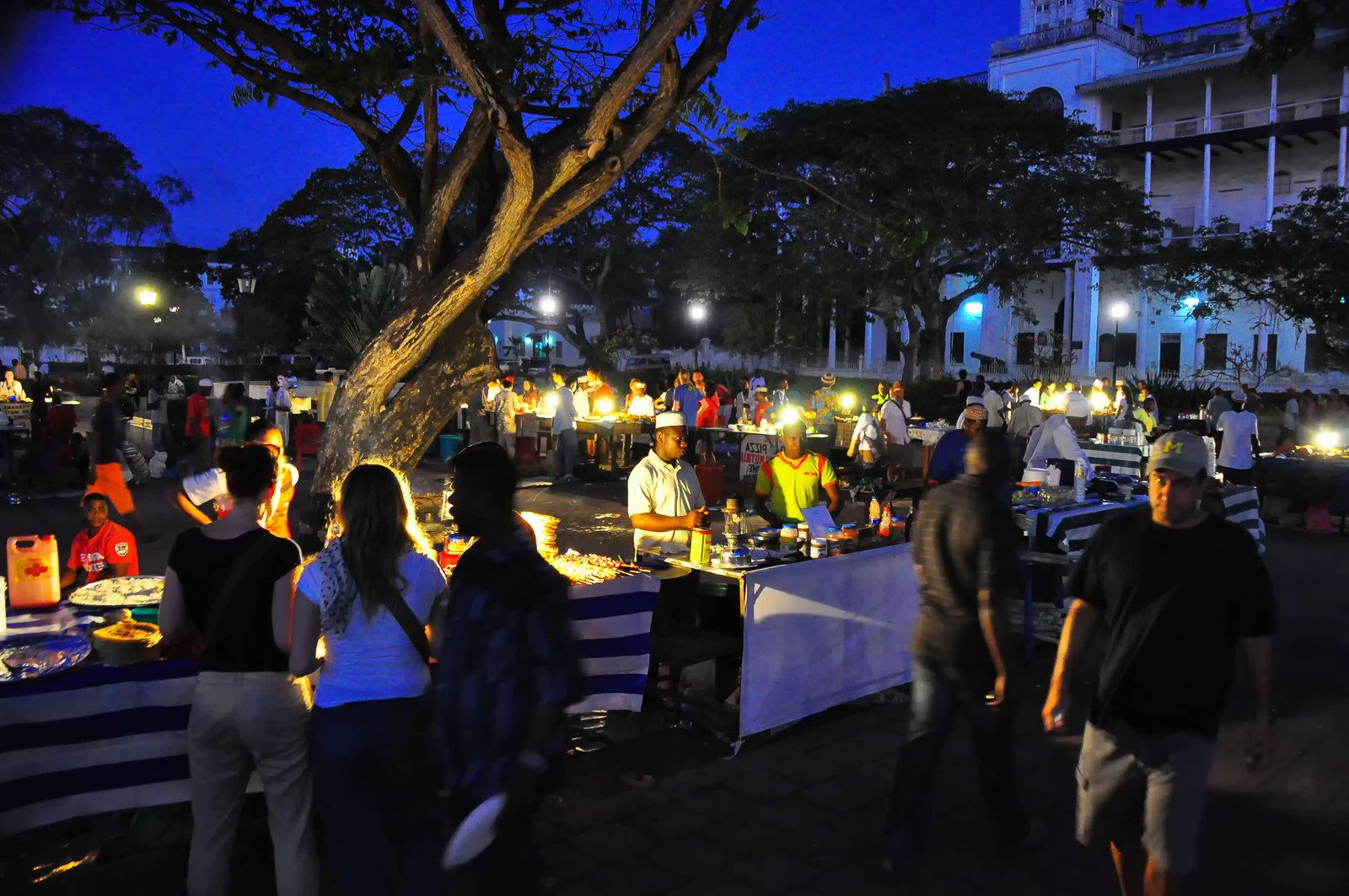
At blue hour, the lamps become architecture.
In Rod Waddington's 2013 photograph of Stone Town's food market, points of white light run across the darkening frame. Each one claims a counter: skewers and bottles in front, a vendor behind, customers gathering at the edge. The tables do not match, and no central host is visible. Yet the lights make the separate businesses legible as one room assembled outdoors.[6]
Inside the same historic quarter, Emerson Spice Rooftop Tea House organizes dusk in almost the opposite way. Its current instructions ask dinner guests to arrive around 18:00, reserve ahead and be ready for the first of eight servings at 19:00.[1] At Forodhani, meanwhile, an evening market gathers sellers, Zanzibari families and visitors around urojo, kebabs, sugar-cane juice and other foods. Its service is distributed among stalls rather than unified by one course sequence.[2][6]
It is tempting to arrange these scenes on a ladder: composed tasting menu above, unruly street food below. That would waste the view. Stone Town's more interesting dining story is horizontal as well as vertical. The rooftop and the seawall are two service systems working with the same sunset. One turns it into an appointment; the other uses it as a signal to multiply choices.
On the roof, everyone enters the same hour
Emerson Spice describes its Tea House as an “informal fine dining” seafood restaurant. At the time of publication, the house menu is listed at $55, built as eight tastings in eight servings and framed around seafood, spices and indigenous plants. Lunch runs separately. Dinner begins with an arrival around 18:00 for sundowners, followed by a prompt 19:00 first course.[1]
That hour between arrival and food is not empty. It makes the changing light part of the reservation. Guests reach the roof while the city is still visible, settle before darkness, then begin eating together. The kitchen gains a synchronized room; the room gains a beginning that no individual table has to invent. Even before a plate appears, the service has asked diners to exchange personal pace for a shared sequence.
Altitude performs another edit. Down in Stone Town's lanes, a person reads the city one turn, doorway and passing body at a time. From a roof, those fragments become a field of sound, walls and horizon. Emerson's own description promises the city's “sights and sounds” with the meal.[1] The view is therefore not incidental décor. It is one of the restaurant's techniques: Stone Town is made panoramic just as dinner is made sequential.
The menu's authorship is equally concentrated. Eight servings can vary, but they arrive as one proposition, paced by one house. A guest may interpret each course, yet the basic route has already been drawn. This is fine dining's particular power here—not greater authenticity, but controlled attention. The restaurant reduces the number of decisions so that timing, progression and the relation between plate and setting can become conspicuous.
On the seawall, dinner starts many times
Forodhani uses repetition instead of synchronization. A 2025 U.S. Department of Agriculture report describes tourists and Zanzibari families gathering at the market every evening. Its examples—urojo, shawarma, kebabs, coconut milk and sugar-cane juice—belong to different vessels, temperatures and speeds.[2] A reported walk through Stone Town in Condé Nast Traveler adds another small observation: meat-filled sambusa eaten while the sun went down in the ocean-facing gardens.[5]
No single vendor needs to provide a beginning, middle and end. One counter can specialize; the person eating supplies the sequence. Dinner might open with juice, stop after a skewer or continue at a second and third light. The market's basic unit is not the course but the encounter between a customer and a stall.
Waddington's photograph makes that modularity visible. One lamp illuminates a vendor's white coat; another catches stacked food; others recede under a large tree. Darkness preserves the gaps between them. The result is neither a single restaurant nor a random crowd. It is a temporary grid whose aisles are made by movement and whose menu expands whenever another counter switches on.[6]
Forodhani has a clock, then, but it is a loose one. Evening draws the participants together without requiring them to sit or eat at once. Each sale can restart the meal. Compared with the rooftop, diners receive more agency and less narrative control: more possible routes, less certainty about what the next serving will be or when it will come.
Spontaneity stands on buried systems
The contrast is not between a designed restaurant and an undesigned market. Forodhani's apparent ease depends on substantial civic work.
When the Aga Khan Trust for Culture completed a $2.4 million restoration of Forodhani Park in 2009, the project included walkways, lighting, sewage, drainage, civic amenities and repair of the seawall. The Trust described the park as one of the last open spaces in the densely populated World Heritage Site and as a longstanding place for civic meeting, leisure and entertainment.[3] Those systems do not dictate which stall serves what. They make repeated assembly possible.
This is the market's backstage. Drainage has none of a grill's theatre; a seawall does not announce a dish. But a public dining room beside the water needs firm edges, usable ground, waste systems, light and a route through the crowd. Fine dining often earns praise for hiding its support work. Forodhani shows a different refinement: shared infrastructure holds steady while many small services remain independent.
The park matters even more because open ground is scarce. UNESCO's urban study describes Stone Town as a high-density place of narrow streets with a limited number of public spaces. Along those streets, low masonry barazas attached to buildings double as places for commerce and socializing.[4] The habit of making social space at an edge is therefore not confined to Forodhani, but the waterfront lets that habit operate at another scale. A building's threshold can hold a conversation or a small transaction; the park can hold an evening economy.
Seen this way, the rooftop and the market do not float above their neighborhood. They are responses to its spatial pressure. One finds room by climbing. The other occupies a rare opening at the sea.
The city is edited twice
Both settings simplify Stone Town, but they simplify it differently.
The rooftop turns the town into a view and dinner into a sentence: arrive, watch the light change, follow eight servings. Forodhani turns the park into an index: this lamp, that aroma, one counter now, another later. The former gives the kitchen control over order. The latter gives the diner control over assembly.
Neither form owns the word “local.” Emerson says it uses the freshest local seafood along with spices and indigenous plants, but its public page does not publish supplier names or procurement records that would let a reader audit that claim.[1] The USDA's sector report says international hotel chains and regional hotel brands or restaurants tend to use different purchasing channels; it does not give venue-level supplier records for Emerson or the Forodhani stalls.[2] Sharing a horizon does not prove that the roof and the seawall share a larder.
Nor does visibility settle the question. A market counter lets customers see displayed food and the person selling it, but display is not a test of provenance, freshness or safety. A tasting menu can name an ingredient precisely without revealing its route to the kitchen. Each setting makes some work vivid and leaves other work out of sight.
The dates in the record set another useful boundary. The park restoration was completed in 2009; Waddington photographed the market in 2013; the USDA described the nightly gathering in 2025; Emerson publishes its current format and price on a page that can change.[1][2][3][6] Together, those sources establish a durable pair of service forms. They cannot promise which vendors, dishes or courses a diner will encounter on a particular night.
What they do show is a neighborhood with two answers to the same design problem: how to make dusk usable. Emerson Spice can declare a prompt 19:00 first course. The Forodhani record is plural instead: families, visitors, stalls and several foods sharing one evening market.[1][2][6]
That is not a contest between refinement and authenticity. It is a wider definition of sophistication. One service narrows choice into a house sequence; the other builds a place in which choices branch among stalls. Stone Town contains both.
Sources
- Emerson Spice Rooftop Tea House, official page — current dinner format, published price, menu framing, 18:00 arrival, 19:00 first course and advance-reservation guidance.
- Benjamin Mtaki, “Zanzibar Hotel Restaurant Institutional.” U.S. Department of Agriculture Foreign Agricultural Service, March 4, 2025 — Forodhani's nightly gathering, examples of foods and drinks, and the wider mix of hospitality procurement channels.
- Aga Khan Development Network, “$2.4 million Revitalisation of Forodhani Park in Zanzibar's Historic Stone Town completed,” July 28, 2009 — restoration scope, infrastructure, seawall and the park's civic role.
- UNESCO World Heritage Centre, “Stone Town of Zanzibar.” Urban Heritage Atlas — the high-density street pattern, limited public space, barazas, commercial uses and conservation context.
- Saumya Ancheri, “Iconic Itineraries: From Stone Town to the Serengeti, Exploring the Vastness of Tanzania.” Condé Nast Traveler, January 10, 2022; updated April 4, 2022 — reported street-level account of Stone Town, sambusa and sunset at Forodhani Gardens.
- Rod Waddington, “Food Market, Stone Town,” October 9, 2013. Wikimedia Commons — documentary photograph of the Forodhani market, licensed CC BY-SA 2.0.