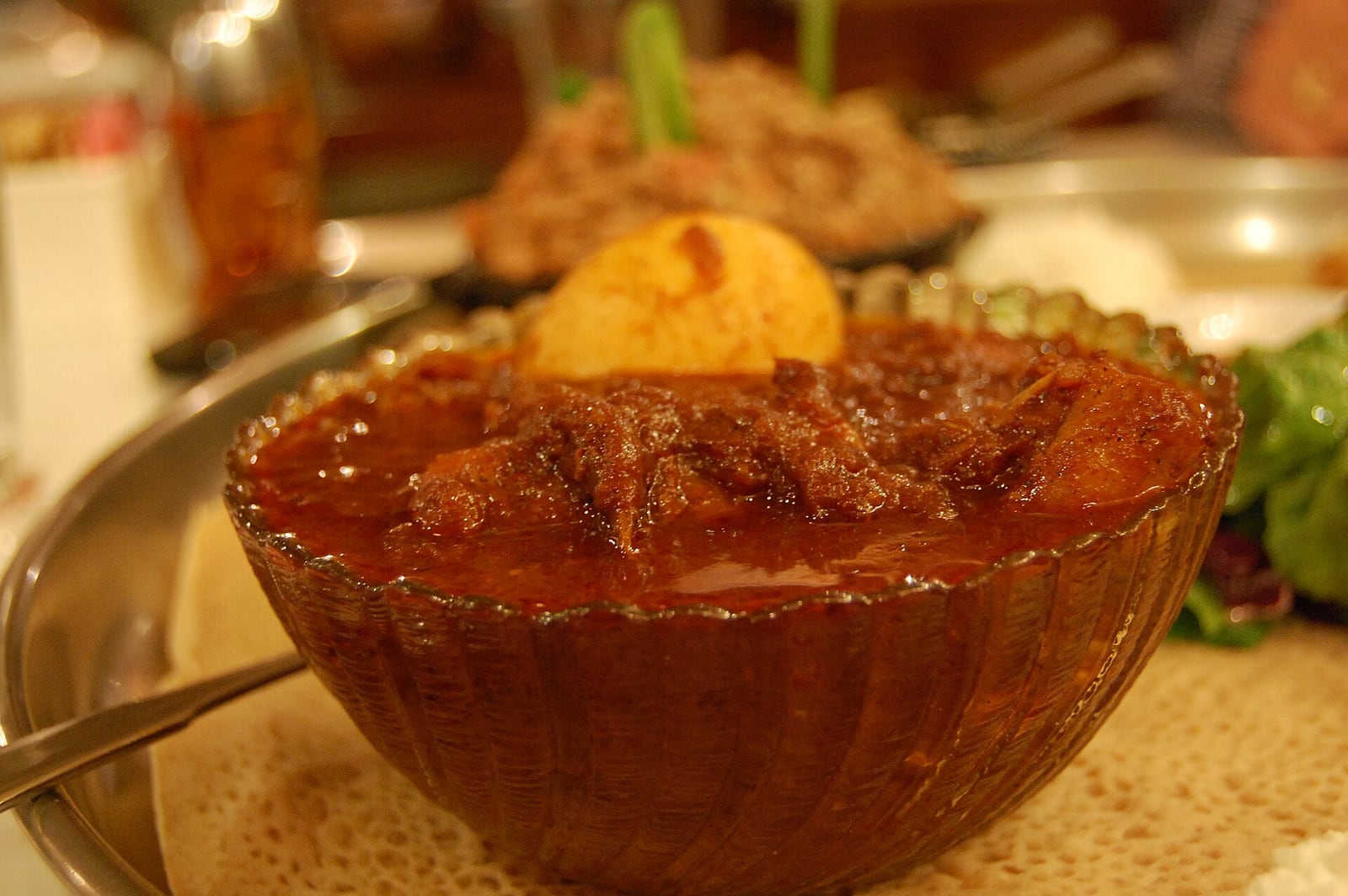
In Stu Spivack's photograph, doro wat arrives in a fluted glass bowl, dark red and glossy under warm restaurant light. A boiled egg rises at the back like a pale buoy. Pieces of chicken interrupt the surface. Around the bowl, the pinprick pores of injera wait for the sauce.[7]
What cannot be seen is the ingredient that built almost everything the camera can see.
The onions have surrendered their edges. They are no longer rings, dice or garnish; they have become the body of the stew. Berbere gives that body its deep rust color and layered heat. Niter kibbeh moves through it as aromatic fat. Chicken supplies the dish's name; chicken and egg supply its most legible shapes. But the first act of doro wat is an onion disappearing without being lost.
That distinction is the way into the plate. Doro wat is often introduced as Ethiopian spicy chicken stew, which is correct but structurally backward. Read only the nouns and the chicken seems to be the luxury while everything else supports it. Watch the pot in sequence and the hierarchy reverses: the sauce receives most of the time, and the meat enters a world the onion has already made.
Before the stew gets rich, it gets dry
Jeff Koehler's report from chef Yohanis Gebreyesus's family kitchen in Addis Ababa gives the transformation household scale. Yohanis's mother, Senait Worku, stirred five pounds of finely chopped red onions for 90 minutes before adding anything else. Her son described doro wat as fundamentally an onion dish, despite its chicken name.[5]
That is not a commandment that every pot must contain five pounds or run on a 90-minute stopwatch. Published methods vary too widely for that. The recipe adapted from Yohanis's cookbook uses one pound of onion, cooked dry for 18 to 22 minutes before oil and spiced butter enter; it later gives the assembled sauce almost another hour to concentrate.[1] A recipe published by the University of Florida Center for African Studies and provided by graduate student Kyle Fahey likewise begins by cooking minced red onion dry until translucent and beginning to color, then adds oil, tomato, garlic, berbere and kibe in stages.[2] Marcus Samuelsson's version starts its onions with spiced butter and runs on a shorter schedule.[3]
The differences matter. They prevent one documented recipe from masquerading as the sole authentic formula. But the longer versions make an essential piece of craft especially visible: onion is not merely browned and pushed aside so the protein can sear. Its water has to leave, its raw bite has to soften, and its chopped geometry has to collapse far enough that thousands of pieces read as one sauce.
At the beginning, the pot is crowded and wet. Steam rises; a spoon draws a path that quickly closes. As moisture leaves, the same quantity occupies less space and demands more attention. The spoon begins to scrape rather than simply stir. The risk changes from watery blandness to scorching. Reduction is not empty waiting. It is the cook deciding, minute by minute, how much onion flavor and texture can be concentrated without turning bitter.
This is also why a shortcut made with a small onion garnish and a thickener misses the dish even if the finished color looks right. Flour or starch can imitate viscosity. It cannot reproduce an onion that has spent enough time becoming the cooking medium.
Fat enters late, then returns at the finish
In the dry-onion methods, fat arrives only after the onion has begun its transformation.[1][2] That sequence keeps two jobs distinct. First, the cook drives off moisture and builds the base. Then oil and niter kibbeh carry garlic, ginger and spices through that base. The sauce begins to grow rich after the onion has begun to cook down.
Niter kibbeh is not plain melted butter with a more exotic name. In Saveur's adaptation of Yohanis's method, butter is clarified, separating clear butterfat from water and milk solids, then gently infused with cardamom, coriander, fenugreek, long pepper, nigella, grains of paradise, dried basil and dried thyme before being strained.[4] Other house blends need not reproduce that exact list. The useful principle is that the fat has been seasoned before it reaches the stew. It contributes aroma even when no whole spice remains visible.
The Yohanis doro-wat recipe uses that butter twice: most goes into the onion base, while a final spoonful is drizzled over the finished chicken.[1] This is a small but elegant piece of sequencing. Long cooking integrates the first addition; the last addition restores a fresher aromatic top note. The same ingredient speaks from inside the sauce and from its surface.
Berbere has its own timing. In that recipe it is first mixed with cold water into a paste, then cooked into the onion with just enough extra water to keep the dense mixture from scorching.[1] The University of Florida sequence similarly gives berbere time in the base before the chicken is added.[2] Heat is therefore not dusted on at the end. Chile and warm spice have to lose their raw edge and become continuous with the onion and fat.
This layering explains why “spicy chicken stew” is such a thin description. It makes spice sound like a volume control. Doro wat uses it as architecture: berbere supplies color, warmth and depth; niter kibbeh supplies a second aromatic register; ginger and garlic sharpen the middle; the reduced onion holds all of them in suspension.
The chicken is the guest in its own stew
The strongest recipes resist crowding the pot with meat. Saveur's headnote to the Yohanis version says directly that doro wat is largely about sauce and warns against overwhelming it with chicken.[1] Its proportions are revealing: four medium onions and four eggs against two chicken legs divided at the joints. The chicken remains important, but abundance is measured in sauce rather than in a pile of protein.
The method protects that hierarchy. Skinless, bone-in chicken pieces are lightly scored, simmered until tender, then lifted out while the sauce continues reducing for 55 to 60 minutes. Only after a final seasoning with mekelesha do the chicken and eggs return to be coated and reheated.[1] Removing the meat is a practical act of control: the sauce gets the concentration it needs without forcing the chicken to endure every remaining minute.
At the table, bone changes the pace. In this bone-in version, doro wat is not consumed as a uniform spoonful or a boneless cube in anonymous gravy. The diner moves between tearing injera, gathering sauce, finding meat and working carefully around joints. That alternation is part of the pleasure. The chicken offers tenderness and recognizable form; the sauce keeps pulling attention back to everything that happened before it arrived.
A restaurant may be tempted to replace the joint with a pristine breast medallion because it looks more luxurious and asks less of the guest. That can be a thoughtful variation, but it also removes bone, dark meat and the slower eating rhythm in one stroke. Refinement should know what it is trading away.
The egg is a surface made to be breached
The boiled egg appears almost absurdly calm against the red stew: smooth, pale, self-contained. Then the sauce stains it.
In the Yohanis method, each peeled egg is slashed lengthwise four times before it enters the pot.[1] The cuts are modest, but they plausibly give the sauce more edges to enter and cling to. When cut at the table, bland white, rich yolk and hot, aromatic gravy arrive in unequal bands. The contrast refreshes the palate without pretending to neutralize the dish.
Samuelsson's introduction remembers the eggs as spicy alongside the tender meat and berbere-laced sauce.[3] “Spicy egg” sounds like a separate preparation, but the recipes suggest a mechanism: the egg becomes seasoned by contact. It is a compact demonstration of the whole dish's logic. A mild ingredient does not need to be reformulated if the sauce can reach it.
This is where precision plating can easily become too tidy. Put a clean half-egg on one side, chicken on another, and a measured dot of onion purée between them, and every component remains visually intelligible. The dish's central action—one thing permeating another—has vanished. Doro wat earns its red smears.
Injera decides what “finished sauce” means
Two published chef-and-cookbook versions seem to disagree about the correct endpoint. The Yohanis recipe concentrates its sauce until thick, then transfers the stew to a platter of injera.[1] Samuelsson explicitly tells cooks not to worry when his sauce remains loose and broken rather than binding like a European-style sauce: it is supposed to soak into injera.[3]
That is a useful disagreement, not a flaw to edit away. Kitchens, families and recipes vary. “Doro wat” does not promise one laboratory viscosity. Both versions, however, judge the sauce in relation to the bread beneath it. Thick sauce must still coat and travel; loose sauce has somewhere intentional to go.
Injera is therefore not a side order performing the work of a fork. Its porous surface becomes a second register of the stew. The top stays available to tear; the area beneath a spoonful darkens, softens and records the sauce.[3][5] One bite can carry a fresh sour edge, another a fully soaked section, another chicken, another egg. The bread turns a single pot into changing textures without forcing the kitchen to separate them.
For fine dining, this relationship is more instructive than any individual garnish. A kitchen can make its injera thinner or thicker, ferment it to a particular acidity, cut it neatly or serve it communally. What it should not do casually is demote it to a decorative crisp. A crisp can add crunch. It cannot receive the stew, and receiving is one of injera's structural jobs here.
Feast time remains in the sauce
Doro wat's long preparation is not only a claim to kitchen seriousness. It belongs to a social calendar.
Koehler's Addis Ababa report follows Senait's family through Ethiopian Orthodox Easter after 56 days of Lenten fasting. Doro wat begins the evening before the feast; the family tastes it after returning from church in the early morning, saves the central meal for lunch, and reheats the pots later as people continue moving through the house.[5] In a 2026 Associated Press report from Ethiopian Orthodox communities around Washington, D.C., worshippers likewise break the Easter fast with doro wat, first in small bites after the overnight service and later around family tables.[6]
These are specific Christian feast accounts, not a claim that every Ethiopian eats doro wat in the same religious setting or follows one ritual. They do reveal what restaurant shorthand often deletes. The dish can hold anticipation, abstinence, advance labor, reheating and repeated hospitality. Its concentration makes sense inside duration.
That gives the modern dining room a better ambition than simply making doro wat expensive. A serious restaurant interpretation might serve a smaller portion, source exceptional chicken, refine the berbere blend or control the sauce with extraordinary consistency. None of those changes is inherently a betrayal. The real test is whether concentration still returns as generosity.
The sauce should remain larger than the protein. The egg should be allowed to take color. Injera should do more than decorate the plate. Service should give the diner enough of the sauce to gather, spill, soak and revisit. If every red trace is confined to a perfect circle, the kitchen has preserved the ingredients and misplaced the dish.
Doro wat's luxury is not that chicken and egg sit on top of an onion sauce. It is that a mountain of onion can be reduced until it seems to vanish, then reappear everywhere at once: carrying chile, holding perfume, coating meat, entering an egg and darkening the bread beneath the final spoonful.
The onion disappears only as an object. As hospitality, it gets bigger.
Sources
- Saveur Editors, “Slow-Cooked Spicy Chicken With Hard-Boiled Eggs (Doro Wat),” adapted from Yohanis Gebreyesus and Jeff Koehler's Ethiopia (2019) — proportions and sequence for the dry-cooked onion base, berbere paste, chicken, sauce reduction, scored eggs, finishing butter and injera service.
- Riley Ravary, “Doro Wot with Kyle Fahey.” University of Florida Center for African Studies — a recipe provided by graduate student Kyle Fahey, who describes it as a synthesis of lessons from Ethiopian women cooks; it documents dry onion cooking followed by staged oil, aromatics, berbere, kibe, chicken and mekelesha.
- Marcus Samuelsson, “Doro Wat.” Epicurious, June 3, 2009 — an alternate recipe and the explicit account of a loose, broken sauce designed to soak into injera.
- Saveur Editors, “Ethiopian Spiced Clarified Butter (Niter Kibbeh),” adapted from Yohanis Gebreyesus and Jeff Koehler's Ethiopia (2019) — clarification, spice infusion, straining and storage method for the aromatic cooking fat.
- Jeff Koehler, “This Epic Meat Feast Is How Ethiopians Celebrate Easter.” Saveur, April 19, 2019 — reported scene from Senait Worku and Yohanis Gebreyesus's Addis Ababa family kitchen, including onion scale, timing, fasting and feast service.
- Jessie Wardarski, “Ethiopian Orthodox Christians in Washington mark Easter with prayer, joyful family celebrations.” Associated Press, April 13, 2026 — contemporary reporting on worship, fast-breaking, doro wat and family celebration in the Washington, D.C., area.
- Stu Spivack, “Ethiopian wat,” Wikimedia Commons — source record, authorship, capture date and restaurant context for the real doro-wat photograph used as the article image. Resized under the CC BY-SA 2.0 license.