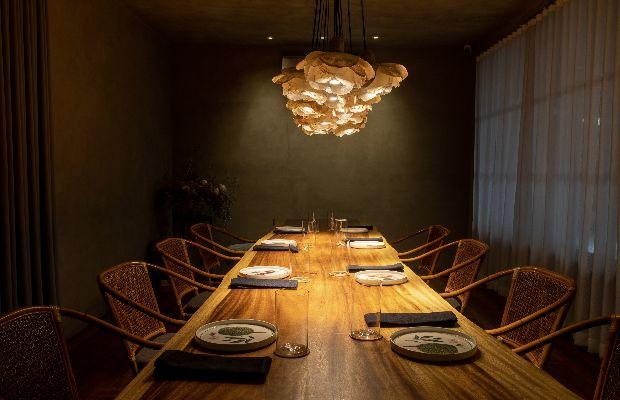
At many ambitious restaurants, the hardest thing to disguise is anxiety. You can feel it in the choreography, in the lecture length, in the way luxury ingredients are pushed forward like credentials. Toyo Eatery is expensive and highly intentional, but it does not read as anxious. What makes the restaurant interesting in 2026 is not just that it modernizes Filipino food. It is that it keeps building a room where precision can stay relaxed, where fermentation and preservation can coexist with banana leaves, hand-eating, folk-song references, and the feeling that dinner is still meant to be shared rather than admired from a distance.[2][3][4][5]
That balance is easier to see if you start with the formats instead of the accolades. The official site fixes the basic frame first: Toyo is currently operating in Makati, Tuesday through Saturday evenings, from its address in The Alley at Karrivin.[1] The current Tock page then shows two distinct ways into the restaurant: a casual kamayan setup served family-style at the center of the table, and an 8-course tasting menu in the indoor dining room with a full view of the kitchen.[2] Asia's 50 Best describes the same split in broader terms: Toyo serves both Kamayan and tasting menus, and the kamayan version explicitly asks guests to drop the cutlery and eat from a feast laid out on banana leaves.[3] Those details are more than booking trivia. They explain the house. Toyo is not trying to trap Filipino food inside one imported prestige format. It wants one restaurant to speak in two related dialects: laboratory precision and communal ease.
Image context: the lead image uses Asia's 50 Best's interior photograph of Toyo Eatery rather than a plated close-up. That choice fits because this article is really about the room's social temperature. Toyo's accomplishment is not one photogenic dish in isolation; it is the way the whole dining environment makes technical food feel inhabited and open.[3][5]
The name tells you the scale of the idea
Tock's description gives away the most important clue early. Toyo, it says, is the Filipino word for soy sauce, an ordinary condiment with deep complexities, and the restaurant is built around reassessing and rediscovering Filipino culture through food.[2] That is an unusually disciplined naming decision. Many high-end restaurants reach for abstraction or grandeur. Toyo starts with a pantry staple.
The choice matters because it defines the scale of the project. This is not a restaurant trying to prove Filipino cuisine belongs in fine dining by borrowing someone else's vocabulary of luxury. It is starting from something modest, brown, salty, familiar, and culturally dense, then asking how much meaning can be built from that level upward.[2][3] Asia's 50 Best says Jordy Navarra developed the concept around his own memories and heritage as well as those of the Filipino people.[3] Read beside the name, that sounds less like branding than like method. The restaurant wants to work from common Filipino reference points rather than from imported symbols of seriousness.
That is why the menu split makes sense. A tasting menu can show refinement and control. A kamayan table can stage memory, informality, and group pleasure. Put together, they say that Filipino food does not need to choose between depth and comfort.[2][3][5]
Technique is used to intensify memory, not erase it
The easiest bad reading of Toyo is that it is a modernist restaurant using local ingredients for color. The 50 Best pages point in the opposite direction. Discovery describes Navarra as trying to capture the terroir of the Philippines through locally sourced ingredients, with menus full of references to popular culture and clever shifts in flavor and texture.[4] The page then gets specific in a useful way: pork barbecue skewers built from three cuts of meat and finished in bone broth, and a complex Bahay Kubo salad that draws from the children's folk song.[4]
Those examples are revealing because they show what the kitchen is actually doing. Technique is present, but it is not there to bleach out recognition. The point is not to make Filipino memory more abstract so it can pass as elite. The point is to make familiar reference points hold more layers. Pork barbecue stays pork barbecue, but the structure is tightened. Bahay Kubo stays tethered to a widely known song, but the dish becomes a way of staging agricultural abundance and regional texture at the table.[4]
Discovery adds another detail that sharpens this reading: guests may be asked to roll lumpia themselves or crush ingredients with mortar and pestle.[4] In lesser hands, those moves would feel gimmicky. Here they suggest something more coherent. Toyo does not want the diner to receive Filipino culture as a sealed performance. It wants participation, but participation in a guided way, where technique and storytelling are held together by service.[4] That is a much harder thing to do well than simple fine-dining polish.
Hospitality is the real separator
This is where the March 2025 50 Best story becomes indispensable. It says the food is of fine-dining quality, but the vibe, service, and hospitality are far from old-school formality, with furnishings by local artisans helping set that tone.[5] That is not incidental decor language. It gets to the restaurant's deepest advantage. Plenty of ambitious restaurants can source carefully and ferment aggressively. Far fewer can stop excellence from turning stiff.
The kamayan explanation in the same story makes the point even more clearly. Navarra describes it as an attempt to recover the comfort of beach-day meals where banana leaves are spread out and food is eaten salo-salo, in a shared style.[5] He admits the restaurant cannot literally recreate that scene, but it can chase the same energy and the same comfort.[5] That sentence explains Toyo better than most chef manifestos. The restaurant is not trying to museum-ify Filipino customs. It is trying to translate their emotional temperature into a contemporary dining room.
The operating structure supports that translation. The story presents Toyo as a husband-and-wife project, with May Navarra handling operations and Jordy Navarra leading the kitchen, and describes the staff in family terms rather than as anonymous luxury machinery.[5] Asia's 50 Best makes the same household logic visible from another angle when it says the restaurant prioritizes Filipino produce and people, building long-term relationships with local farmers and artisans.[3] The restaurant therefore feels personal in two directions at once: inward, through the way the Navarras run it, and outward, through the supplier and artisan network that shapes the room.
Why Toyo matters now
By 2026, Toyo no longer needs the "rising" label. Asia's 50 Best says the restaurant first entered the ranking in 2019, was named The Best Restaurant in the Philippines 2025, and also won the Gin Mare Art of Hospitality Award that year.[3] Those honors matter, but the stronger reason to care is structural. Toyo looks like a durable answer to a broader fine-dining problem: how to become more exacting without becoming more alienating.
The restaurant's current operational details reinforce that sense of discipline. Tock shows weekly reservation releases on a fixed Thursday schedule three weeks out, a defined dinner service, and two clearly differentiated menu experiences rather than a fuzzy all-purpose room.[2] That kind of clarity usually signals a house that knows what it is doing. But clarity alone is not why Toyo lasts in memory. The restaurant lasts because the technical side and the social side are pulling in the same direction.
Asia's 50 Best also notes that Toyo won the Sustainable Restaurant Award 2023, removed beef from its menus in 2022, and now runs a menu of which roughly half the dishes are vegetarian or vegan.[3] The March 2025 story adds that the local-first supply model has created business for communities that were not previously selling what they grow, and that the Navarras are already thinking about going deeper into cultivation themselves.[5] Put plainly, Toyo's "people and planet first" line is not decorative copy. It is changing what ingredients appear, how they are sourced, and what kind of hospitality the restaurant can honestly claim.[3][5]
That is why the house-with-a-lab image feels right. One half of Toyo is unmistakably technical: fermentation, preservation, carefully structured tasting, regional references tightened into plate logic.[2][3][4] The other half is domestic in the best sense: sharing, comfort, looseness of posture, handcrafted surroundings, service that tells stories without freezing the room.[3][4][5] Many restaurants can do one side. Toyo's distinctiveness is that it keeps both alive at once. In Manila, luxury does not have to arrive as distance. At Toyo Eatery, it arrives as recognition sharpened by craft.[2][3][4][5]
Sources
- Toyo Eatery official website, current contact page and opening details for the Makati restaurant.
- Tock, "Toyo Eatery - Makati City, NCR," current reservation page describing the restaurant concept, Thursday release schedule, Kamayan menu, 8-course tasting menu, and dinner hours.
- Asia's 50 Best Restaurants 2025, "Toyo Eatery," list profile covering the restaurant's current ranking, chef background, Kamayan and tasting menus, sustainability commitments, and 2025 awards.
- 50 Best Discovery, "Toyo Eatery - Manila - Restaurant," discovery profile covering the locally sourced menu logic, Bahay Kubo salad, pork barbecue skewers, interactive dining elements, and service storytelling.
- 50 Best Stories, "Toyo Eatery wants the world to feast Filipino style," March 2025 feature on the restaurant's relaxed hospitality, local artisan furnishings, kamayan comfort logic, husband-and-wife operating structure, and local-first sustainability model.