The easiest way to misread Epice is to imagine that a restaurant named after spice must be trying to hit the diner with force. The house itself tells you otherwise. On the official page, head chef Charne Sampson says she has always loved spices, but that the point is not heat, it is "layers of flavour that roll over the palate in waves."[1] Food & Home, visiting in early 2025, heard the same principle almost word for word.[3] That repetition matters because it describes not just a slogan, but the technical problem the restaurant is trying to solve.
As of April 11, 2026, Epice's current public menu makes that problem unusually legible. The restaurant is selling a Spice Journey and a Vegetarian Spice Journey at R2195 per person, with dishes that move from oyster, granadilla, kimchi prawn tart to cumin, sweet potato, beef drippings, berbere, then into combinations such as Cape Point tuna, asada, jalapeno, avocado, perlemoen, labneh, sultana, pork, Cape Malay, a sorbet trolley, and dessert options that split between coconut, lime, pineapple, saffron kulfi and "Ouma's milk tart." The same page also shows how tightly the experience is managed: a discretionary 13.5% service charge, deposit-backed reservations, a no-BYO rule, and an adults-first child policy.[1] None of that reads like a casual tasting menu. It reads like a restaurant that knows spice only stays intelligible when sequence is protected.
The timing is not accidental. The official site currently banners Epice as a 2026 Eat Out Awards two-star restaurant, while the World Culinary Awards page records it as Africa's Best Restaurant 2024.[1][4] Those distinctions matter less as trophies than as evidence that the house has managed to turn a potentially messy idea into a repeatable system. Plenty of chefs can add spice. Far fewer can make spice feel architectural.
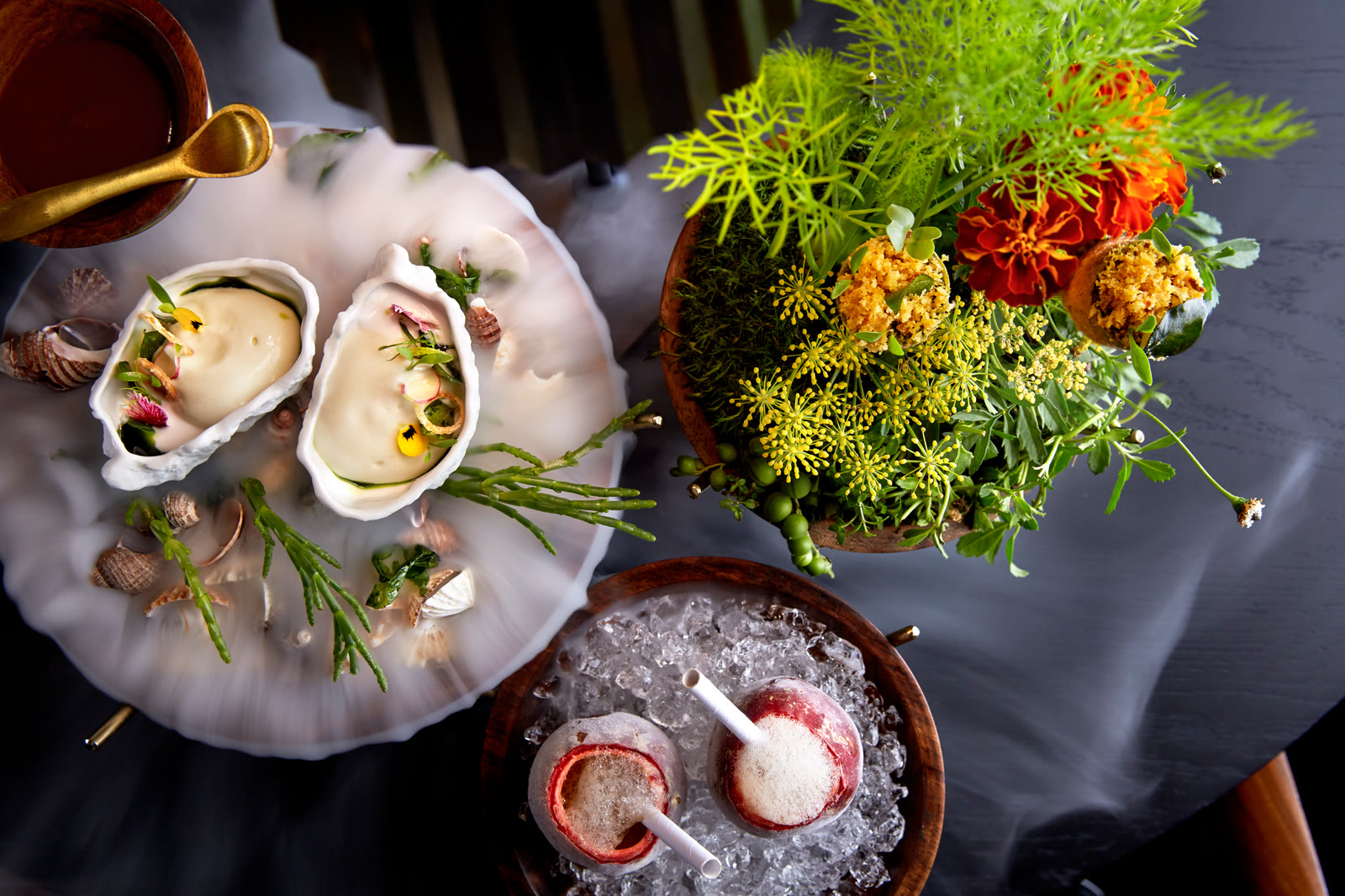
Image context: the lead image uses one of Epice's official dining photographs rather than a portrait of the chef or an exterior shot. That choice fits the piece because the argument turns on how the meal moves. The oysters, herb bowl, and icy palate cleansers share one overhead frame, which makes the restaurant's logic visible before a single paragraph explains it.[1]
1. The menu is written as movement, not as one long crescendo
The current menu is revealing because it refuses the lazy equation of spice with escalation. Instead of moving from mild to hotter to hottest, the dishes change register repeatedly.[1] Acidic fruit appears beside shellfish. Jalapeno shows up next to avocado and tuna. Berbere is paired with sweet potato and beef drippings rather than used as a blunt red-flag signifier. Cape Malay enters one course as a marker among pork, sultana, labneh, and perlemoen, not as a standalone identity claim.[1]
That is where the technical intelligence sits. A lesser restaurant might organize a "spice" meal like a collection of statements: here is the Indian course, here is the North African course, here is the hot course, here is the cooling course. Epice works harder than that. It keeps allowing perfume, sweetness, salinity, sourness, dairy, smoke, and heat to overlap just long enough that one note modifies the next. Sampson's "waves" line is useful precisely because it implies recurrence rather than climax.[1][3]
The menu language supports that reading. Granadilla, kimchi, berbere, asada, jalapeno, labneh, and kulfi appear in one tasting structure without the page ever pretending these references belong to one pure lineage.[1] The point is not authenticity theater. The point is controlled traffic. Spice is being used as connective tissue across a multilingual pantry.
2. The room and the carts are part of the craft
This is also why the restaurant's service design matters so much. The official page calls Epice an intimate restaurant; Inside Guide's 2025 special page describes an atmospheric 45-seater in Franschhoek looking onto the Le Quartier Francais courtyard and organized around a "fragrant culinary journey"; Food & Home later described the same room as hushed, earth-toned, and opened toward a cool courtyard planted with lemon trees and greenery.[1][2][3] That environment is not a decorative afterthought. It is part of how the flavors land.
Food & Home's account is especially helpful because it shows the meal being explained rather than merely delivered. A cocktail trolley arrives first. Then another cart rolls to the table carrying spices that are discussed one by one, with provenance and flavor profile unpacked for the guest.[3] Inside Guide's 2025 description of the restaurant as a "fragrant culinary journey" lands for the same reason: the house wants the meal to be read in motion, course by course.[2] These are not Instagram gimmicks in the context of the article's argument. They are pacing tools.
The trolleys keep the diner aware that spice is something to read, not merely to endure. One cart primes the palate. Another interprets the spice vocabulary. The sorbet trolley resets the mouth before the meal turns again.[2][3] In other words, the house does not simply compose spicy dishes; it composes the conditions under which spice can still feel differentiated after six, eight, or more encounters with aromatic intensity.
3. Cape Malay is the hinge, but not the border
The restaurant's strongest move may be that it never treats Cape Malay influence as a museum piece. Inside Guide's 2025 special page says Sampson's refined dishes are inspired mostly by India, but also by Spain, Japan, Mexico, and other "exotic locales."[2] The current official menu then shows what happened after that outward-looking pantry hardened into a house style: Cape Malay sits beside berbere, jalapeno, kimchi, labneh, and kulfi without any one reference being asked to explain the whole restaurant.[1][2]
Put together, those accounts explain why the menu feels so open without becoming vague. Cape Malay is the hinge because it gives the house a lived South African grammar of sweetness, perfume, curry leaf logic, and historic Indian Ocean traffic. It is not the border because Sampson is clearly willing to let that grammar absorb other routes: East African berbere references, Mexican salsa macha, jalapeno, labneh, kulfi, kimchi.[1][2]
That matters because modern fine dining often mishandles cross-cultural reference in one of two ways. It either sanitizes everything into luxury-neutral sameness, or it stacks global cues on the plate so aggressively that the meal turns into passport collage. Epice avoids both traps by keeping the references subordinate to flow. Even the course names suggest that the target is a tasting rhythm, not a geography lesson.[1]
4. Operational discipline keeps the spice legible
The operational rules on the official page look severe until you read them through the food. Deposits are required to prevent no-shows. Cancellations must happen 48 hours ahead for a full refund. Guests cannot bring their own wine. Children under eight are not admitted. Lunch is restricted to Friday to Sunday, while dinner runs Monday to Sunday.[1] These details are not romantic, but they are clarifying.
Epice is trying to preserve concentration. A meal organized around aromatic layering can get muddy fast if the room becomes too noisy, if pacing starts slipping, or if every table introduces its own bottle logic. The rules protect sequence for the same reason the menu uses trolleys and palate cleansers. They limit interference.
That helps explain why the restaurant has scaled recognition without loosening its concept. Inside Guide's 2025 special page was already describing an atmospheric room in Franschhoek built around a fragrant culinary journey.[2] The official page now presents that same idea in a tighter public form, with the Spice Journey positioned as a fully controlled sequence, while the World Culinary Awards page places Epice at the top of the continent for 2024.[1][4] What those milestones suggest is not that Epice found the hottest possible flavor profile. It suggests the restaurant found a way to make spice repeatable as structure.
Why Epice feels sharper than the usual "spice restaurant" pitch
Epice works because it understands that spice is not a singular sensation. It is timing, residue, temperature, sweetness, perfume, and relief. The official menu reads like a route map rather than a dare.[1] The room design and carts make explanation part of the service rather than a lecture added afterward.[2][3] The wider source trail points to a chef who treats Cape Malay memory as a base note while letting the pantry travel outward.[2][4]
That is why the restaurant feels worth writing about as craft rather than novelty. A spicy tasting menu is easy to pitch and hard to sustain. Epice sustains it by keeping the diner aware of movement: wave, reset, reprise, contrast, return. The heat may arrive, but it is never left alone to do all the work. The restaurant's real achievement is that it makes spice behave with manners.[1][2][3][4]
Sources
- La Colombe Restaurant Group, "Epice Restaurant, Franschhoek" - official page covering the restaurant's current menu wording and prices, Charne Sampson's statement about spice as layered waves, the 2026 Eat Out Awards banner, reservation rules, location, trading hours, and the official dining photographs used for this article.
- Inside Guide, "Épice Winter Special: R895 for 7 courses" - 2025 feature covering the atmospheric 45-seat room at Le Quartier Francais, the fragrant-journey framing, and Sampson's India-led menu influences alongside Spain, Japan, Mexico, and other routes.
- Food & Home Magazine, "Things to do in Franschhoek: Add spice to your life at Epice" (January 8, 2025) - feature covering the courtyard setting, spice-cart explanation, breadboard detail, and Sampson's emphasis on flavor layers rather than raw heat.
- World Culinary Awards, "Africa's Best Restaurant 2024" - winner page confirming Epice (South Africa) as the category winner.