
Cinefood's 9-minute, 24-second short on Le Calandre is useful because it refuses the easiest myth about avant-garde fine dining.[1] The title, "Dare to Win," sounds as if the film will celebrate risk as swagger, rupture, and chef-as-solitary-genius bravado. The footage does something quieter. It keeps returning to hands, bowls, notebooks, copper pans, family clippings, and a room designed to soften the landing.[1][2] The result is a stronger claim than generic innovation talk. At Le Calandre, daring survives because it has been domesticated.
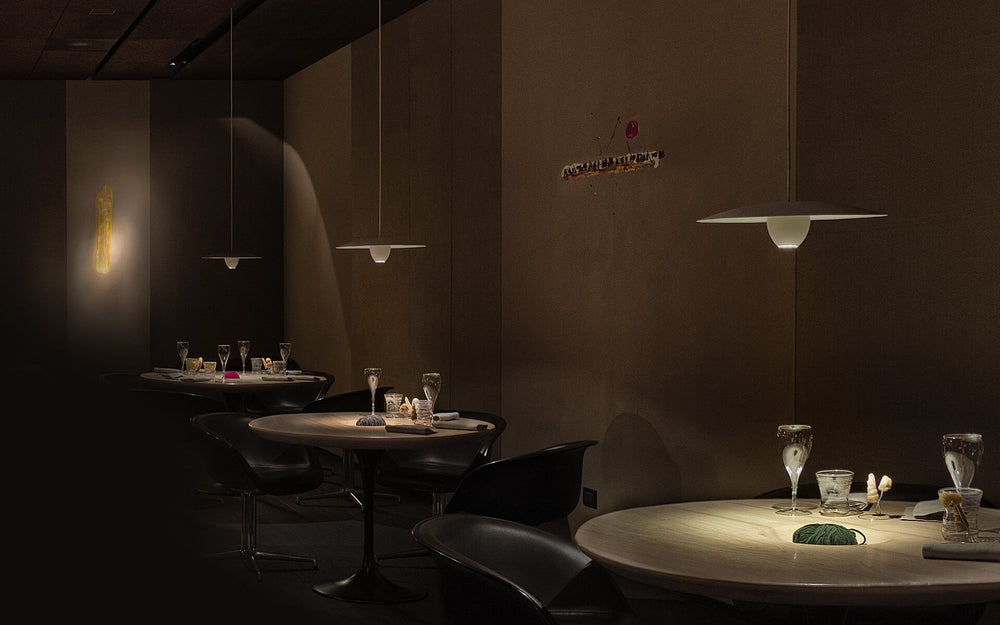
That argument is already visible in the official materials around the restaurant. The Alajmo site does not describe Le Calandre as a laboratory detached from ordinary hospitality. It describes a family house that became the headquarters of the group, passed from Erminio Alajmo and Rita Chimetto to their sons in 1994, with Max in the kitchen and Raf in the dining room.[2] The same page says the dining room was designed by the brothers to create a multisensory atmosphere for Max's playful cuisine, with tables carved from a 300-year-old ash oak tree and hand-blown glassware made with artisans across Italy.[2] That is not an incidental design note. It is the system that keeps provocation readable.
The restaurant's own menu language points the same way. Le Calandre does not force guests into a single heroic tasting track. The official page says diners can choose between three tasting menus or take 3, 4, or 5 courses across the menus, with Classici dedicated to house signatures and the Max and Raf menus changing seasonally.[2] The current Spring 2026 PDF makes that plurality concrete, listing iconic references such as Murrina Cappuccino, Suono N'Uovo, and a variation on "Passi d'Oro" risotto, while also splitting the seasonal field into different narrative lanes at 280 euro.[4] Le Calandre is therefore worth an annotated viewing not because the film uncovers hidden chaos, but because it shows how much structure is required before play can feel effortless.
The signature-dishes section on the official site gives the best vocabulary for reading the video. It calls Max's philosophy a blend of memory, intuition, and creativity, then describes the cuttlefish cappuccino as playful reclamation of humble ingredients and the Chocolate Games as an invitation to approach the table with lightness and wonder.[2] The film honors that language, but it also quietly corrects how people often hear it. The wonder matters, yet the movie keeps insisting that wonder has to be stabilized by lineage, documentation, and room discipline before it can function as luxury.
Image context: the cover uses Le Calandre's official dining-room photograph. It is the right image here because the documentary's most interesting point is architectural: the restaurant's boldness is cushioned by dark walls, suspended light, round tables, and a deliberately private atmosphere built by the family itself.[2]
Around 0:00 to 0:30, the film defines daring through touch before it gives us a thesis
The opening half-minute does not begin with a manifesto card or a roar from the pass.[1] It begins with macro close-ups of glossy, saffron-toned surfaces, a narrow stream of sauce, and kitchen motion seen at working distance.[1] That opening matters because it withholds the theatrical language implied by the title. The film does not present daring as violence done to ingredients. It presents daring as proximity to texture and finish.
That reading fits Le Calandre's own public self-description better than the usual "boundary-pushing" cliche. On the official site, the restaurant's history is inseparable from Max and Raf's division of labor, and the signature-dishes text puts feeling, memory, and human connection alongside research.[2] In other words, risk is already embedded in a family-operated hospitality structure. The camera's early insistence on spoon, bowl, liquid, and station work turns that structure visible. Before the film tells us who Max Alajmo is, it shows us a house where the smallest tactile decisions carry the emotional burden.[1][2]
Around 1:30 to 3:30, notebooks, stations, and copper pans turn invention into a repeatable system
The middle stretch is where the documentary becomes more revealing. We see kitchen stations from a slight remove, a notebook propped open on a counter, cooks checking a printed page, and a conversation staged against a wall of copper pans.[1] Those are not glamorous images in themselves. That is exactly why they matter. The documentary is saying that daring at Le Calandre has to pass through notation, repetition, and inheritance before it reaches the guest.
The family history page sharpens that point. The Alajmos' story begins not with Le Calandre's global prestige but with food trade in postwar Padua, then the founding of the restaurant in 1981, and finally the handoff to the children in 1994.[3] Seen against that history, the notebook and clipping imagery in the film do not feel decorative. They feel constitutional. This is a restaurant where experimentation has been archived into family memory rather than detached from it.
The menu architecture reinforces the same reading. The official site says Classici holds the signature repertoire while the Max and Raf lanes keep changing with the seasons.[2] That is a subtle but important arrangement. It means Le Calandre does not treat invention as permanent revolt against its own past. It keeps one menu lane available as a memory bank and lets the other lanes absorb seasonal drift. The film's kitchen paperwork and station checks are visual proof of that balance.[1][2][4]
Around 4:20, the highlighted "Suono N'Uovo" clipping shows how Le Calandre packages provocation
The clearest moment arrives when the documentary cuts to an article clipping with the line "La nuova provocazione si chiama Suono N'Uovo."[1] Even without speaking Italian, the structure is readable: the film wants us to notice that one of the house's provocations has already moved from plate to printed discourse. A dish is not only served; it is named, framed, and argued over in public language.
That is a decisive correction to the macho version of culinary daring. If the house were running on shock alone, there would be no need for this layer of documentation. Yet Le Calandre's own signature-dishes text makes clear that Max's work is built from dialogue between opposites, humble ingredients reclaimed with play, and a willingness to keep emotion close to research.[2] The Spring 2026 menu PDF places Suono N'Uovo directly inside the active tasting program rather than in a museum annex.[4] The documentary's clipping therefore does double work: it treats provocation as part of the restaurant's public memory, and it shows that the provocation survives because it can keep being cooked, explained, and re-entered into current service.[1][2][4]
That same section also clarifies the house difference between novelty and continuity. The official page says the brothers designed the room to support Max's playful cuisine, not to overwhelm it.[2] If a dish like Suono N'Uovo begins from symbolic or disorienting intent, the room and service grammar keep that intent from becoming abrasive. The provocation arrives in a softened register: intimate table, low light, controlled service trajectory, and enough family history behind it that the guest feels guided rather than ambushed.[1][2]
Around 7:00 to the end, the film turns the chef back into one role inside a family machine
Late in the short, the imagery cycles back through interview setup, family photographs, and more plating rather than building toward one climactic chef-genius statement.[1] That choice is editorially smart. It leaves the viewer with a system rather than a personality cult. The chef is central, but he is never isolated from the dining room, the archive, the older generation, or the younger cooks working the stations.[1][3]
That is why Le Calandre still feels important in 2026. Plenty of luxury restaurants can produce a surprising dish. Fewer can make surprise feel habitable. Le Calandre's public materials say that the house is built around family roles, signature memory, seasonally refreshed menu lanes, and a handcrafted multisensory room.[2][3][4] The film translates those claims into moving images and ends up making a sharper argument than its title first suggests. Daring here is not raw disruption. It is the patient conversion of provocation into something guests can inhabit with pleasure.
Replay the short with that in mind and the documentary's calmness starts to look like the point.[1] The bowls, the notebook, the article clipping, the copper pans, the room, the family photographs, and the return to plating all say the same thing. Le Calandre's real luxury is not that it dares. It is that it knows how to house daring without letting it turn noisy.
Sources
- Cinefood, "Dare to Win | Le Calandre Alajmo," YouTube video, published February 17, 2026.
- Alajmo, "Le Calandre" official page, covering the restaurant's history, dining-room design, tasting-menu structure, and signature-dish framing.
- Alajmo, "Alajmo Family" official history page, covering the family's postwar food-business roots, the 1981 opening of Le Calandre, and the intergenerational structure of the group.
- Alajmo, "Calandre SPRING 26" menu PDF, covering the current 280 euro tasting price and active dishes including Suono N'Uovo and Passi d'Oro.