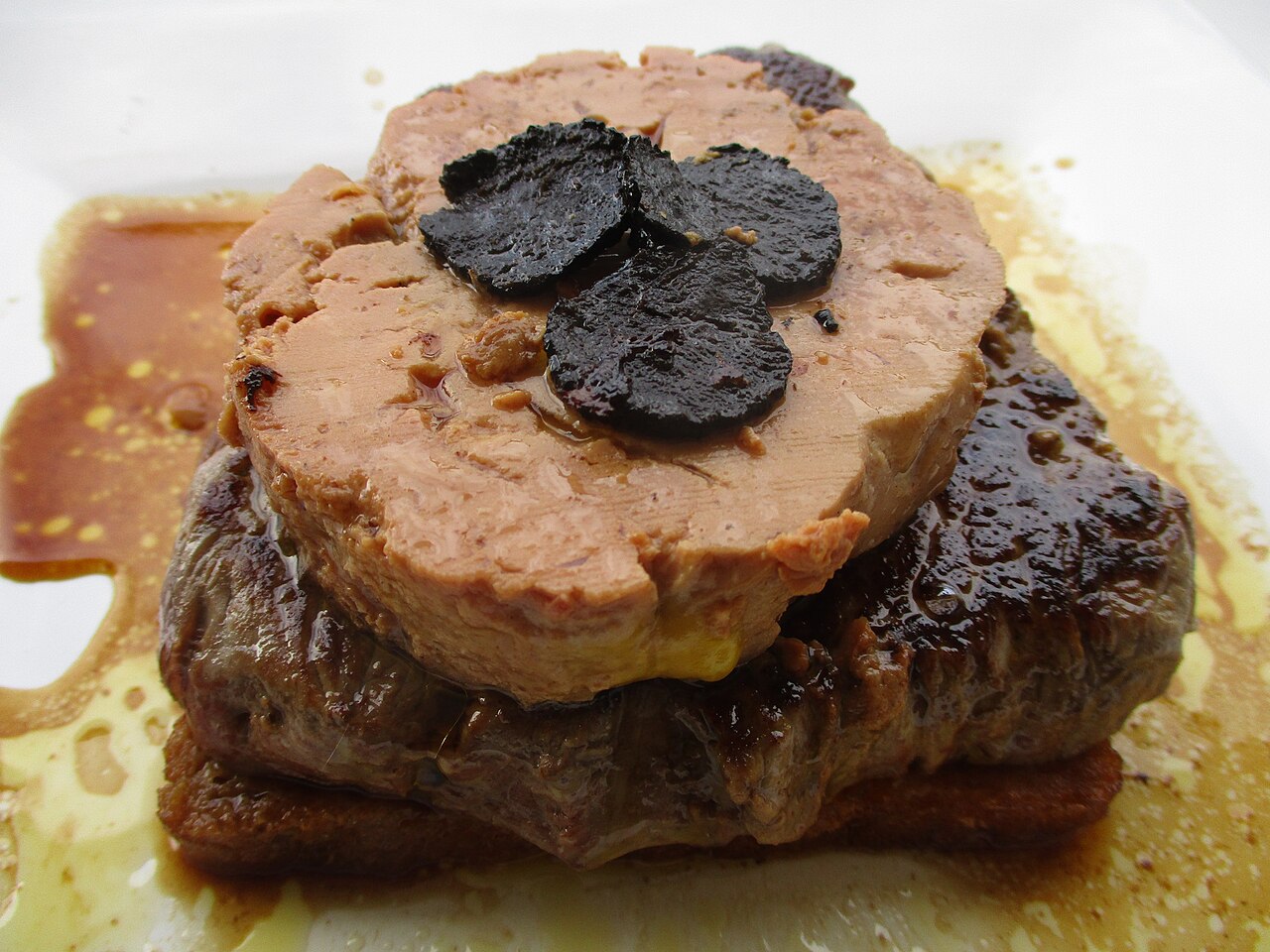
Tournedos Rossini looks like fine dining refusing to apologize for itself. Beef fillet, fried bread, foie gras, black truffle, and Madeira sauce are all expensive signals before the fork moves. But the dish is more interesting than a pile of rich ingredients. It survives as a classic because it makes excess obey a tight piece of engineering: base, meat, fat, aroma, sauce, heat, and immediate service all have to line up.
That is why bad versions feel vulgar so quickly. Add too much sauce and the toast goes soggy. Sear the foie gras too early and it slumps into grease. Cook the beef past the point of tenderness and the dish becomes heavy before it becomes luxurious. Shave truffle as decoration rather than aroma and the top note disappears. Tournedos Rossini is not a maximalist dish in the loose sense. It is a vertical dish, and vertical dishes punish disorder.
Its origin story is appropriately slippery. The dish is named for Gioachino Rossini, the Italian composer whose reputation for appetite became part of his public afterlife. Northern Public Radio's NPR-distributed Rossini food essay frames Tournedos Rossini as a reminder that his connoisseurship was famous enough to attach a whole recipe grammar to his name: beef, foie gras, truffle, Madeira, and demi-glace.[2] But the exact authorship is less stable than the legend. D'Artagnan's classic-dish account names Careme, Casimir Moisson, and Escoffier as rival possibilities, then treats the uncertainty as part of the dish's inherited mythology.[4] That uncertainty is useful. It keeps the focus on the grammar rather than on one immaculate birth certificate.
The Bread Is Not A Platform
The crouton is easy to treat as an edible coaster. It is more important than that. In Escoffier's recipe tradition, the tournedos are arranged on round bread croutons fried in clarified butter, and the sauce is built around Madeira, meat glaze, and truffle.[1] Great British Chefs' modern version keeps the same basic architecture: fried bread first, steak next, foie gras on top, thin truffle, and Madeira gravy poured at service.[3] The bread is the only part of the stack that can accept both fat and juice without pretending to be delicate.
That makes the crouton the dish's structural conscience. Beef gives the dish its center, foie gras gives it the dangerous richness, truffle gives it the aromatic ceiling, and Madeira sauce ties the plate to old French sauce craft. But the bread tells the kitchen whether all of that has been timed correctly. If the slice arrives crisp enough to catch the first rush of sauce and meat juice, the dish feels composed. If it arrives waterlogged, every expensive ingredient suddenly looks like it was asked to do too much.
The best crouton is therefore not nostalgic garnish. It is a control surface. It lets the diner cut down through the stack and get contrast: crisp edge, tender beef, melting foie, sauce, then the slight chew of bread that has absorbed just enough. Without that base, Tournedos Rossini becomes steak with toppings. With it, the plate becomes a small construction.
Foie Gras Is A Timing Test
Foie gras is the ingredient that makes the dish famous and the ingredient most likely to ruin it. It has to be seared hard enough to brown and warm, but not so long that it gives up its shape. Great British Chefs has the foie gras seared over high heat at the end, then placed over the rested steak before the truffle and sauce finish the dish.[3] That sequence matters because foie gras does not behave like a normal garnish. It keeps score.
If the steak is too hot, the foie gras melts into a fatty blanket. If the steak is too cool, the top element feels detached. If the foie gras is too thick, the dish becomes blunt; too thin, and it loses the luxurious pressure that makes the dish recognizably Rossini. The kitchen is aiming for a narrow middle: enough heat to make the liver taste roasted and alive, enough structure to let the slice sit visibly on the beef.
This is where the dish's old luxury becomes modernly awkward in a productive way. A contemporary kitchen cannot simply rely on foie gras to impress. The ingredient is contested, expensive, and texturally unforgiving. It has to justify itself through proportion. In a strong Rossini, foie gras is not a trophy. It is the layer that changes the beef's register from steakhouse pleasure to grand-cuisine tension.
The Sauce Should Not Shout
Madeira sauce is the dish's final test of restraint. Escoffier's preparation points toward meat glaze, Madeira, and truffle rather than a loose pan gravy.[1] Great British Chefs' version builds a deeply reduced beef stock and Madeira gravy, then uses it to finish the assembled stack.[3] Both approaches tell the same story: the sauce should bind the dish, not flood it.
Madeira is useful because it brings sweetness, oxidation, acidity, and winey depth without making the plate taste like dessert. Demi-glace gives body. Truffle ties the sauce to the slices on top. The result should be glossy and concentrated, almost architectural in its own right. It has to make the beef taste more like beef, the foie gras less isolated, and the bread more purposeful.
The mistake is to use sauce as apology. Tournedos Rossini does not need to be softened into comfort food. Its pleasure is the contact between firm and soft, crisp and melting, roasted and aromatic. A heavy pour reduces those contacts to richness. A precise spooning lets the diner move between them.
Why It Feels Difficult Now
Tournedos Rossini feels difficult now because it asks for expensive ingredients, serious sauce work, careful meat cooking, last-minute foie gras, and a diner willing to accept overt luxury without irony. It is not built for casual speed or plant-forward minimalism. Even the origin accounts read like a catalog of grand-cuisine names and vanished restaurant aura rather than like a recipe designed for frictionless modern service.[4]
But the dish's supposed heaviness is also what makes it worth rereading. Tournedos Rossini is not interesting because every dinner should return to foie gras and truffle. It is interesting because it shows how old luxury worked when it was at its best. The point was not simply to place the costliest ingredients in one frame. The point was to make each ingredient occupy a role so clear that removing one would change the whole mechanism.
Take away the bread and the dish loses its base. Take away the foie gras and it becomes a dressed tournedos. Take away the truffle and the top note vanishes. Take away Madeira and demi-glace and the layers stop speaking to one another. That interdependence is the reason the dish still teaches something, even to kitchens that would never put it on the menu.
The Stack Has To Earn The Bill
The photograph used here is useful because it does not hide the problem.[5] The beef is visible. The foie gras is visible. The truffle is visible. The sauce is visible. Even the bread base peeks out beneath the stack. There is nowhere for the dish to disappear into plating tricks. The luxury either organizes itself or it looks merely expensive.
That is the standard Tournedos Rossini sets. It asks a kitchen to make abundance legible. The diner should understand, without a lecture, why the bread was fried, why the beef was cut thick, why the foie gras was seared at the last second, why the sauce was reduced, and why the truffle belongs on top rather than buried below. The dish is rich, but richness is not the argument. Coordination is.
When it works, Tournedos Rossini has the confidence of an old room that still knows how to move. The knife passes through layers that could have fought each other and instead arrive in order: crisp, tender, melting, aromatic, glossy. It is not subtle food. It is disciplined food wearing a velvet jacket.
That makes the dish more than a period piece. It is a reminder that maximalism can be precise. Fine dining often talks about restraint as subtraction, but Tournedos Rossini offers a different lesson: sometimes restraint means adding the dangerous things and then making each one behave.
Sources
- Auguste Escoffier, "Tournedos Rossini" in Le Guide Culinaire, via ckbk - classic recipe reference for the fried crouton, shallow-fried tournedos, Madeira, meat glaze, foie gras, and truffle structure.
- Tom Huizenga, "Composers In The Kitchen: Gioachino Rossini's Haute Cuisine," Northern Public Radio/NPR, 2024 - context on Rossini's gourmand reputation and the dish grammar attached to his name.
- Great British Chefs, "Tournedos Rossini Recipe" by Richard Turner - modern method reference for bread, beef, foie gras, truffle, and Madeira gravy sequencing.
- D'Artagnan, "Rediscover a Culinary Classic: What is Tournedos Rossini?" 2017 - classic-dish account summarizing the ingredients and the uncertain origin traditions around Careme, Moisson, and Escoffier.
- Wikimedia Commons, "File:Tournedos Rossini 1.jpg" - 2019 real photograph by Arnaud 25 used as the article image.