Matsutake is one of the few luxury ingredients that becomes less interesting when treated like a luxury ingredient. Shave it everywhere, bury it under sauce, or use it as a price signal, and the mushroom loses the thing that made it worth chasing: a sharp, piney, almost spicy aroma that wants space, heat, and restraint. The mushroom is expensive, but its real value is not abundance. It is timing.
That timing begins before the kitchen sees a crate. Matsutake is not a neat farm product waiting to be scaled. In Japan, Tricholoma matsutake is tied to red pine forests, soil condition, understory management, weather, and the appearance of fruiting bodies that cannot be scheduled like cultivated button mushrooms.[1] A fine-dining room that buys matsutake is therefore buying a piece of ecological uncertainty. The mushroom arrives with a forest clock attached.
The result is an ingredient that behaves differently from most restaurant luxuries. Caviar can be portioned. Truffle can be shaved tableside until the guest understands the bill. Wagyu can announce itself through marbling before it is cooked. Matsutake is more volatile. Its fragrance is the argument, and fragrance is fragile. The kitchen's job is to keep the mushroom from becoming just another expensive brown thing.
The Scarcity Is Ecological
Japan's matsutake story is often told as a story of appetite, but the stronger sourcing story is habitat. A 2024 Mycoscience paper on long-term matsutake harvests in Nagano notes that domestic production in Japan reached 12,000 metric tons in 1941 and has fallen over roughly 80 years to only a few dozen tons in recent years.[1] That is not a normal premium-food cycle. It is a collapse in the conditions that let a wild ingredient appear at scale.
Nippon.com's 2025 data summary, citing Japan's Ministry of Agriculture, Forestry and Fisheries, gives the same arc in more market-facing terms: production peaked at 12,000 tons in 1941, stood at 3,500 tons in 1960, and in recent years has stayed below 100 tons except for a 140-ton crop in 2010.[2] It points to the loss of satoyama, pest damage, and a shortage of younger workers as part of the decline.[2] That matters because matsutake is not simply "rare" in the abstract. It is rare because a specific human-forest system has changed.
The Global Fungal Red List Initiative gives the ecological pressure a wider frame. It lists Tricholoma matsutake as Vulnerable, with an inferred decline of more than 30 percent over 50 years, tied to declining pine-forest habitat, disease, altered land use, and in some areas damaging collection methods.[3] The mushroom's status is not just a Japanese supply inconvenience. It is a warning that the luxury depends on living habitat, not only on picker skill or importer access.
That is why a matsutake course should not feel casual. The ingredient carries more than seasonality. It carries the memory of open pine stands, thin litter, disturbance, careful collection, and a rural labor system that no dining room can recreate once it has disappeared. A chef does not need to lecture the guest about all of this, but the plate should behave as if the mushroom is difficult to replace.
Imports Do Not Make It Simple
Japan's declining harvest did not end matsutake appetite; it globalized it. The U.S. Forest Service's account of commercially harvested American matsutake explains that harvest from Pacific Northwest forests increased as the similarity between American matsutake and Japanese matsutake helped meet Japanese demand.[5] The same abstract is careful about the management boundary: American matsutake can remain a sustainable forest product if harvest and forest habitats are managed appropriately.[5]
That "if" is doing a lot of work. The moment a wild ingredient becomes internationally valuable, the supply chain tends to hide the forest. Diners see a menu line. Chefs see a distributor sheet. Pickers, permits, weather, export channels, forest ownership, and habitat disturbance sit behind the plate. Matsutake's price can make it seem like the market has solved the problem, when the market has only moved the problem through a longer route.
For restaurants, imported matsutake can be a legitimate answer. It may be the only practical answer in many seasons. But the substitution changes the story. A Japanese domestic matsutake, a Korean pine mushroom, a Pacific Northwest American matsutake, and a Scandinavian specimen may share a culinary family resemblance, yet they arrive from different forests, labor systems, and freshness windows. A good menu should not flatten all of that into one word.
This is where sourcing becomes more than procurement. The fine-dining question is not "Can we get matsutake?" It is "What kind, from where, at what stage, and for what use?" A mushroom bought for a clear soup has different requirements from one bought for charcoal grilling. A mushroom that will be shaved raw over rice needs aroma and texture at a different pitch from one folded into a sauce. The best kitchens buy for the dish, not for the trophy.
Aroma Is The Main Ingredient
Matsutake's famous fragrance is not garnish. It is the ingredient's center of gravity. Kikkoman's glossary identifies methyl cinnamate and mushroom alcohol as contributors to matsutake's unique aroma and recommends preparations such as earthenware-pot cooking and matsutake rice because they preserve or carry that fragrance.[4] Those uses are not accidental traditions. They are aroma-management systems.
This explains why matsutake is so easy to mishandle in a tasting menu. Too much fat can blur it. Too much acid can turn it sharp in the wrong direction. Too many other aromatic ingredients can make it hard to tell whether the diner is tasting matsutake, broth, smoke, soy, citrus, or garnish. The mushroom is forceful, but not indestructible. It needs a frame that lets the volatile note move upward.
The classic solutions are simple for a reason. Rice captures aroma while giving the mushroom a quiet stage. Clear soup lets steam carry the scent before the spoon arrives. Charcoal grilling can deepen the exterior while leaving the mushroom's perfume intact if the cook stops before smoke becomes the point. A small covered vessel can turn service into a reveal: lift the lid, and the first course is smell.
Fine dining does not have to imitate those forms exactly, but it should respect their logic. Matsutake wants to be encountered through air as much as through chewing. A clever dish that hides the aroma under a heavy jus has solved the wrong problem. The mushroom's best luxury is not intensity alone. It is the way intensity arrives and then fades.
The Service Move Is Restraint
A kitchen can make matsutake feel expensive by using too much of it. That is the dull route. The better move is to make the mushroom feel specific. One slice on hot rice can do more than a crowded pile if the rice is seasoned correctly. A few grilled pieces can carry a course if the smoke is clean, the salt is light, and the mushroom is still juicy. A broth can become memorable if the matsutake is allowed to scent the liquid without turning the bowl into mushroom tea.
Restraint also protects the supply story. If the article's ecological sources teach anything, it is that matsutake should not be treated like a garnish that exists for menu glamour.[1][2][3] The ingredient's scarcity is not a branding trick. It reflects reduced habitat, forest disease, altered land use, changed rural labor, and the difficulty of managing a wild mycorrhizal resource across generations. The plate should spend that difficulty carefully.
This does not mean every matsutake dish must be austere. Butter can work. Beef can work. Egg can work. Shellfish can work. But the supporting ingredients should behave like architecture, not competition. If the diner cannot smell the mushroom before thinking about the sauce, the kitchen has lost the hierarchy.
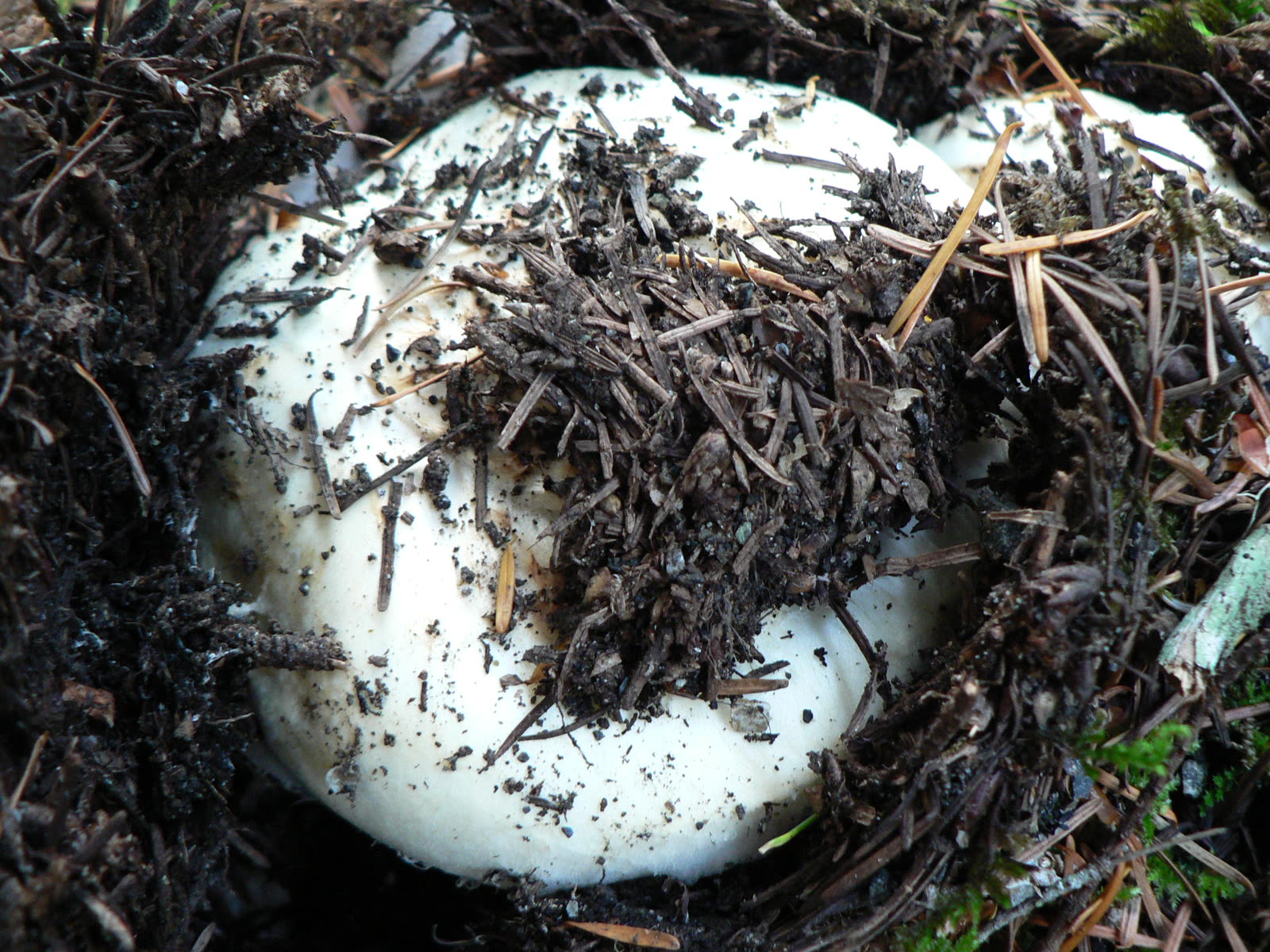
The image used here keeps that hierarchy honest. Steve Redman's 2008 National Park Service photograph shows a matsutake at Mount Rainier, thick-stemmed and plain among forest litter.[6] It is not a glamour shot. That is why it works. The mushroom's fine-dining value begins as something half-hidden, seasonal, and dependent on the ground around it. The dining room only receives the final evidence.
What The Price Should Buy
The right way to read matsutake's price is not as a proof of status. It is a bill for uncertainty. The customer is paying for habitat, search time, seasonal variance, sorting, transport, and the risk that the mushroom's most valuable quality will fade before service. The restaurant is paying for the discipline to keep the dish from becoming overbuilt.
That makes matsutake a useful test of a kitchen's confidence. An insecure kitchen makes the mushroom perform wealth. A confident kitchen lets the mushroom perform weather. It gives the guest enough heat to open the aroma, enough simplicity to recognize it, and enough context to feel why this wild thing is not interchangeable with the cultivated mushrooms that carry most menus through the year.
Matsutake is therefore not luxury because it is rare in the lazy sense. It is luxury because its rarity is legible all the way down: pine roots, forest floor, changing land use, hand harvest, import routes, volatile aroma, and a service window that punishes delay. It asks a restaurant to align procurement, cooking, and dining-room timing around a fragrance that cannot be fully controlled.
That is the pleasure when it works. The bowl opens, the rice steams, the mushroom lifts, and the room briefly smells like a forest after the menu has done everything it can to stay out of the way.
Sources
- Hitoshi Furukawa et al., "Long-term effects of forest management on the dynamics of Tricholoma matsutake harvest over 41 years in a Pinus densiflora forest in Nagano Prefecture, Japan," Mycoscience, 2024 - research article on Japanese matsutake production decline, red pine habitat, and forest-management dynamics.
- Nippon.com, "Japan Relies on Imports to Satisfy Craving for Matsutake Mushrooms," 2025 - data summary citing Japan's Ministry of Agriculture, Forestry and Fisheries on production decline, imports, satoyama loss, pests, and labor constraints.
- Global Fungal Red List Initiative, "Tricholoma matsutake" - conservation profile listing the species as Vulnerable and summarizing habitat decline, pine disease, altered land use, and collection pressure.
- Kikkoman Corporation, "Matsutake Mushrooms" - culinary glossary covering aroma compounds, cooking methods such as earthenware pots and matsutake rice, and short storage guidance.
- USDA Forest Service Research and Development, "Ecology and management of the commercially harvested American matsutake" - abstract on Pacific Northwest harvest, Japanese demand, and sustainability conditions for American matsutake.
- Wikimedia Commons, "File:Matsutake mushroom. (c814c29f8fa446cdb024c6c7b2c73a5f).JPG" - 2008 National Park Service photograph by Steve Redman at Mount Rainier National Park used as the article image.