Some luxury dishes survive because they are rich. Others survive because they are rare. Tour d'Argent's duck has lasted because it does something harder: it turns a bird into a system. Order duck here and you are not only ordering meat. You are ordering a breed choice, a sauce logic, a service sequence, a piece of silverware, a family archive, and a house style that has been kept legible across different dining eras. [1][4]
That is why the right way to read the dish is not as a relic of Parisian grand-restaurant theater. It is better understood as one of the clearest examples of how French fine dining makes technique visible without flattening it into demonstration. The room may have the famous Seine-and-Notre-Dame view, and the service may still carry the aura of ceremony, but the center of gravity is practical: how to extract the most pleasure from duck by making sauce, timing, and tableside finishing inseparable. [2][6]
The bird is only half the dish
Tour d'Argent's own current material is revealing on this point. The house describes duck as an institution there since 1890, and it still ties that identity to Challans birds from Maison Burgaud, its official supplier for more than seventy years. The ducks are raised in the open air in the Vendee and fed a vegetal diet before entering the restaurant's system of recipes and sauces. [4]
That sourcing detail matters because the dish is not built on brute luxury signaling. It is built on the argument that one specific kind of duck can take intense handling without losing tenderness. The sauce work depends on that. So does the contrast between breast, leg, and the darker, more metallic depth that enters once the carcass is pressed or otherwise folded back into the dish's liquid logic. [4][6]
The Ordre des Canardiers, the Rouen-based association devoted to preserving the Rouennaise duckling tradition, lays out the classical rules with unusual clarity. In its formulation, the duckling is not bled, is roasted while still bleeding for roughly 17 to 20 minutes, the breasts are lifted, and the carcass is pressed so the blood can help thicken the sauce. [6] That description is important not because every modern elite dining room reproduces every historical gesture in identical form, but because it tells you what the dish is trying to optimize. The climax is not a carving photo. The climax is a sauce whose body comes from the bird itself.
This is the point many diners miss when they treat pressed duck as a curiosity. The press is not there to make the room gasp. It is there because the old recipe is obsessed with concentration. French haute cuisine has many routes to luxury; this one gets there by refusing waste and by converting anatomy into sauce.
Frédéric Delair's real invention was codification
Tour d'Argent's shop text says the house inherited from Frédéric Delair a duck ceremony in which each gesture was codified, and it explicitly notes that the duck in the press bears Delair's name. It also states that each duckling served according to the house's recipes continues to be numbered. [4] That last detail is easy to treat as branding. It is more interesting than that.
Numbering does two things at once. First, it tells the diner that the dish is repeatable, which is a strong claim in fine dining where many restaurants now sell novelty more aggressively than mastery. Second, it makes continuity part of the taste. You are made aware that the duck in front of you belongs to a sequence, not a one-off flourish. The meal arrives with lineage attached.
Tour d'Argent's history page helps explain why this matters so much to the house. Andre Terrail bought the restaurant from Frederic Delair in 1911, folding Delair's culinary legacy together with the Cafe Anglais inheritance through family connection and restaurant culture. [1] In other words, duck at Tour d'Argent is not merely a famous plate inside an old restaurant. It is one of the mechanisms by which the restaurant narrates its own continuity.
That continuity is unusually concrete. The house history emphasizes that it is not a museum but a theater, and that distinction is useful. Museums preserve objects behind glass. The theater model preserves scripts by staging them again and again, with just enough adaptation to keep them alive. [1] The numbered duck is one of those scripts.
Why the ritual still works in the current room
After the renovation and reopening cycle completed in 2023, Tour d'Argent made a point of presenting the restaurant not as a sealed temple of heritage but as a revived dining room with an open kitchen and a more explicit view of the work. The official restaurant page describes Chef Yannick Franques conducting a brigade before "the most beautiful stage in the world," and it stresses that service gestures are elevated into a house ritual of their own. [2]
That description could sound like marketing inflation if the underlying object were weak. With duck, it lands because the choreography has a job to do. The room is on the sixth floor, looking across the Seine, Notre-Dame, and Ile Saint-Louis. [2] A lesser restaurant would let the panorama become the product. Tour d'Argent instead uses the panorama as the backdrop for a sequence that still ends at the plate and sauceboat.
The Christofle connection sharpens this further. Tour d'Argent's article on the silversmith describes a long relationship between the two houses, naming Christofle as the maker of the restaurant's famous duck press and noting that the historical Rubans collection, created in 1907, remains on the tables. During the renovation period, Christofle restored the restaurant's silverware rather than replacing it wholesale. [5] That is exactly the right design choice for a duck dish built around ritual. The silver is not neutral equipment. It is part of the house's claim that old forms can carry present-tense pleasure without becoming costume.
Franques preserves the grammar by changing the sentences
The strongest sign that Tour d'Argent is still alive rather than embalmed is that Yannick Franques does not treat duck as one frozen plate. On the chef page, the house describes him as a cook shaped by Eric Frechon, Christian Constant, Alain Ducasse, Jean-Louis Nomicos, and two-star work in Vence before arriving at Tour d'Argent in 2019. It also frames his role as reinterpreting the great classics of the house with contemporary lightness while keeping their generosity intact. [3]
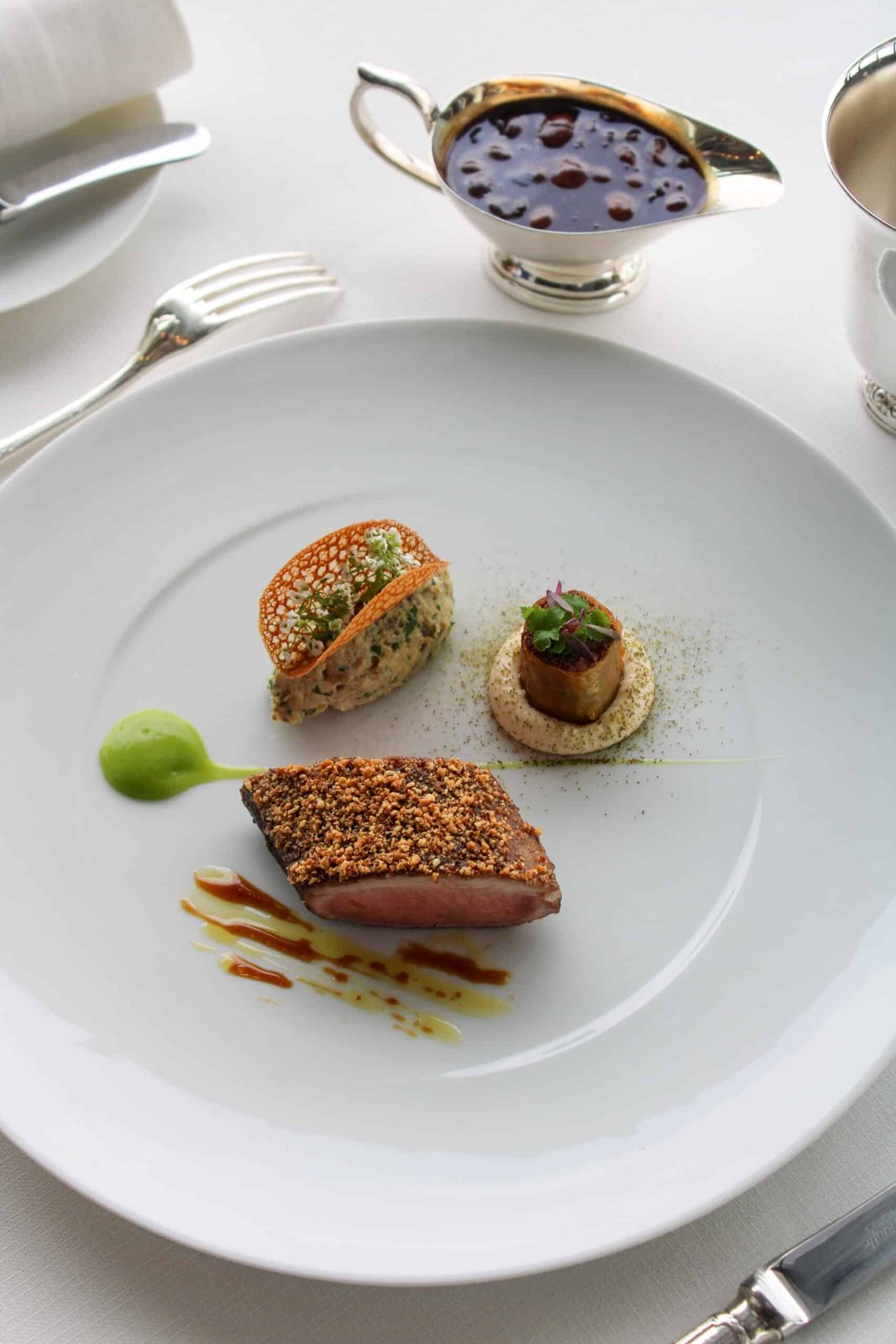
That is not abstract positioning. In 2024 the restaurant published a new duck composition, "Caneton au fil du temps," built from roasted duck breast from Maison Burgaud with smoked almonds, eggplant caviar with Greek yogurt, a confit leg in pastilla-style stifado, and a Corinth molasses jus. [7] Whether or not you think this version has the mythic force of the classic pressed-duck service, it proves something important: the house still treats duck as a living language.
This is where many heritage restaurants fail. They confuse fidelity with immobility. Franques appears to understand that the deeper inheritance at Tour d'Argent is not one immutable garnish set; it is the insistence that duck can carry the restaurant's identity if the cooking remains sauce-conscious, generous, and legible at the table. [2][3][7]
So the real achievement is not that the pressed duck still exists. It is that the restaurant can sustain both a canonical version and newer duck expressions without breaking the audience's sense of what the house stands for.
What you are really ordering
If you order duck at Tour d'Argent, order it for concentration and pacing. Order it if you enjoy the feeling that service is helping finish the argument of the dish instead of merely delivering it. Order it if you want one of the clearest surviving examples of French restaurant culture treating sauce as a public event rather than a hidden kitchen detail. [2][6]
Do not order it merely because it is famous. Fame is the least interesting part of the experience. The enduring value is that the house still knows what kind of seriousness the dish requires: a specific bird, a codified set of gestures, enough confidence to let ritual remain visible, and enough flexibility to let the chef write new duck sentences in the old grammar. [3][4][7]
That is why the dish still works. At Tour d'Argent, duck is not memorabilia. It is the place where French fine dining shows its hand most clearly: technique turned outward, service made structural, memory given a sauceboat and a number.
Sources
- La Tour d'Argent, "Our History" - house history, Terrail ownership timeline, and the 2023 reopening context.
- La Tour d'Argent, "The Restaurant" - dining room setting, service ritual, and current room description.
- La Tour d'Argent, "The Chef" - Yannick Franques biography and the house's description of his approach to the classics.
- La Tour d'Argent Epicerie, "Plain" - current house duck description, Challans/Burgaud sourcing, Delair codification, and numbered-duck note.
- La Tour d'Argent, "La Maison Christofle ou l'art sur la table" - the silver duck press and restored historical tableware.
- L'Ordre des Canardiers, "The recipe" - technical outline of Rouennaise duckling and the sauce-thickening role of the pressed carcass.
- La Tour d'Argent, "The 'Caneton au fil du temps'" - current 2024 duck creation by Yannick Franques.