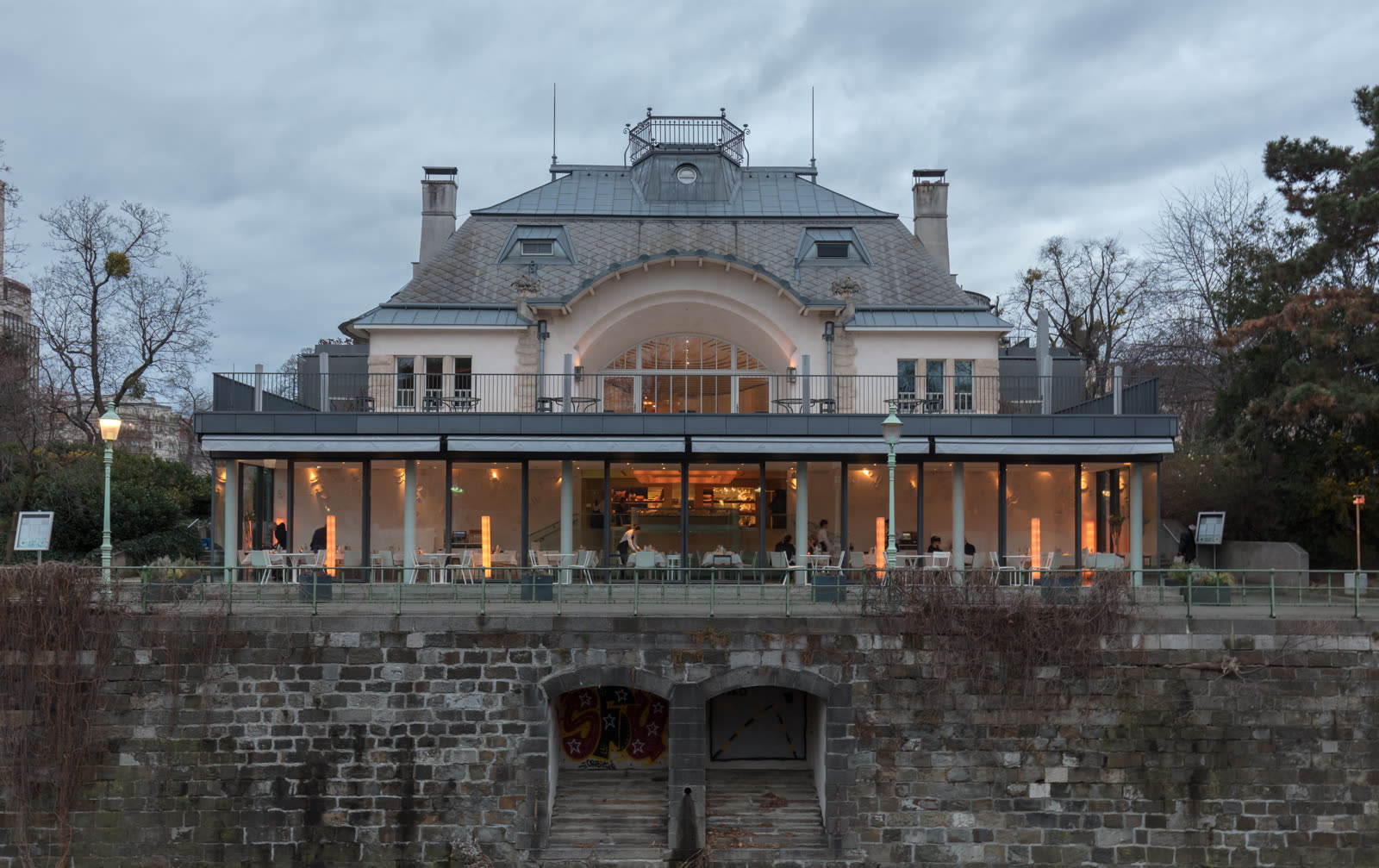
Walk into the Stadtpark on any evening and you will eventually see the pavilion. It sits at a slight angle to the Wienfluss, its glass-and-steel frame catching the park light differently than the surrounding trees. People walk past it with dogs or strollers. Then there is the restaurant inside — one of the most carefully constructed dining rooms in Europe, operating inside a public park, entirely without the marble-lobby insulation that most comparable tables use as social armor.
That gap between the setting and the ambition is the first thing Steirereck teaches you about itself.
The setting as a statement
Steirereck moved from its original Rasumofskygasse address in the third district to the Stadtpark pavilion in 2005. That was not merely a real estate decision. The building sits adjacent to the Wienfluss channel, inside a public park that Viennese families use daily, and the restaurant operates a casual Meierei counter right next to it — a dairy-focused counter-service spot open from early morning. [1]
The adjacency matters architecturally and philosophically. The fine-dining room is not hermetically sealed from the city; it operates with visible proximity to the public space around it. Diners arrive through the park, sometimes past children and joggers. This is not accidental. The Reitbauer family has consistently framed Steirereck as a place that belongs to Vienna, not above it.
The chef signal: Heinz Reitbauer Jr. and the logic of inheritance
The restaurant was founded by Heinz Reitbauer Sr. and his wife Margareta in 1970. Their son Heinz Reitbauer Jr. took over the kitchen in the 1990s and has since driven the culinary direction — but the operation has remained a genuine family structure: Birgit Reitbauer manages the floor and the wine program with a sensibility that is widely cited as one of the more distinctive in Central European fine dining. [1][2]
What makes the Reitbauer Jr. signal legible is the consistency of position. He does not rotate through international sourcing trends or chase ingredient fashions from other culinary capitals. The kitchen is built around Austrian identity: freshwater fish from lakes and rivers that most diners have never considered as fine-dining material, heritage breed livestock from the Pannonian plains, forest foraged produce, and a direct relationship with growers who have often supplied the restaurant for more than a decade.
This is not marketing language. It is operational commitment. The menu changes continuously — sometimes daily — because it follows what the supply chain delivers rather than what a fixed format demands of it. [2]
What the menu format reveals
Steirereck does not publish a fixed menu in the conventional sense. The kitchen offers a daily tasting menu structure, currently running across multiple courses with a pace designed for the full evening. [1]
Several characteristics define the format:
- Freshwater fish as an anchor: pike-perch, char, lake trout, eel — ingredients that high-end European kitchens have historically underused. Reitbauer treats these with the same technical precision applied to ocean fish at peer addresses. [2]
- Alpine and Pannonian plant material: the meadow, forest, and farm vocabulary is Central European by design. Dishes build flavor from ingredients that have cultural roots in the region rather than prestige imports.
- Service pacing at full evening tempo: the experience runs several hours. This is not a restaurant where efficiency is the product. The room is designed for sustained attention.
- The herb trolley: a signature service moment — an assortment of fresh herbs and aromatics rolled to the table, allowing diners to add fragrance and texture live. It is one of the most photographed service moments in Central European fine dining and one of the few theatrical touches in an otherwise measured room. [3]
Pricing is not transparently listed in advance in the same way as some German or Nordic peers, but current signals from booking platforms and diner reports place the full evening spend — menu, drinks, and service — broadly in the range of most two-star-equivalent Western European dining rooms. Budget accordingly.
The food philosophy: why Austrian terroir, not European luxury tourism
Most luxury restaurants in Vienna draw their identity from Viennese imperial-era prestige: the Habsburg associations, the Ringstrasse architecture, the classical repertoire. Steirereck works against that grain by pointing outward — toward the lakes of Styria and Carinthia, the Waldviertel forests, the Neusiedler See wetlands, and the small farms that supply ingredients with no international name recognition.
The practical effect on the plate is that you are likely to encounter things you have not eaten before in a fine-dining context: freshwater shellfish, unusual root vegetables, fermented dairy forms specific to Austrian alpine tradition, game birds from local hunting regions. This is not novelty for its own sake. The kitchen is not performing eccentricity. It is extending a regional vocabulary that existed long before anyone thought to fine-dine with it. [2][4]
Reitbauer has spoken in interviews about the discipline required to resist the pull toward imported luxury ingredients — bluefin tuna, high-grade Japanese produce, premium international cuts — when local Austrian materials require years of sourcing relationship to bring to the same level of quality. That trade-off is legible in the food: what you eat here does not travel well to an international pitch deck, but it is more genuinely place-specific than almost anything else at comparable price and ambition. [4]
The Meierei: the other room worth knowing
Adjacent to the fine-dining pavilion, the Meierei operates a separate concept: dairy-forward, counter-service, open from morning through early afternoon. Austrian cheeses, cultured butters, bread, and milk products are the core. [1]
For diners arriving in Vienna for a single Steirereck booking, knowing the Meierei exists matters because it reframes what the Reitbauer project is actually doing: this is not one restaurant extracting maximum margin from a famous address. It is a hospitality system with multiple entry points, different price tiers, and a consistent logic of Austrian dairy and land culture running through both rooms.
Who this table is for (and what it asks of you)
Steirereck is a strong fit if you want:
- a flagship European evening built around a regional identity that is not exported globally,
- direct access to freshwater fish and Central European terroir ingredients that most international fine-dining catalogs ignore,
- a room with genuine Viennese character rather than generic luxury-hotel atmosphere,
- a service approach that is warm and specific rather than formally distant.
It may be a weaker fit if you want the international prestige signal of a more globally ubiquitous Michelin vocabulary, or if you prefer a tightly fixed menu format you can preview in advance.
The park setting remains one of Steirereck's most unusual properties. You arrive through grass and walking paths. In summer, the terrace extends into the park. In winter, the glass holds the park light into the evening. These are not distractions from the food — they are part of the coherence of the whole project.
The durable read
Steirereck has been in the World's 50 Best consistently since the early years of that ranking — reaching its highest placement in 2015 — and has accumulated international recognition over three decades without fundamentally shifting its identity to court it. [3]
That stability is the relevant signal for diners in 2026. This is not a restaurant reinventing itself for a new audience cycle. It is a family kitchen that has stayed committed to Austrian terroir long enough that the terroir commitment now reads as authorship rather than limitation.
For a serious dinner in Vienna, the question is not whether Steirereck is worth it — the evidence is substantial. The question is whether you want the kind of specific, place-bound, ingredient-led experience it reliably builds, or whether you want something more globally legible. Both preferences are legitimate. Steirereck serves the first clearly.
Sources
- Steirereck official website — concept, Meierei, reservation, and Stadtpark background.
- Steirereck cuisine page — sourcing philosophy, seasonal ingredient approach, and supply chain description.
- The World's 50 Best Restaurants — Steirereck profile and ranking history.
- Michelin Guide Austria — Steirereck im Stadtpark restaurant listing with inspector notes and current recognition.
- Fine Dining Lovers — Steirereck profile: Heinz Reitbauer's philosophy, the meadow program, and freshwater fish technique.