
The easiest way to misread Restaurant Tim Raue is to call it "Asian fusion" and stop there.[1][2][3] That phrase is not fully wrong, but it is too lazy for what actually happens in the room. Tim Raue's own materials describe a more exact structure: Japanese product precision, Thai aromatics, Chinese kitchen philosophy, and a repeated flavor grammar of sweetness, spiciness, and acidity.[2][3] The masterclass matters because it turns those website words back into a living argument. You can hear where the taste profile comes from, what kind of dining room it is meant to serve, and why Berlin remains more than an address in the story.[1]
That makes the video more useful than a prestige clip or a chef-origin myth.[1] Raue explains that Singapore opened the field for him, not because it delivered a generic "Asian" style, but because it showed him a dense urban mix of Vietnamese, Indonesian, Malay, Chinese, Thai, and Japanese influences that did not fit the old European caricature of sweet-and-sour takeout.[1] The official vision page on the restaurant site now freezes that evolution into house doctrine, while the menu page shows how the doctrine splits into two tracks: Kolibri x Berlin, which folds regional memory and childhood flavors into the restaurant's spice language, and Koi, which leans into the most explicitly Asian-influenced dishes of recent years.[2][3]
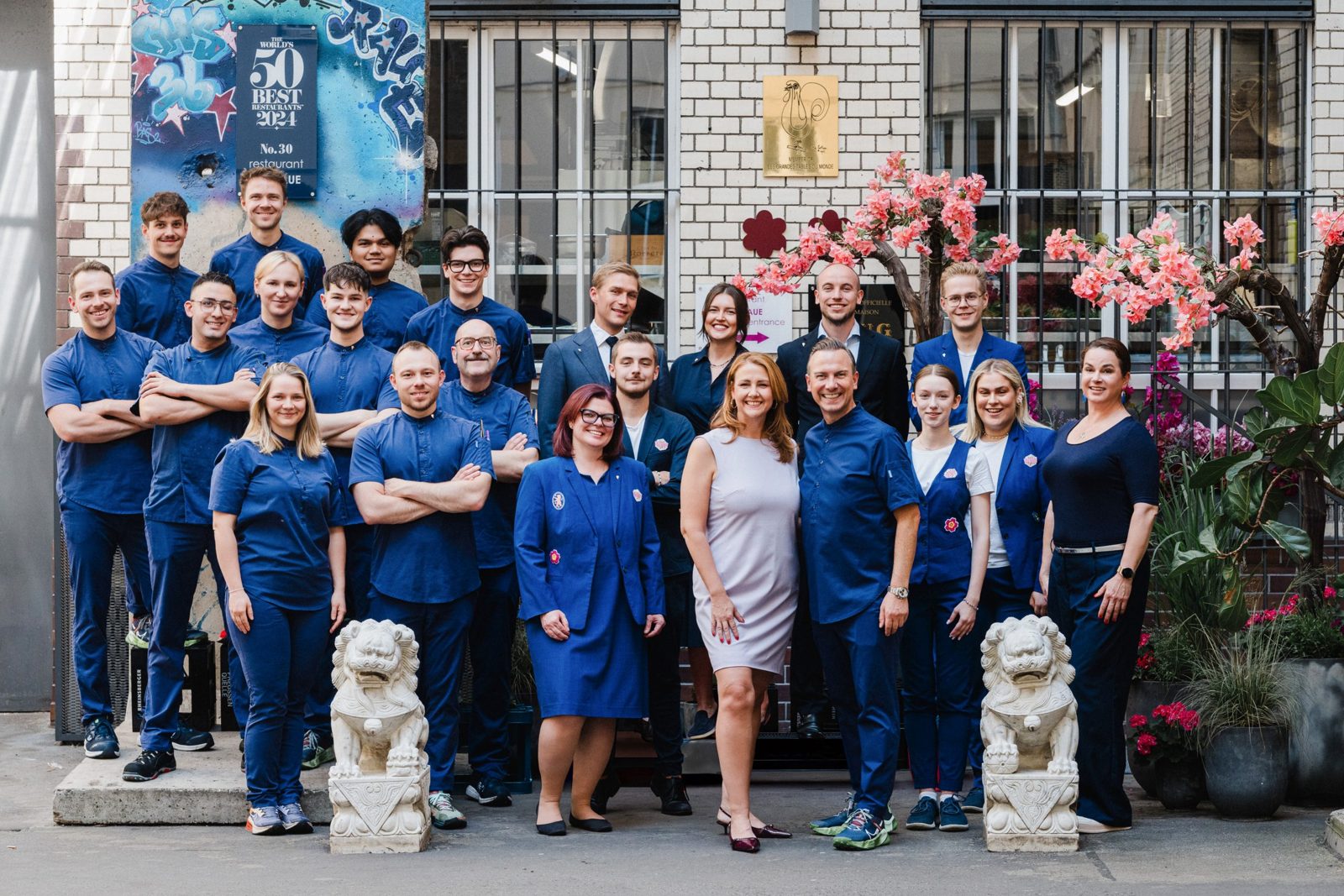
The team page adds the second half of the puzzle.[4] It describes a dining room at Checkpoint Charlie where Tim Raue, Marie-Anne Wild, and their staff try to deliver high precision without the dusty posture of old gourmet formality. That point matters because the food's sharpness could easily slide into aggression if the service style were equally stiff. Instead, the house seems designed to keep intensity on the plate while leaving the room socially open.[2][4][5]
Image context: the cover uses Restaurant Tim Raue's official team photograph. That choice fits because the article's claim is not that one chef's personality alone explains the restaurant. The more interesting point is that the house turns a strong personal taste grammar into a collective Berlin performance, with the team carrying the anti-pomp tone as much as the cuisine does.[4]
Around 1:40 to 4:10, Raue rejects harmony and defines the restaurant's real engine
The first important turn comes when Raue answers the obvious question: why is a Berlin chef cooking this way at all?[1] His answer is revealing because it is less about fashion than about appetite. Singapore, in his telling, was not a theme park of "Asia" but a serious schooling in urban plurality. He talks about discovering cuisines that had nothing to do with the flattened European shortcut of "pork sweet and sour," and then he makes the crucial contrast with French fine dining: classical French cooking, he says, seeks harmony, while he wants impact, movement, and energy.[1]
That single contrast clarifies the restaurant's current written self-description.[2][3] The official vision page says the kitchen style combines Japanese product perfection, Thai aromatics, and Chinese kitchen philosophy.[2] The menu page then sharpens the emotional effect of that combination by naming sweetness, spiciness, and acidity as the recurring play of flavors across the house, including the vegan menu.[3] My inference from the video plus those pages is that the restaurant's core idea is not fusion for novelty's sake. It is an attempt to build a high-end tasting menu around tension rather than smoothing everything into one polished line.[1][2][3]
That is why the phrase "sweet-sour pressure" is a better shorthand than "Asian-inspired."[1][3] The point is not the passport of any single dish. The point is the way flavor should arrive: lively, directional, and slightly destabilizing, with acid and heat doing more of the structural work than in a more classical French luxury room.[1][2]
Around 6:20 to 6:55, the Berlin story turns out to be about hospitality as much as flavor
The second strong moment comes when Raue moves away from travel and into childhood.[1] He says he grew up poor in Berlin, learned Turkish before anything else, and remembers the generosity of Turkish families who shared food with an openness he did not associate with mainstream German culture.[1] That passage matters because it prevents the restaurant from reading like a pure import story. Singapore expands the pantry, but Berlin gives the house its social charge.
The official pages support that reading from the restaurant side.[2][4][5] The vision page says the interior is deliberately urban, with poured asphalt, gallery lighting, and furniture that keeps the raw character of Kreuzberg alive inside an upscale space.[2] The team page says the staff aim for charming, professional service without "a pompous peacock pose," and specifically frames the team as versatile and individual in a way that matches the city around them.[4] VisitBerlin condenses the public-facing version of the same idea by describing the restaurant near Checkpoint Charlie as Michelin-starred and Asian-inspired, but the video makes the deeper point: the room is not trying to impersonate some placeless luxury internationalism.[5]
This is where Tim Raue becomes more interesting as a fine-dining subject. Plenty of top restaurants borrow globally and serve beautifully. Fewer make urban biography legible in the dining mood itself. Here, Berlin seems to show up in three linked ways: bluntness of flavor, looseness of social posture, and an unwillingness to let refinement become timid.[1][2][4]
Around 33:00 to 34:25, one langoustine dish shows how the whole house thinks
The langoustine segment is the best food-specific passage in the masterclass because it translates theory into mouthfeel.[1] Raue begins with the sweetness of the shellfish itself, then explains that he pairs it not with a butter-soft luxury garnish but with a Thai-style vinaigrette, fish sauce, lime, green mango, ripe mango, and a wasabi element that eventually becomes more elegant than the dish's earlier deep-fried version.[1] Even through the roughness of live-demo language, the logic is unmistakable: sweetness is only the opening move. The dish needs acid, salt, perfume, and texture to become complete.
That logic maps neatly onto the official menu descriptions.[3] Kolibri x Berlin is described as a Berlin homage that joins regional ingredients and childhood flavors to Raue's spice world of sweetness, spiciness, and acidity.[3] Koi is presented as the restaurant's most explicitly Asian-inspired collection, gathering Thai flavors, Chinese and Japanese ingredients, and what Raue has learned through travel.[3] The langoustine demonstration sits between those two menu identities. It is luxurious enough for a flagship tasting room, but it refuses the sleepy softness that luxury shellfish can slide into. Lime and fish sauce keep the sweetness awake; wasabi and crisp elements keep it moving.[1][3]
This is also where Raue's anti-harmony talk stops sounding like attitude and starts sounding like craft.[1] He is not rejecting balance in the childish sense of wanting everything louder. He is building balance by forcing sweet, hot, and sour components to stay visible instead of dissolving into creaminess or plush sameness. In fine dining, that distinction is huge. A lot of expensive food aims for seamlessness. This kitchen seems to prefer contour.[1][3]
Around 4:35 to 5:25 and 47:15 to 48:20, the restaurant's luxury offer is intensity without social stiffness
Another useful thread in the video concerns audience.[1] Raue says global recognition changed his clientele, bringing in younger guests who want to have fun rather than submit to old dress-code theater; later he notes that Berlin's local tech and startup crowd has also pushed demand for vegan menus and different eating habits.[1] Those comments could sound like ordinary hospitality talk, but beside the official team page they become a more coherent statement of house identity.[4]
The restaurant is selling a serious luxury meal, but it does not want to stage seriousness in the old ceremonial way.[1][4] That is why the service language on the team page matters so much, and why the official menu structure matters too.[3][4] The house offers distinct menu worlds rather than one vague chef's whim, and it does so inside a room that wants sharp flavors and sharp standards without demanding that the guest perform antique reverence. In that sense, Restaurant Tim Raue is not anti-fine-dining at all. It is trying to update what fine dining feels like when Berlin street memory, Asian pantry knowledge, and business realism all stay in the frame at once.[1][2][3][4]
That is the value of the masterclass in 2026.[1] It reveals that the restaurant's real signature is not a single dish or a generic East-meets-West line. The stronger signature is a three-part discipline: flavor must have contour, hospitality must stay warm and unpretentious, and the room must keep Berlin's edge even while serving luxury. Once you see those three parts together, the restaurant stops looking like a fusion success story and starts reading like a fully authored city restaurant.[1][2][3][4][5]
Sources
- 50 Best Restaurants TV, "Exclusive Masterclass with Chef Tim Raue," YouTube video, published February 18, 2022.
- Restaurant TIM RAUE, "Vision" - official page covering the restaurant's philosophy, kitchen style, and Berlin-rooted interior concept.
- Restaurant TIM RAUE, "Menu & Wine" - official page describing the current Kolibri x Berlin, Koi, and Vegan menu identities.
- Restaurant TIM RAUE, "Team" - official page covering the service philosophy, team structure, and the team photograph used as this article's lead image.
- visitBerlin, "Restaurant Tim Raue" - official Berlin tourism profile identifying the restaurant as Michelin-starred, Asian-inspired, and located near Checkpoint Charlie.