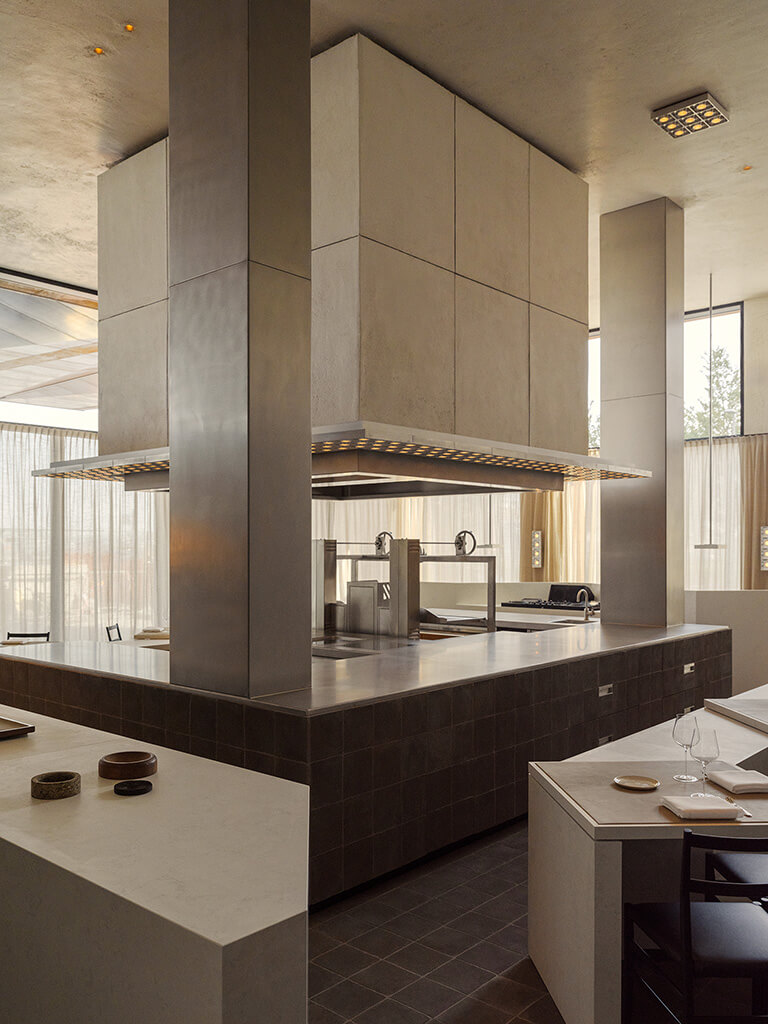
The most interesting thing about The Jane in 2026 is not that it survived leaving one of Europe's most photogenic dining rooms. It is that the restaurant seems to have understood the move as an operations problem, not merely an address change.
For eleven years, The Jane lived inside the former chapel of Antwerp's Groen Kwartier, a room so visually forceful that it could easily outrun the food in memory. The official story page now marks the break cleanly: since 5 October 2025, The Jane has been on Het Eilandje, in the Montevideo site near the Scheldt and the Kattendijk Dock.[1] 50 Best Discovery describes the same pivot as a new chapter, from iconic chapel to historic harbour district, with Nick Bril's cooking now placed inside a redeveloped warehouse complex.[2] That geography matters. The restaurant has moved from sacred drama to port movement, from vertical awe to horizontal flow.
The old room set an almost unfair baseline. ArchDaily's 2014 account of the Piet Boon design describes a former military-hospital chapel where the altar became a glass-embraced kitchen, 500 unique stained-glass panels turned religious imagery into a contemporary food-and-life iconography, and an 800-kilogram chandelier stretched 12 by 9 meters across the center of the room.[3] That was not neutral hospitality architecture. It was destination theater. Guests entered already under instruction: look up, slow down, understand dinner as spectacle.
The new Jane appears to ask for a different kind of attention. Condé Nast Traveler's current review says the October 2025 second chapter moved into Antwerp's harbour district with a smaller, more intimate ambition, shifting from spectacle toward quieter sensory experience.[4] Gault&Millau reads the new aperitif room and open kitchen similarly: an avant-garde light sculpture, an uptempo sound setting, and Nicolas Schuybroek's minimalist elegance create a more intimate frame that keeps tablemates, chef, and kitchen team in deliberate contact.[5] Read together, the sources point to a room where intimacy is not a soft adjective. It is the operating brief.
Image context: this post uses The Jane's own Romain Laprade photograph of the new room because the article is about room mechanics after the move. The value of the image is in the scale: warm chairs, industrial windows, and a room no longer dominated by chapel spectacle. The visual argument is service, proximity, and reset.[1]
1. The room now starts before the table
The old chapel gave The Jane a single overwhelming first act. The new layout seems more sequenced. Condé Nast Traveler describes guests moving from an inviting aperitif bar into a bright dining room arranged around a large stainless-steel kitchen.[4] Gault&Millau also begins its current account in the aperitif space, where light, sound, and anticipation prepare the guest for what follows in the open kitchen and restaurant.[5] That staging matters because fine-dining pacing often succeeds or fails before the first formal course. If the opening drink functions as a decompression chamber, the dining room does not have to carry all the atmosphere at once.
This is a practical hospitality choice. A famous restaurant moving out of a famous room risks producing either nostalgia or overcompensation. The Jane's new sequence gives the guest time to adjust. The entrance can be social, the aperitif can tune tempo, the dining room can tighten focus, and the kitchen can become visible without needing to perform as an altar.[4][5] The movement is smaller, but more controllable.
That control is especially important because the restaurant's reputation still brings expectation. 50 Best Discovery calls The Jane one of Antwerp's most difficult-to-book tables and lists it at No.36 on The World's 50 Best Restaurants 2024.[2] Recognition can make a room stiff. The new Jane's apparent answer is to keep the guest closer to process: fewer visual hierarchies, more contact with the kitchen, and service that can carry personality without fighting the architecture.[4][5]
2. Smaller is not automatically quieter
The move was framed publicly as a search for a more intimate format. Restaurant Ranking reported before the reopening that the new location would be more personal, refined, balanced, and designed for connection, with Schuybroek handling the design and three menus then described in the EUR285-EUR375 range.[6] Les Grandes Tables du Monde now summarizes the result as a 26-seat dining room and dynamic kitchen led by Bril, a more focused era after a decade in the chapel.[7] Gault&Millau's current menu listing gives a similar price architecture: The Jane Tasting Menu at EUR285, Signature Menu at EUR305, and Experience at EUR345.[5]
Those numbers and seat counts are not decorative. They explain what the new restaurant is selling. The Jane has not become casual, cheaper, or less ambitious. It has narrowed the frame. A 26-seat room changes the density of attention; the kitchen can read the room faster, service can adjust tone more precisely, and pacing can feel less like procession than conversation.[5][7]
The risk is that "intimate" can become another luxury cliche. At this level, intimacy has to be engineered. It depends on sightlines, noise, staffing, table spacing, and the order in which the guest encounters the room. Gault&Millau's emphasis on the contact between tablemates and the chef's team suggests that the new room is trying to make proximity functional rather than merely aesthetic.[5] The restaurant is not shrinking for modesty. It is shrinking to increase resolution.
3. The kitchen becomes a social instrument
The chapel's glass kitchen was already visible, but its placement in the former altar gave it symbolic force.[3] The new kitchen seems to work differently. Condé Nast Traveler describes tables arranged around a large stainless-steel kitchen; Gault&Millau describes an open kitchen woven into the room's sensory build-up.[4][5] That changes the social contract. Instead of kitchen-as-shrine, the new model moves toward kitchen-as-centerline.
This is why the move belongs under service operations as much as design. In a room built around the kitchen, cooks and servers cannot hide behind architectural grandeur. Timing, handoff, facial expression, heat, and sound all become part of the guest's reading. Done badly, that kind of exposure can feel tense. Done well, it gives dinner a live pulse and lets service become less scripted without becoming loose.
The menu language supports the same reading. 50 Best Discovery describes restrained architecture matched by cooking built around fermentation, Japanese influences, pristine produce, bespoke dishware, attentive service, and well-balanced flavours.[2] Gault&Millau highlights lightly aged fish, grilled Norwegian langoustine, deep sauce work, and the way Bril sublimates products through flavor concentration.[5] The cooking, in other words, still depends on control. The new room's job is to make that control feel close enough to be sensed, not distant enough to be worshipped.
4. Leaving the chapel also reduces the nostalgia tax
Restaurant Ranking reported that the former location had closed at the beginning of 2025 and cited media reports that the rent had reached EUR23,000 per month.[6] Whether one reads that as financial pressure, creative pressure, or both, the operational consequence is the same: The Jane had to stop paying to preserve an image it could no longer fully control. The chapel made the restaurant famous, but it also fixed the restaurant inside a very specific mythology.
The harbour site gives Bril a cleaner second grammar. The official story page leans into Het Eilandje's identity as Antwerp's old harbour neighbourhood, shaped by 19th-century shipping, warehouses, the Scheldt, and the redeveloped Montevideo Residence.[1] That is not as instantly theatrical as a chapel, but it may be more flexible. The port story carries movement, trade, water, and reuse. It gives The Jane a way to remain Antwerp-specific without living inside one monumental room's memory.[1][2]
There is a diner-facing benefit here. A restaurant trapped by its most famous photograph can become a pilgrimage site first and a meal second. The new Jane asks to be judged by sequence again: aperitif, kitchen, table, sauce, sound, service, exit.[4][5] That is healthier for a restaurant whose best work depends on precision and contrast rather than on one frozen image.
What the move buys
The Jane's second room is compelling because it treats hospitality as a designed chain. The evidence is not one dazzling object. It is the linked system: new harbour neighbourhood, smaller room, aperitif staging, open kitchen, menu tiers, tactile materials, visible team, and service that tries to mix etiquette with wit.[1][2][4][5][7] In the chapel, awe arrived almost before dinner began. On Het Eilandje, the restaurant has to earn attention course by course.
That is a harder proposition, and probably the more interesting one. The old Jane proved that fine dining could fuse food, rock-and-roll mood, chapel volume, and high design into an unforgettable Antwerp event.[3] The new Jane is testing whether the same house can make a quieter, more connected room feel just as alive. If it works, the achievement is not reinvention as branding. It is operational maturity: knowing when the room that made you famous has stopped being the room that lets you cook, serve, and listen best.
Sources
- The Jane Antwerp, "Our story" - official account of the 5 October 2025 move to Het Eilandje, Montevideo Residence context, design collaborators, address, opening pattern, and the Romain Laprade image used for this post.
- 50 Best Discovery, "The Jane - Antwerp" - current profile covering the move to the historic harbour district, No.36 ranking in The World's 50 Best Restaurants 2024, tasting-menu price marker, opening days, address, and menu/service description.
- ArchDaily, "Restaurant 'The Jane' Antwerp / Piet Boon" (2014) - design record of the former chapel, altar kitchen, stained-glass panels, chandelier, architects, and Richard Powers photography credit.
- Lisa Riehl, "The Jane," Condé Nast Traveler - current review of the October 2025 second chapter, aperitif-to-dining-room sequence, stainless-steel kitchen, service tone, and new harbour address.
- Gault&Millau Belgium, "The Jane" - current review of the new room, open-kitchen contact, Nicolas Schuybroek design, menu prices, opening hours, awards, and service/food observations.
- Restaurant Ranking, "The Jane returns in October" (2025) - reopening report covering the Eilandje move, Limastraat 5 address, more intimate concept, menu range at announcement, pop-up interval, founding history, and reported rent context.
- Les Grandes Tables du Monde, "The Jane" - current listing describing the post-chapel return, Nicolas Schuybroek interior, 26-seat dining room, dynamic kitchen, contact details, and Limastraat 5 address.