Restaurant rankings usually flatten a room into a number. Dewakan's 2026 signal is more interesting than that. Its move to No.62 on Asia's 50 Best Restaurants' extended 51-100 list, after a 22-place climb, reads less like a scoreboard bump than a confirmation that Malaysia's ingredient-first fine dining has stopped sounding provisional.[3][4]
The old lazy framing would be to ask whether Kuala Lumpur can produce a restaurant that looks legible to global fine dining. Dewakan has already answered that. The sharper question is how a restaurant can stay recognizably Malaysian when it operates at the level of two Michelin stars, a 48th-floor room, international destination pricing, wine pairings, non-alcoholic pairings, and regional-list scrutiny.[1][2][3] Darren Teoh's restaurant is compelling because it does not treat locality as a softer alternative to polish. It treats locality as the engine that lets polish have a point.
As of April 20, 2026, Dewakan's own public menu sets out the structure clearly: the Dewakan Tasting Menu is listed at RM870 nett per guest, with a RM266 non-alcoholic pairing, RM353 five-glass wine pairing, and RM636 seven-glass wine pairing; the restaurant also says the majority of its chosen produce is grown, planted, and reared in Malaysia.[1] Michelin's current listing gives the culinary grammar behind those numbers: fermentation, in-house dry-aging, seasonal fruits and herbs, and a nose-to-tail menu organized around local, native, and endemic ingredients, including some that have faded from everyday recognition.[2]
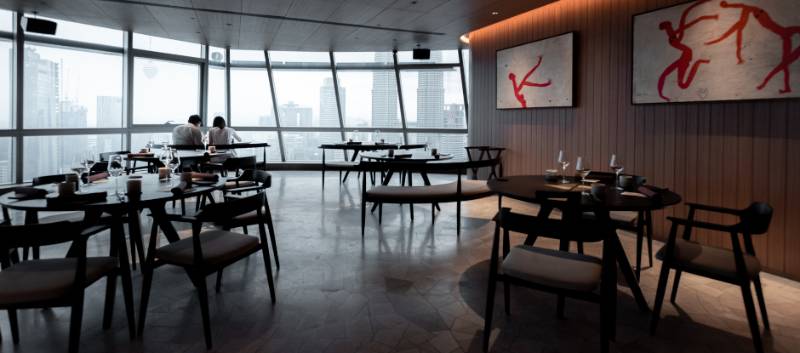
Image context: this article uses 50 Best's Dewakan dining-room photograph rather than a dish close-up because the trend is not only on the plate. The room, high above Kuala Lumpur, matters. It shows the argument in physical form: local Malaysian products do not have to be staged as rural nostalgia to carry fine-dining authority.[3]
The trend is moving from discovery to system
The most important change is vocabulary. A decade ago, a restaurant using Malaysian forest, farm, sea, and market ingredients in a tasting-menu format could be described as discovery. That word still has romance, but it can also patronize the subject. Dewakan now looks more like a system. The restaurant's official language defines the name as a combination of the Malay words for god and food, then ties the dining experience to meaningful connections with the people and culture represented in each ingredient.[1] That is not a garnish of identity. It is the operating premise.
Michelin's description gives the system a harder edge. The menu is not just "local"; it is worked through preservation, aging, fermentation, and whole-product logic.[2] This matters because an ingredient-first movement matures only when it gains technique. Without technique, a rare herb or fruit becomes a show-and-tell object. With technique, it can carry texture, acidity, bitterness, sweetness, aroma, and memory across a sequence of courses.
Dewakan's current menu language makes that visible. The official page lists items such as choy sum nori, mango curry, banana heart with kerdas, roast eggplant with keluak and candlenut oil, slow-cooked red snapper with a broth made from temu, tapai with pickled rose, sweet leaf sorbet with nam nam, and Temuan chocolate with jaggery ice cream.[1] A weaker restaurant would make those words feel like a glossary. Dewakan's task is more demanding: turn them into appetite before they become anthropology.
That distinction is the heart of the movement. Malaysian ingredients can be taught to outsiders, but they should not have to spend the whole meal explaining themselves. Dewakan's strongest position is that it can make the unfamiliar feel edible first, then let the cultural and ecological context deepen the pleasure.
The room stops the story from becoming pastoral
Many ingredient-led restaurants lean on countryside imagery. Dewakan's setting pushes in the opposite direction. The restaurant is on Level 48 of Skyviews, Naza Tower, in Platinum Park, and 50 Best's 2026 account emphasizes the high-floor view, the floor-to-ceiling windows, and a bright, luxurious dining room over the heart of Kuala Lumpur.[1][3] That location changes the meaning of the food.
If the same menu were staged in a low rural room, it would be easier to read it as a return-to-land story. In a tower, the argument becomes more contemporary. Malaysian biodiversity, indigenous knowledge, urban aspiration, and destination luxury are asked to occupy the same table. The room refuses the idea that local ingredients must arrive in a deliberately humble frame to be credible.
This is why the image matters. The photograph is not flashy: dark tabletops, wide glass, city haze, a few figures in the distance, warm art on the wall.[3] It gives Dewakan a specific urban pressure. A diner is not being invited to leave Kuala Lumpur behind for a fantasy of untouched nature. The city remains visible. The menu has to carry farms, jungles, mountains, coasts, and indigenous references into a room where towers and traffic are still part of the evening.[1][2][3]
That makes the restaurant more useful as a trend signal. The next stage of Malaysian fine dining will not be won by copying Nordic farm language, Japanese omakase grammar, or French luxury codes. It will be won by rooms that can make local product knowledge feel native to modern Malaysian life, whether that life is in Kuala Lumpur, Penang, Johor, Sabah, Sarawak, or beyond.
Ranking momentum matters because a second signal appeared
Dewakan is still the anchor, but it is no longer alone in the regional conversation. The Star's March 2026 report notes that Dewakan reached No.62 and Penang's Gēn returned at No.89 on Asia's 50 Best Restaurants' extended list.[4] That pairing matters because it prevents the story from becoming a one-restaurant exception. Dewakan can be the flagship, while Gēn's presence suggests that Malaysian ingredient-first cooking is becoming legible across more than one city and dining format.[3][4]
The 50 Best list write-up frames Gēn as a Penang restaurant whose seasonal tasting menus present nostalgic Malaysian flavours with modern technique.[3] Dewakan's own profile in the same feature is different: it emphasizes indigenous connection, modern reinterpretation, and the high-rise Kuala Lumpur room.[3] Together they describe a broadening lane. One version can be vertical, metropolitan, and highly staged; another can be rooted in Penang's food memory and slower pace. The shared thread is confidence that Malaysian produce and culinary memory can generate the architecture of a menu, not just decorate it.
That is why the 22-place climb is worth mentioning without over-worshipping the list.[3][4] Rankings are imperfect cultural instruments. They reward visibility, network effects, and international voter exposure as much as they reward the actual dinner. But they still show when a restaurant's language has become easier for the region to recognize. Dewakan's climb says the category has moved from "interesting Malaysian outlier" toward "regional reference point."
Technique keeps locality from becoming a slogan
Michelin's ingredient feature is useful because it keeps the conversation close to kitchen labor. Teoh explains kulim as a forest-garlic-like product that the restaurant dries and turns into seasoning powder; the same article moves through cendawan kukur, daun selom oil, and a red-snapper broth built with temu pauh and turmeric leaves.[5] That is the right kind of detail. It shows why ingredient-first cooking is expensive, slow, and fragile. The chef is not only sourcing a product; the team has to discover how it behaves.
This is where Dewakan's tasting-menu price begins to make more sense.[1] The money is not only paying for skyline, service, and ceremony. It is paying for uncertainty absorbed before the guest arrives: which local products are good enough, which ones survive aging or fermentation, which ones need gentler heat, which ones can lead a course, which ones should appear as aroma, relish, broth, oil, or bitterness.[1][2][5]
The drink program extends the same logic. Dewakan lists an alcoholic pairing, two wine-pairing tiers, and a non-alcoholic pairing, then says the pairings are built to complement the tasting menu.[1] In a menu based on herbs, fermented elements, local fruits, native aromatics, and uncommon bitterness, drinks cannot behave like a generic luxury add-on. They have to translate the food's grammar into liquid pacing. The RM266 non-alcoholic pairing is especially important here because it acknowledges that a modern tasting menu needs more than wine to express place.[1]
Locality becomes persuasive when every adjacent system has to answer it. The menu, the preservation program, the pairing structure, the room, the reservation terms, and the service length all point toward the same proposition: Malaysian ingredients are not a theme night. They are the load-bearing material.
What Dewakan changes
Dewakan's achievement in 2026 is that it makes the movement feel inevitable after the fact. Of course Malaysia should have a fine-dining language built from its own produce, indigenous ingredients, ferments, coastal products, fruits, herbs, spices, and city appetite. Of course that language should be able to sit on the 48th floor rather than apologize for entering a luxury room. Of course a serious restaurant in Kuala Lumpur should be able to choose tapai, nam nam, banana heart, keluak, candlenut, temu, and Temuan chocolate without treating them as exotic props.[1][2]
The hard part was building the proof. Dewakan has spent years turning the proof into a working dinner: technical enough for Michelin, visible enough for Asia's 50 Best, and still rooted enough that the ingredients do not vanish under imported prestige.[2][3][4][5] That is why the current moment feels larger than one ranking move. The restaurant has helped make a new baseline. Malaysian fine dining no longer has to ask permission to sound like itself.
Sources
- Dewakan, official website - current philosophy, Level 48 Skyviews address, tasting-menu and pairing prices, Malaysian-produce statement, reservation terms, dining duration, and menu examples.
- MICHELIN Guide, "Dewakan - Kuala Lumpur" - current listing covering Two Stars, local/native/endemic ingredients, fermentation, in-house dry-aging, seasonal fruits and herbs, address, and service notes.
- Rachael Hogg, "Asia's 50 Best Restaurants 2026: the 51-100 list revealed," 50 Best Stories (March 12, 2026) - Dewakan at No.62, the article's lead image, room description, Indigenous-connection framing, and Gēn context.
- Michael Cheang, "KL's Dewakan and Penang's Gen listed among Asia's best 100 restaurants," The Star (March 12, 2026) - current Malaysian ranking context, Dewakan's 22-place climb, No.62 placement, Gēn at No.89, and Malaysia two-star context.
- Rachel Tan, "Dewakan Puts The Spotlight On Malaysia's Indigenous Ingredients," MICHELIN Guide (March 10, 2018) - ingredient-focused feature on Teoh's native-produce approach, kulim, cendawan kukur, daun selom, temu pauh, turmeric leaves, and sourcing communities.