
Mirazur is easiest to misread at the exact moment when it looks most settled. In 2019, Mauro Colagreco's restaurant in Menton collected the two cleanest trophies a modern fine-dining room can hold: three Michelin stars and the No.1 position on The World's 50 Best Restaurants list.[3][4] A weaker story would stop there, as if the restaurant had solved itself. The more useful story starts after the medal moment, because Mirazur's signature is motion.
The 50 Best video from June 2019 is worth revisiting for that reason. It is brief, promotional, and polished, but it does not behave like a victory montage alone. It shows a restaurant in the middle of alteration: fewer seats, a refreshed dining room, a garden used as an engine rather than scenery, and a chef trying to make place feel active instead of decorative.[1][3] The official Mirazur site now describes the restaurant as an ecosystem facing the Mediterranean, guided by 12 acres of biodynamic and permaculture gardens, while Colagreco is framed as a circular-gastronomy advocate whose work has expanded far beyond the original house.[2] The video catches the earlier hinge point, when the restaurant's public identity moved from beautiful Riviera destination to a more explicit operating philosophy.
That distinction matters for diners. A restaurant can have a view, a garden, and a famous chef without becoming a place-driven restaurant. Mirazur's argument is narrower. It asks the guest to read the meal as a set of transfers: mountain to sea, France to Italy, garden to plate, morning harvest to evening service, architecture to tempo. The video compresses those transfers into four minutes, and the written record around it supplies the missing weight.[1][2][3][4]
The opening minute makes geography part of service
In the opening stretch, the camera treats the room and the Riviera outside it as one continuous field. That is not just beauty footage. The restaurant sits in Menton, close to the French-Italian border, facing the Mediterranean and backed by the Alps; the official site uses that same geography as the first frame of the guest promise.[2] The 50 Best profile from Mirazur's No.1 year goes further, quoting Colagreco on the border as a place where sea, mountains, France, Italy, and the Mediterranean push against each other.[4]
That helps explain why the 2019 refurbishment was more than a fresh coat of taste. The accompanying 50 Best article notes that the dining room moved from 15 covers to 12, with full floor-to-ceiling views for all tables, whitewashed surfaces, rounded interior details, and service uniforms meant to echo the sea's movement.[3] In ordinary luxury terms, reducing covers can read as exclusivity. At Mirazur, it reads more like alignment. Fewer seats let the view behave less like a privilege granted to some tables and more like the room's baseline condition.
The video is useful here because it makes the architecture legible without needing a floor plan. The room is calm, but it is not neutral. Light, windows, white surfaces, and curved service movement all push the guest toward the same basic sensation: the meal is being held between shore and hillside. My inference from the video and the renovation notes is that Mirazur's luxury is not density of ornament. It is the removal of enough obstruction that place can enter the pacing of dinner.[1][3]
The garden sequence turns the menu into a clock
The middle of the video shifts the center of gravity away from the table. Garden footage matters because it changes what "menu" means. The 50 Best article says the organic garden sits about 300 meters from the restaurant, is harvested each morning by the kitchen and service team, and provides the starting point for a daily-changing menu.[3] The later 50 Best No.1 profile describes the gardens as three-tiered and south-facing, with Colagreco emphasizing morning picking and chemical-free cultivation.[4] Mirazur's current site scales the claim outward, describing 12 acres of biodynamic and permaculture gardens as the frame for a seed-to-plate cuisine.[2]
That chain of facts keeps the video from becoming generic harvest romance. The garden is not a mood board attached to a tasting menu. It is a scheduling device. If product comes in daily, if there is no fixed menu in the usual sense, and if the kitchen gives priority to product quality over recipe repetition, then the meal is organized by ripeness and labor before it is organized by chefly signature.[3][4] The restaurant's famous phrase about having "365" seasons has been repeated often enough to risk sounding like branding, but the video restores some of its practical edge. A garden changes by the day. A menu that follows it inherits that instability.
This is where Mirazur differs from restaurants that use local sourcing as a moral halo. Colagreco's method makes local produce operationally inconvenient in a productive way. The restaurant has to coordinate gardeners, cooks, servers, seafood from Menton's Port Garavan, nearby Provençal and Ligurian wines, and a dining room whose reduced seat count increases attention per guest.[3] The point is not that the guest should admire the garden from a distance. The point is that the garden keeps interrupting the kitchen's temptation to repeat yesterday's success.
The plating shots show restraint as choreography
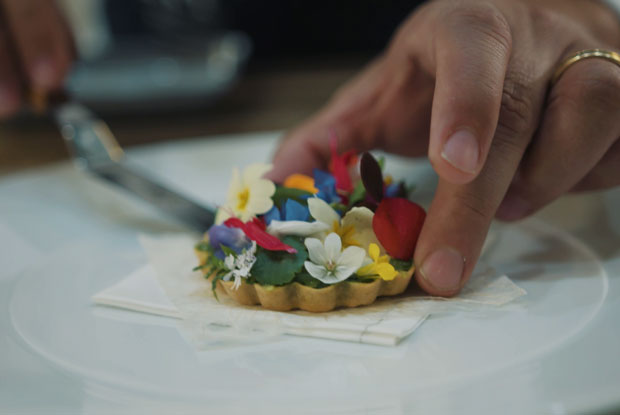
When the video moves into kitchen and plating detail, the restaurant's visual language becomes smaller and more tactile. The flower-topped tart documented in the 50 Best article, Le printemps en tarte, is a good emblem because it is vivid without needing to become theatrical.[3] The dish looks delicate, but the more important structure is the handoff behind it: harvest, trimming, pastry, placement, plate, room.
That matters because Mirazur's international reputation could easily have pushed it toward spectacle. The No.1 profile mentions an iconic dish called Green, built from peas and kiwi and tied to Colagreco's experience of walking through pea plants with his son.[4] The current official language emphasizes color, texture, local seasonal ingredients, and environmental commitment.[2] Those descriptions all point toward a kitchen that wants intensity without heaviness. The video reinforces the same idea by staying close to hands, surfaces, and produce rather than turning every plate into a magic trick.[1]
The best way to read this is as choreography, not minimalism. Mirazur is not plain. It is controlled. The renovation brought new visual polish to the room, but the plate still needs to feel as if it has passed through a living supply chain before reaching the table.[3] The fine-dining move is therefore not "garden food, but expensive." It is the synchronization of fragile materials with a service system precise enough to let fragility survive.
The final impression is a restaurant built to keep moving
The video's strongest aftertaste is not the 2019 award cycle. It is the sense that Mirazur keeps trying to outrun stasis. The 50 Best renovation article already described further plans for an open kitchen, guest tables within that kitchen, an atelier, and a sommelier tasting area.[3] The current Mirazur site, with its emphasis on circular gastronomy, B Corp and Plastic Free certifications, gardens, and Colagreco's wider restaurant group, shows how that urge to keep extending the system became part of the public identity.[2]
That makes Mirazur a useful case study in post-trophy fine dining. The danger after global recognition is preservation: keep the winning menu, protect the image, turn the restaurant into its own museum. Mirazur's better instinct is restlessness. The restaurant uses a border location, a garden clock, a calmer room, and a menu without fixed daily repetition to resist becoming a frozen version of 2019.[1][2][3][4]
For a diner, that does not guarantee a perfect meal. It does clarify what kind of meal Mirazur is trying to make. The restaurant is asking to be read less as a static destination and more as a weather system with service attached: Mediterranean light, hillside growth, border traffic, seafood landings, lunar and seasonal cues, and a dining room tuned to let those forces arrive in sequence. The video is short, but it captures the essential point. Mirazur's prestige sits on movement, and movement is harder to fake than polish.
Sources
- 50 Best, "Mauro Colagreco Reveals The New Mirazur," YouTube video, 2019.
- Mirazur official site, restaurant overview, gardens, chef profile, and current commitments.
- William Drew, "Mirazur restyled: see inside Mauro Colagreco's newly refreshed restaurant with our exclusive video," The World's 50 Best Restaurants, 2019.
- Giulia Sgarbi, "Mirazur's moment: how Mauro Colagreco's masterpiece became The World's Best Restaurant 2019," The World's 50 Best Restaurants, 2019.