Awards can make a restaurant easier to notice and harder to read. That is the risk around The Chairman in 2026. Asia's 50 Best has put Danny Yip's Hong Kong restaurant back at No. 1 in the region, which invites the usual language of triumph, scarcity, and bucket-list urgency.[1] But the reason The Chairman keeps mattering is narrower and more interesting. It has spent years proving that Cantonese fine dining does not need to become louder as it becomes more ambitious. If anything, this restaurant has kept refining an opposite idea: remove the garnish of prestige, make the room calmer, enlarge the kitchen's margin for precision, and let ingredient quality and pantry judgment do the talking.[1][2][4]
The basic operating facts already suggest that posture. The official site places the restaurant on the third floor of The Wellington, 198 Wellington Street, Central, and keeps the schedule unusually straightforward for a room with this level of demand: lunch from 12:00 to 15:00, dinner from 18:00 to 23:00, seven days a week.[5] Michelin's 2026 guide still lists it at one star and describes the address as a Cantonese destination whose culinary vision has stayed consistent through the move.[2] That matters because The Chairman has never sold itself as a reinvention machine. It is a restaurant interested in refinement, not reboot theater.
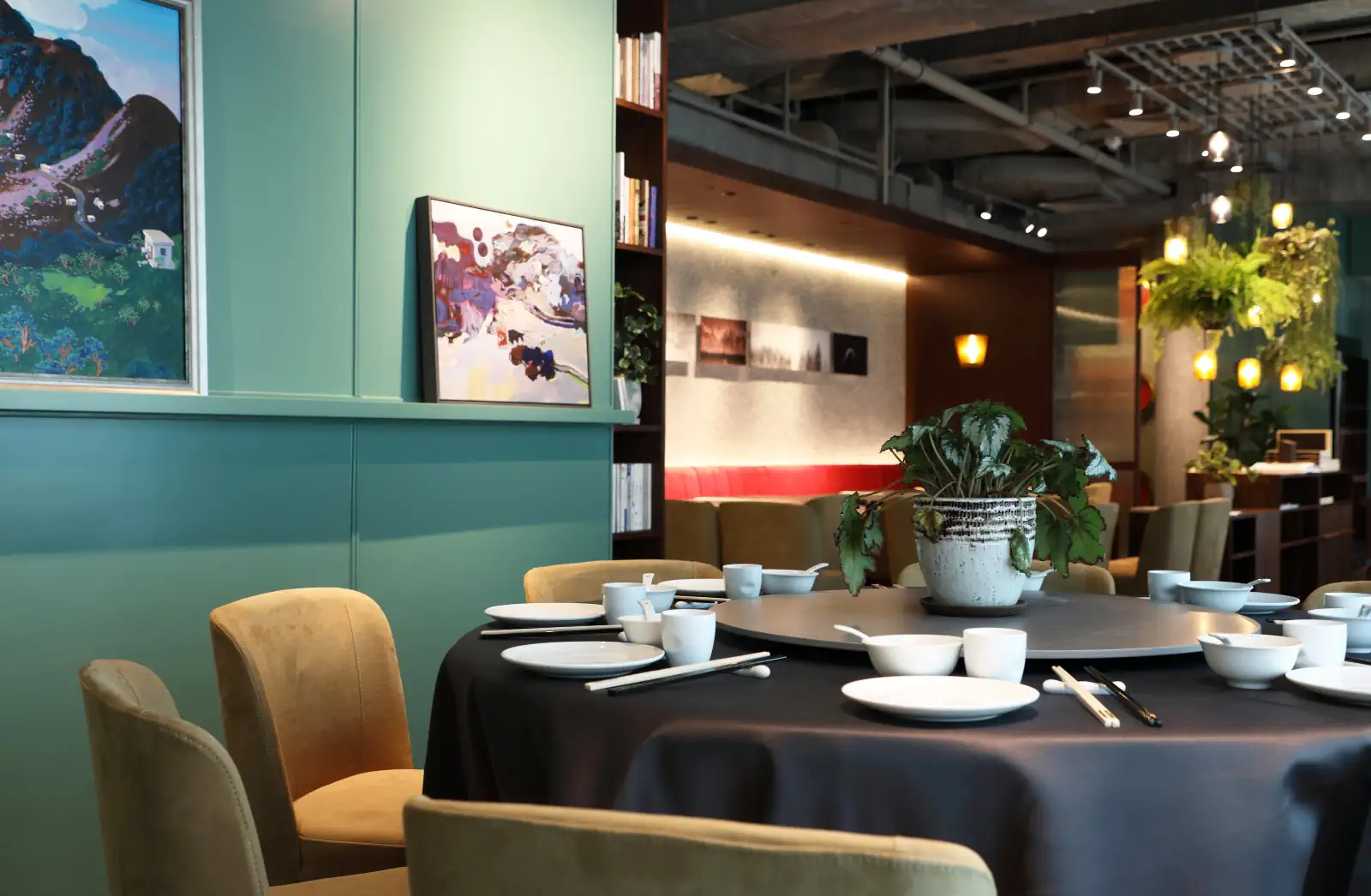
Image context: the cover uses an official dining-room photograph rather than a plated close-up because this profile is about the restaurant's social temperature as much as its food. The Chairman's achievement is not just a signature crab or one perfect sauce. It is the way a now-famous room still feels composed, legible, and oddly unshowy once you imagine the meal actually unfolding there.[4][6]
The move made the restaurant quieter, not grander
The best recent source on this point is Michelin's report on "The Chairman 2.0." When the restaurant left Kau U Fong for The Wellington, Michelin noted two operational changes that matter more than the relocation headline itself: seating capacity dropped by roughly 20%, while the kitchen became larger and better equipped.[4] Those details explain a lot. Many famous restaurants use a new address to scale up prestige. The Chairman used its move to lower density and increase working room.
That trade is central to the house style. Michelin says the smaller dining room gives front-of-house staff more time to pay personal attention, while the expanded kitchen gives back-of-house teams more efficiency, consistency, and creative bandwidth.[4] Read next to the official hours and the steady, all-week opening pattern on the restaurant's own site, the place starts to look less like a trophy room and more like an extremely disciplined engine.[5] The point is not scarcity for its own sake. The point is controlled throughput.
That calmer layout also helps explain why The Chairman keeps feeling unusually domestic for a globally ranked room. The dining room in the official photograph does not lean on palace cues or executive-club darkness.[6] The Michelin feature describes it instead as warm and homey, with plants, books, and textures that soften the authority of the address.[4] This is a subtle but serious fine-dining choice. A restaurant serving Cantonese food at this level could easily stage itself as untouchable. The Chairman keeps choosing familiarity over intimidation.
Its luxury is ingredient editing, not maximal display
The Chairman's public reputation often condenses around a few famous dishes, especially the steamed fresh flowery crab with aged Shaoxing wine and flat rice noodles.[2][4] That dish deserves the attention, but it can also narrow the reading. The broader pattern matters more. Michelin's listing says the restaurant still works mostly with organic ingredients, small suppliers, and local fishermen, while the 50 Best Discovery profile pushes the same point further: the restaurant champions Cantonese traditions through produce from its own organic farm in Sheung Shui and from neighbouring suppliers, then spins classic dishes into new iterations without turning them into conceptual puzzles.[2][3]
That sourcing language is the real center of gravity here. The Chairman is not trying to modernize Cantonese food by making it look less Cantonese. It keeps the grammar intact and then tightens the edit. Discovery's menu examples make this concrete: the famous steamed crab, the pepper mud crab finished with premium soy, preserved black beans, and olive greens, and a Sichuan peppercorn stewed oxtail that sounds bolder on paper than it likely feels in the mouth because the restaurant's whole philosophy is to let ingredient quality speak before seasoning style takes over.[3] This is where "luxury as subtraction" becomes the right phrase. The Chairman does not pile up signals. It pares dishes back until stock, rice noodle texture, preserved pantry notes, and the sweetness of shellfish become audible.
Michelin's move report reinforces the same reading from another angle. Even after the relocation, signatures remained on the menu, including the steamed flowery crab and the camphor-wood smoked black-foot goose.[4] Restaurants built mainly on novelty would treat a new kitchen as a reason to replace themselves. The Chairman used the better workspace to sharpen continuity. That is a more difficult kind of confidence.
Why the room still feels current in 2026
The easy answer is the ranking. Asia's 50 Best says plainly that The Chairman has returned to the top spot for the first time since 2021.[1] But the deeper reason is that the restaurant now reads like an answer to a problem that fine dining keeps struggling with: how to become globally visible without becoming generic in the way visibility looks.
Discovery's phrasing is useful here. It says "the food comes first" at The Chairman.[3] That can sound obvious, almost empty, until you set it against the current high-end landscape. A lot of contemporary prestige rooms want food, service, architecture, and storytelling all competing at once for the guest's memory. The Chairman seems to prefer hierarchy. The room is warm. Service is attentive. The sourcing story is there if you need it. But the meal keeps guiding attention back toward what Cantonese cooking can do with freshness, restraint, preserved ingredients, and precise liquid logic.[2][3][4]
That is why the 2026 top ranking feels less like a victory lap than a clarification.[1] The Chairman is not important because it represents a louder future for Cantonese fine dining. It is important because it makes a quieter one look durable. The move to The Wellington improved the mechanics without inflating the theater.[4][5] The supply logic stayed local and ingredient-led.[2][3] The famous dishes stayed famous for reasons deeper than branding. And the room, even at the top of Asia's list, still suggests that the highest form of restaurant confidence may be to stop insisting on your importance and simply cook with enough exactness that the point becomes self-evident.
Sources
- The World's 50 Best Restaurants, "The Chairman returns as The Best Restaurant in Asia 2026."
- MICHELIN Guide, "The Chairman – Hong Kong - a MICHELIN Guide Restaurant."
- 50 Best Discovery, "The Chairman - Hong Kong - Restaurant."
- MICHELIN Guide, "Michelin Movers & Shakers: The Chairman 2.0, Noi, and Magistracy Dining Room."
- The Chairman Group, official website - address, opening hours, and booking contacts.
- The Chairman Group, official dining-room image asset used as this article's lead photograph.