
MICHELIN Guide's 5-minute, 26-second video on Sühring matters because it was filmed in the immediate afterglow of a change that could easily have pushed the restaurant into self-mythology.[1] The clip arrives right after the Bangkok restaurant earned its third star in the MICHELIN Guide Thailand 2026, and the accompanying MICHELIN article frames the result as historic: Sühring became Thailand's second Three MICHELIN Star restaurant and Asia's first Three MICHELIN Star German restaurant.[1][5] Yet the twins do not spend the film performing conquest. They keep returning to the same smaller units instead: a long journey, their own savings, the house they moved into, the team that stayed, the heritage they wanted to represent, and the guests who still come first.[1]
That emphasis changes how the restaurant reads. The official site says Sühring has, since March 2016, presented modern German fare inspired by childhood memories and family recipes, elevated into haute cuisine while carrying contemporary Central European influences.[2] The chefs page pushes the foundation further back, to annual summers on the twins' grandparents' farm, where fermentation, pickling, smoking, drying, and curing entered their vocabulary as old-school German habits rather than as luxury tricks.[3] Read together with 50 Best's 2025 list note on the restaurant at No.22, the picture sharpens: Sühring is not just a German restaurant transplanted to Bangkok, nor merely a cosmopolitan tasting menu hiding behind heritage language. It is a house where Germany, the Netherlands, Italy, and Thailand are filtered back through one deliberately maintained domestic atmosphere.[6]
That is why Annotated Viewing is the right mode here. The video is short, but it gives a rare look at the restaurant's internal grammar on the day after the accolade that might have distorted it.[1] The reservations page, meanwhile, shows the supporting discipline that keeps warmth from dissolving into looseness: bookings open 60 days ahead, the restaurant recommends reserving about a month in advance, sets clear dietary boundaries, welcomes children only from age 6, and imposes a 5,800 THB per-person fee for no-shows or cancellations within 48 hours.[4] My inference from those sources is that Sühring's real luxury lies in the combination. The house behaves warmly because the operating edges are already sharply drawn.
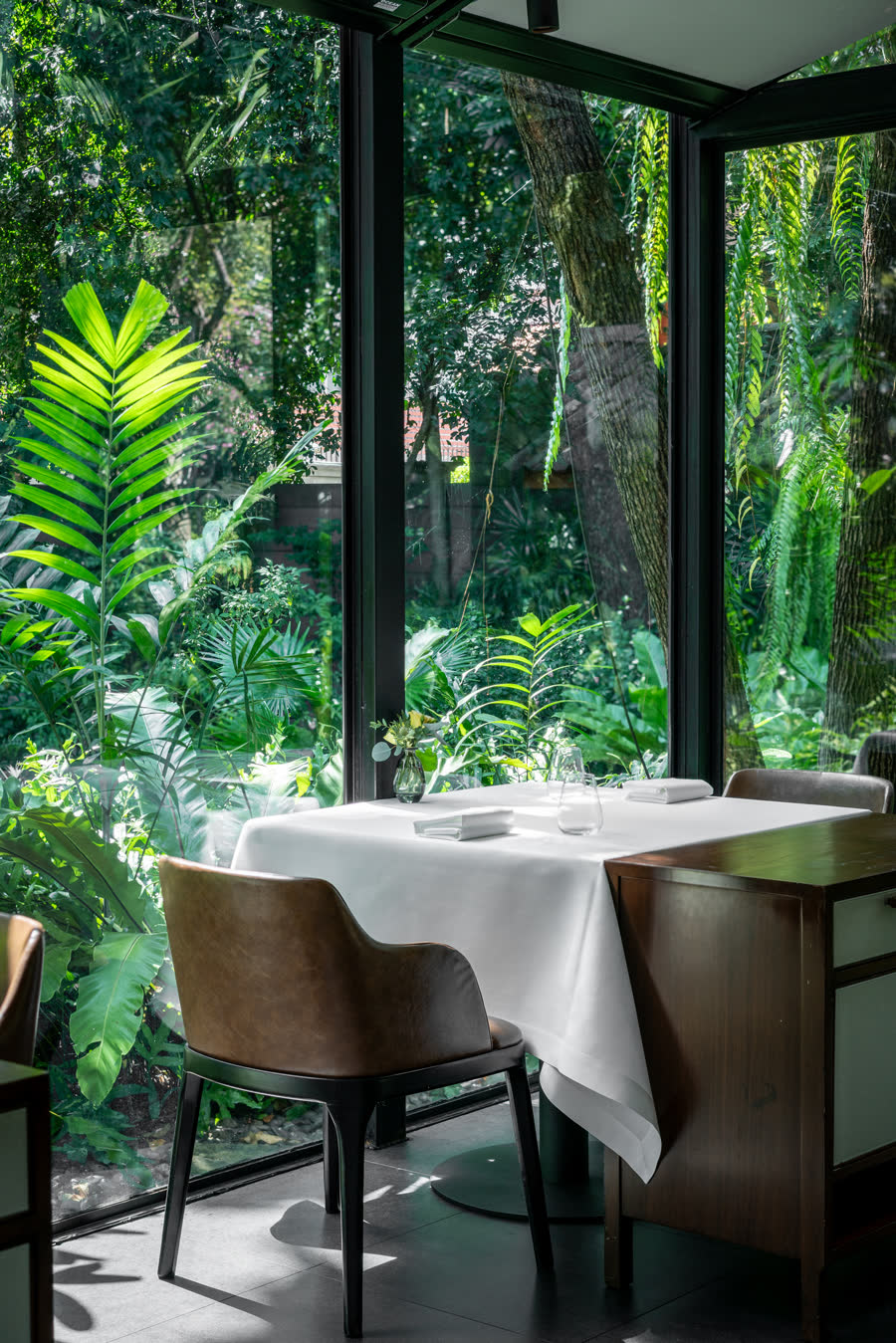
Image context: the cover uses Sühring's official dining-room photograph from the restaurant site. That choice suits the article because the video's main claim is spatial before it is technical. The third star lands most clearly when you read Sühring as a villa organized into several hospitality moods, each one making German memory feel lived rather than staged.[2]
Around 0:40 to 1:20, the twins define the restaurant as a house before they define it as an award winner
The film's first revealing passage comes when the twins step backward from the celebration and tell the origin story in house terms.[1] The captions have them say they had been in Bangkok since 2008, opened Sühring in 2016, used all their savings, moved into the house, renovated it gradually, and invited people into what was, in effect, their home while representing their heritage.[1] That sequence matters because it refuses the standard prestige narrative. The restaurant does not begin, in their telling, with a tasting menu concept, a ranking, or a technical manifesto. It begins with inhabiting a building and deciding what kind of emotional environment it should project.
The official about page supports that reading almost line by line.[2] It describes the twins as inviting guests to their home and promises warm hospitality inside a relaxed, soothing, elegant environment. It also makes a point of the room structure itself: the main Dining Room, the more exposed Kitchen, the garden-facing Glass House, and the upstairs Living Room for private dining.[2] Those choices are not decorative extras around the food. They are the way Sühring stops haute cuisine from becoming monolithic. A restaurant built from childhood memory and family recipes would feel thin if it were served in a room that behaved like a laboratory or a temple. The villa matters because it lets the food arrive with gradations of intimacy.
This is also where the Bangkok setting becomes more interesting than a simple contrast line about "German food in Thailand."[2][6] The restaurant could have treated German identity as museum reconstruction, something heavy, enclosed, and national in tone. Instead, the film and the site both point toward a lighter solution: a house open to climate, garden view, and personalized service, where heritage is carried through mood and ritual as much as through recipes.[1][2] The third star, under this reading, rewards not only the plates but the successful conversion of memory into a livable hospitality format.
Around 1:30 to 2:20, the new accolade is framed as continuity, not permission to become colder
The strongest section in the video comes after the emotional release of the award itself.[1] One twin calls the day a new beginning, then immediately says they will do everything the same: welcome guests, bring the best possible experience to each person, and make the guests happy.[1] A few beats later, the film turns to team continuity. Some staff members, they say, have been with them almost ten years, and the core priority remains unchanged: guests come first, memorable experiences come first, positive energy through the day comes first.[1]
That is an unusually revealing response to a third star. Many restaurants, once they reach that level, begin to present refinement as severity. Standards rise, and the public face hardens with them. Sühring's video argues for a different model. Prestige should intensify responsibility, not alter emotional register.[1] The official reservations page helps explain how that can work in practice.[4] The restaurant can maintain a soft spoken front because it has already defined its thresholds: when bookings open, what dietary limitations it can and cannot accept, what age of guest fits the experience, what happens if a table vanishes at the last minute, and how corkage is controlled.[4] None of that reads as incidental administration. It is the quiet scaffolding that allows the room itself to remain calm.
My inference from the video and the booking rules together is that Sühring's warmth is engineered rather than casual.[1][4] The restaurant's tone depends on precision, but precision is pushed backstage. That is what makes the film's post-award language so persuasive. Saying "we do everything the same" after three stars is not false modesty. It is a statement that the restaurant's identity was already complete in the right places: in team retention, guest handling, and the discipline of house hospitality.
Around 2:20 to the end, preservation technique and long-tenured service explain why Sühring's German identity stays legible instead of theatrical
If the first half of the video is about origin and emotional continuity, the second half makes clearer why Sühring's cuisine does not dissolve into generic European luxury.[1] The chefs page gives the key: the twins' grandparents' farm introduced them to preservation methods rooted in German tradition, especially fermentation, pickling, smoking, drying, and curing.[3] Those are not just techniques for flavor. They are forms of memory storage. They let a restaurant build a menu around time, keeping, and transformation rather than around surface national signifiers.
That is where 50 Best's 2025 description becomes useful.[6] The list presents Sühring as a restaurant where experiences from Germany, the Netherlands, Italy, and Thailand are brought under one roof, producing a seasonal haute cuisine with a strong German identity that can also be playful.[6] The phrase "strong German identity" matters because it tells us the restaurant has not solved globalization by blurring everything into prestige internationalism. Nor has it solved it by sealing itself off. The restaurant stays readable because the deepest layer of its cuisine comes from durable techniques and childhood habits, while the villa and the Bangkok context keep those habits from feeling hermetic.[2][3][6]
The MICHELIN article about the win frames the team behind the historic result rather than only the chefs in isolation.[5] That emphasis fits the film and the site. Sühring's third star makes sense not as the triumph of a single signature dish, but as recognition that the whole system holds together: the inherited grammar of preservation, the domestic scale of the house, the multi-room pacing, the clear operational boundaries, and the staff continuity that keeps service from feeling brittle.[1][2][3][4][5]
That is why the video still explains Sühring so well in 2026.[1] It catches the restaurant at the exact moment when outside recognition could have rewritten the story, and shows that the better story had already been written from inside. The twins talk about savings, renovation, heritage, staff, guests, and emotion before they talk about conquest.[1] The official site talks about family recipes, hospitality, and four ambiances before it talks about grandeur.[2] The chefs page roots the menu in the old preservative logics of a grandparents' farm.[3] The reservations page shows the controlled perimeter necessary to protect all that softness.[4] Put together, those materials make one point hard to miss: at Sühring, the third star crowns the house, not just the plate.
Sources
- MICHELIN Guide, "The Day After Three MICHELIN Stars: Inside the Sühring Twins' Historic Win," YouTube video, published December 23, 2025.
- Restaurant Sühring, "About us," official page covering the restaurant's March 2016 opening, childhood-memory and family-recipe framing, four dining ambiances, and warm-house hospitality language.
- Restaurant Sühring, "Chefs," official page covering the twins' grandparents' farm and the German preservation techniques that shaped their cooking vocabulary.
- Restaurant Sühring, "Reservations," official page covering the 60-day booking window, waitlist, dietary boundaries, age policy, cancellation fee, corkage, and dress code.
- MICHELIN Guide, "The Day After Three MICHELIN Stars: Inside the Sühring Twins' Historic Win," article page on the team's historic 2026 Thailand guide result.
- The World's 50 Best Restaurants, "The World's 50 Best Restaurants 2025: the list revealed," listing Sühring at No.22 and describing its strong German identity built from experiences across Germany, the Netherlands, Italy, and Thailand.