
National Geographic's 5-minute, 25-second short on Aponiente is still useful because it captures the restaurant before its marine rhetoric became a familiar shorthand in global fine dining.[1] In the video, Angel Leon is already presented as "the chef of the sea", already experimenting with sustainable seafood, and already pushing diners toward ingredients and techniques that do not behave like a standard luxury-fish tasting menu.[1] What the short does not yet contain is Aponiente's current degree of institutional polish. In 2026, Michelin describes the restaurant in El Puerto de Santa Maria as a Three Stars: Exceptional cuisine destination, housed in a tide mill dating back two centuries, with a kitchen built around continual discovery, sustainability, recycling, seawater, plankton, and the salvaging of discarded fish.[5]
Read beside the current menu and reservations FAQ, that progression makes the short easier to understand.[3][4] Aponiente's live menu now breaks the meal into "Salty snacks," "Salty sea," "Sweet sea," and "Coffee time," prices the tasting at 310 EUR, and keeps the beverage structure almost as explicit as the food structure, with NoLo pairing at 150 EUR, wine pairing at 180 EUR, and Non Plus Ultra pairing at 300 EUR.[3] The FAQ is even more revealing. It says the menus are based exclusively in sea products, states plainly that there is no vegetarian menu, warns that late arrivals may lose snacks or the full menu, and limits photo and video use to private purposes because surprise remains part of the restaurant's operating logic.[4] Those details matter because they show Aponiente is not simply a chef's marine imagination given free rein. It is a tightly sequenced product.
That is the best way to watch the video now. Eater's short write-up on the film says Leon's restaurant has a chemistry lab-like setup and is dedicated to discovering marine products such as edible plankton, sea cucumber, sea anemone, and cuttlefish.[6] The official site, meanwhile, still defines Aponiente through conservation and management of the ocean through research.[2] Put those signals together and the film stops reading like a chef-profile mini-documentary. It starts reading like a blueprint for a restaurant that wants the sea to function not as an ingredient category, but as a full culinary grammar.
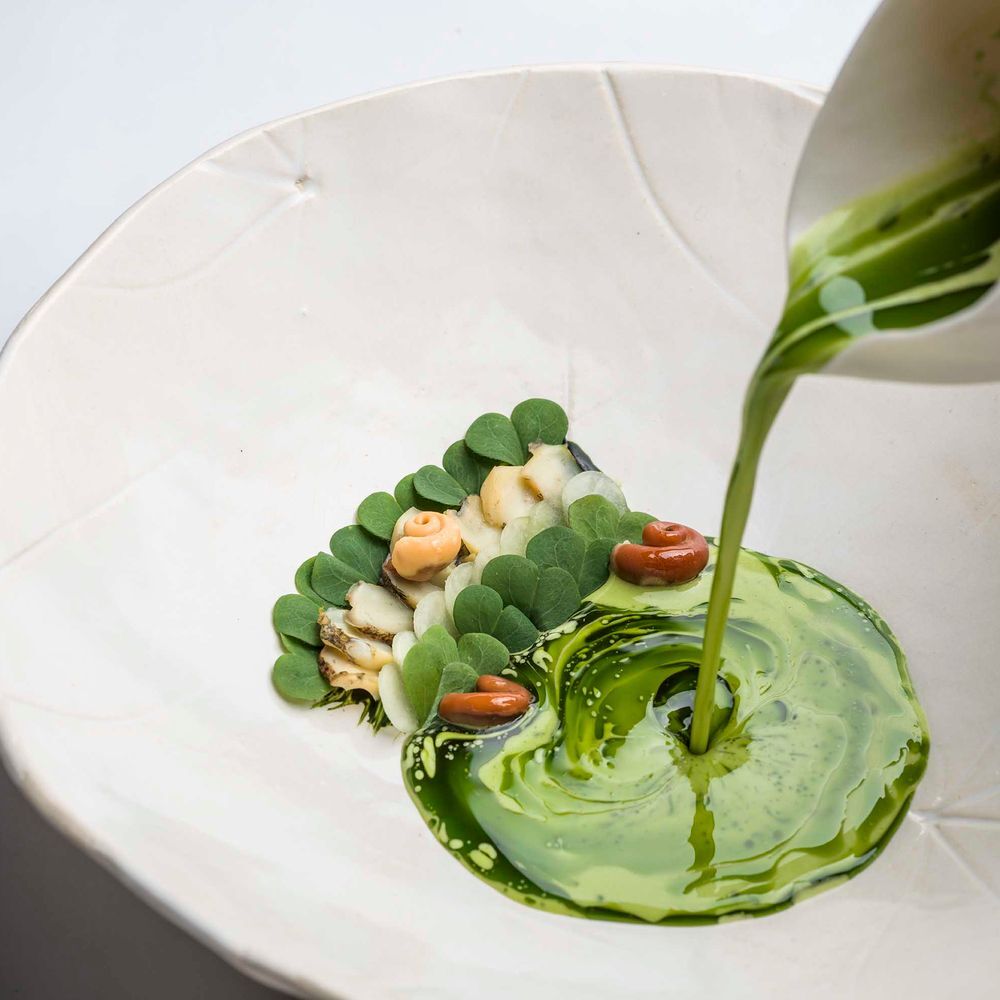
Image context: the lead image uses Michelin's current dish photograph rather than an exterior or dining-room shot because this article is about transformation at the plate. Aponiente's strongest claim is that marine ingredients can be made to behave with the concentration, elegance, and tonal range usually reserved for a broader pantry.[5][6]
Around 0:00 to 1:30, the film begins with habitat before luxury
The short does not open like a conventional high-end restaurant promo. Before the food becomes legible as plated luxury, the viewer is pushed toward water, marsh, work, and the surrounding conditions that make a marine restaurant possible.[1] Watching that opening after reading Michelin's current inspector text is clarifying. Michelin says Aponiente is housed in a two-century-old tide mill and built around what the natural estuaries have to offer.[5] The architectural and ecological frame is doing real work here. The restaurant does not want diners to think of the sea as a refrigerated inventory of premium species. It wants the sea to arrive with systems attached: tides, waste, reuse, salinity, and the idea that habitat itself can organize cuisine.
That distinction separates Aponiente from a lot of seafood luxury. In many tasting rooms, "seafood" still means shellfish prestige, expensive fish, and polished sauce work attached to a mostly French logic of hierarchy. Aponiente keeps some of that refinement, but the opening images suggest a harder ambition. The sea is not being mined for treasures and then translated into already familiar luxury syntax. The sea is being treated as an environment with its own rules, one that should reshape what counts as edible, what counts as waste, and what counts as elegance.[1][2][5]
This is why the official site's language about conservation and research is not just halo branding.[2] In the short, ecological context is not a paragraph of mission text added after the cooking. It arrives first. That sequencing matters. The restaurant is trying to make environmental intelligence the precondition of pleasure rather than its moral afterthought.
Around 1:30 to 3:40, the kitchen starts to look less like a fish restaurant and more like a marine lab
The middle section is where Leon's project becomes easiest to misread and most interesting to defend. We see unfamiliar textures, new manipulations of seafood, and a tone of discovery that could easily collapse into spectacle if it were not grounded by the written sources.[1] Eater's description helps here because it says directly that Aponiente works from a chemistry lab-like setup and seeks out marine products that most diners would not expect to find in a tasting menu.[6] Michelin now extends that same logic into a more complete philosophy, naming seafood sausages, bioluminescence, seawater cookery, plankton, and the salvaging of discarded fish as parts of Leon's working world.[5]
The crucial point is that novelty is not the end of the sentence. The video keeps showing technique as translation rather than as flex. Marine ingredients are handled, extracted, intensified, or retextured until they can hold a role in the menu that diners already understand: broth, sauce, bite, sequence, relief, surprise.[1] That is why the current menu's chapter structure matters so much.[3] "Salty sea" can include green crab essence, sea cucumber, cephalopod roe, razor clams with peas, baby squid with garlic, tuna tendons, and cuttlefish-potato stew; "Sweet sea" then asks the same marine pantry to cross into dessert, followed by a final "Coffee time" that keeps the maritime vocabulary alive through petit-fours logic.[3] The restaurant is not only finding unusual things from the water. It is forcing them into a complete syntax.
That syntactic pressure is what turns Aponiente into fine dining rather than research theater. A sea cucumber can be startling on its own; plankton can sound radical on its own. But a restaurant earns its seriousness when those ingredients stop feeling like isolated discoveries and start behaving like grammar: they can open, deepen, reset, sweeten, and close a meal. The short hints at that transition, while the current menu proves it has become operational.[1][3][6]
Around 3:40 to the end, sustainability becomes pacing, not messaging
The strongest part of the film is that it never asks the viewer to choose between sustainability and pleasure.[1] Leon's public argument, as summarized by Michelin, is about raising awareness, opening minds, and introducing concepts diners cannot find elsewhere, while also building cuisine around recycling and the full use of what the estuary offers.[5] In weaker hands, that could become educational dining with a side of virtue. At Aponiente it appears to become pacing.
The FAQ unexpectedly confirms this. Aponiente protects punctuality because the dining room and kitchen are calibrated around attention; it warns that late arrival can mean losing snacks or even the full menu; and it keeps private-use limits on photos and videos because surprise still matters to how the meal lands.[4] Those are not side policies. They are evidence that the restaurant treats sequence as part of the dish. Sustainability here is not just a sourcing principle. It is inseparable from how the guest is taught to read the food. If discarded fish are revalued, if seawater becomes a medium, if plankton can migrate from scientific curiosity into pleasure, the service has to control the order in which those claims become believable.[4][5]
That is why the short still holds up so well. It shows an early Aponiente already trying to do something harder than "creative seafood."[1] The restaurant is building a marine worldview sturdy enough to absorb luxury, science, activism, and sensory surprise without breaking into separate messages. The current written materials show that the ambition only got stricter with time: a sea-only tasting menu, hard service boundaries, explicit beverage architecture, and a Michelin inspector's description that reads almost like a manifesto for estuary-to-table modernism.[3][4][5]
Watch the film with that in mind and Leon's real move becomes clearer.[1] He is not simply asking diners to admire strange creatures from the water. He is asking them to accept that the sea can organize an entire meal the way terroir, game, or classic French market luxury once did. That is a much bigger claim than novelty, and it is what makes Aponiente still feel radical even after the world learned the phrase "chef of the sea."[1][2][5][6]
Sources
- National Geographic, "This Chef's Creations Will Make You Hungry for Sustainable Seafood | Short Film Showcase," YouTube, published March 12, 2016.
- Aponiente official homepage, describing the restaurant through ocean conservation and management via research.
- Aponiente, "2024-11-19AponienteMenu_ENG.pdf," current menu PDF covering chapter structure and current tasting and pairing prices.
- Aponiente, "2024-11-19AponienteFAQSReservasENG.pdf," reservations FAQ covering sea-only menus, punctuality, private-use photo rules, and dietary limits.
- MICHELIN Guide, "Aponiente – El Puerto de Santa Maria - a MICHELIN Guide Restaurant," covering the restaurant's three-star status, tide-mill setting, and inspector description of Leon's marine philosophy.
- Eater, "Watch: How a Spanish Chef Is Reimagining the Seafood Restaurant," summarizing the National Geographic short and describing Aponiente's chemistry-lab-like setup and marine ingredient research.