Watch the hand that serves Tête de Moine. It makes an easy circle. Now look at the bite on the plate. The cheese has a tight waist and a fringe so elaborate that picking it up feels like undoing somebody’s handiwork. Where, in that single sweep of the wrist, did the server find time to make all those pleats? [1][2]
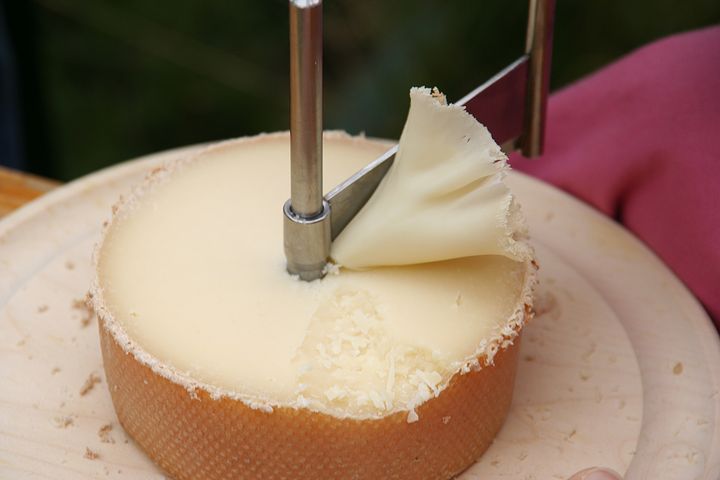
A wheel small enough for the table
Tête de Moine comes from the Swiss Jura. The whole raw-milk cheese measures just 10 to 15 centimetres across. Set one on its end and there is room on a cheeseboard for the entire working surface. Cheese from Bellelay Abbey appears in a record from 1192. The implement that looks so perfectly fitted to it arrived some eight centuries later, in 1982, from a precision mechanic in the Jura. [1]
The implement is a girolle. A spindle rises through the centre of the wheel and anchors it to a wooden base. The server lays the blade flat against the exposed cheese and guides the handle clockwise. The maker suggests giving the wheel ten to fifteen minutes out of the refrigerator before starting. The pleasure of watching is that everything is in view. You can follow the blade from the spindle all the way to the rind and see a whole frill gather in front of its straight edge. [2][3]
What happens along the blade
In a 2025 experiment, Jishen Zhang and colleagues marked the face of a wheel so they could follow a sector of cheese through the cut. Imagine drawing two lines from the centre out to the rind, as if marking off a narrow slice of cake. On the intact wheel the distance between those lines records how much cheese the blade will travel through at any given radius. On the loose shaving, the same marks tell you how much length that part of the cheese has kept. [4]
The strip shrank in the direction of the cut. In the interior, the gap between the marks shrank to about a third of its original length. At the rim, it kept about nine-tenths. The researchers traced the difference to friction against the blade. The cheese is stickier towards the middle, while the drier cheese near the outside slides more readily. Those different encounters with the same piece of metal leave a lasting change in the shaving. [4][5]
Think of gathering just one edge of a ribbon on a running stitch. The gathered edge fits into a small space. The free edge still has a generous length of ribbon to spend, and it falls into waves. A shaving of Tête de Moine has something like that seam built into it. The shorter inner portion and the comparatively long outer portion are still joined. As the shaving comes free, the outside buckles into the folds you can see on the plate. [4][5]
The first bite
There is a small experiment left for the diner. Take a rosette by its base and touch the loose fringe to your tongue first. Then try the little pinch of cheese where the folds meet. The same mouthful offers two textures. At the rim there are thin leaves with air between them. At the base several folds arrive together, giving the teeth something more substantial to press. Shaving also exposes a great deal of surface to the air, which is why the girolle’s maker recommends the cut for its effect on aroma. [2]
That makes the rosette worth serving on its own, at least for the first taste. Press it flat on a cracker and you still have a good piece of Jura cheese. Lift it to your mouth intact and you get to eat the pleats.
Sources
- Swiss PDO-PGI Association, “Tête de Moine AOP,” on the wheel, its production area and the history of the girolle.
- La Girolle Originale, instructions for using the scraper and tasting the rosettes.
- P. Y. Stucki, photograph of a girolle forming a shaving, Wikimedia Commons.
- Jishen Zhang and colleagues, “Morphogenesis of Cheese Flowers through Scraping,” Physical Review Letters, 2025.
- ESPCI Paris, the research team’s explanation of how friction varies across the wheel.