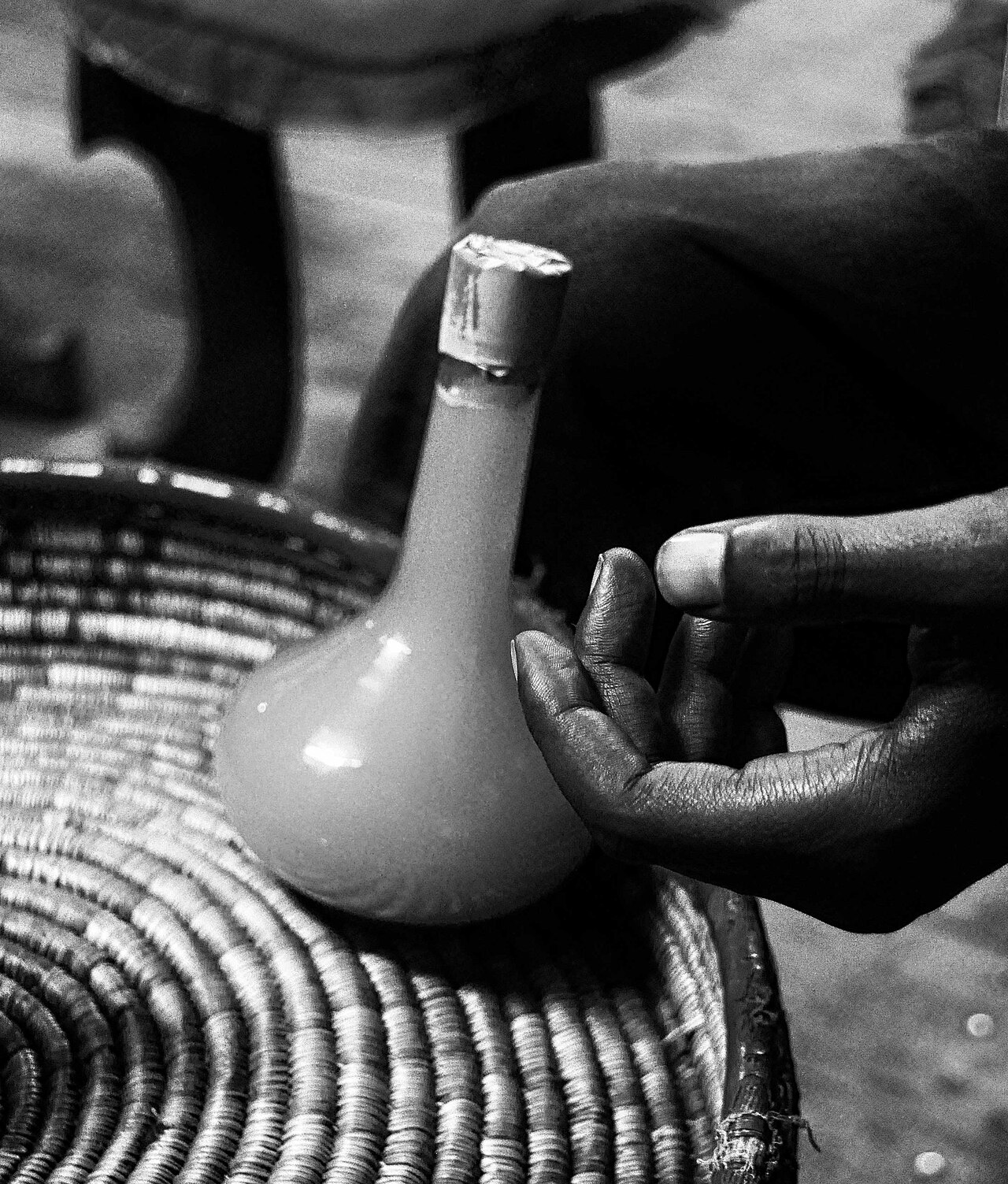
The glass looks as if someone trapped late-afternoon light inside a laboratory flask. Tej can arrive amber or orange, still or faintly lively, cloudy enough to catch the room. Honey appears first in the imagination, so a sommelier’s reflex is often to send the wine toward dessert. That is precisely where the interesting part of it can disappear.
Tej belongs beside the spice, not after dessert. Its best restaurant role is not “the sweet Ethiopian pour” saved for the check. It is a savory-course hinge: honey against chile, fermentation acid against richness, and the dry herbal bitterness of gesho pulling the finish back from syrup. The placement only works, however, when a dining room tastes the actual batch. Tej is a tradition, not a standardized flavor.
That distinction matters because the name covers an unusually broad sensory field. A 2022 study of 21 tej samples collected in Addis Ababa, Bahir Dar and Debre Markos found pH values from 2.8 to 3.8, alcohol from 6.36 to 11.34 grams per 100 milliliters, and residual sugar from 0.37 to 31.6 grams per liter.[1] Those ranges describe wines that could behave very differently at the table. One may be lean, tart and quietly bitter; another may feel rounder, fruitier and plainly sweet. A pairing written for the category rather than the bottle is already guessing.
Honey opens the door; gesho keeps it from swinging too far
Traditional tej begins with honey and water, then acquires its defining counterweight from the leaves or stems of Rhamnus prinoides, known as gesho. The production sequence varies, but the 2022 survey describes a first spontaneous fermentation of diluted honey, followed by gesho and a further fermentation before filtering.[1] In a study of Amhara-region production, the process could run 15 to 30 days, with honey character, weather, ingredients and household method all contributing to the result.[3]
Gesho deserves more respect than the shorthand “Ethiopian hops.” It performs a comparable bittering job, but it is a different plant with its own chemistry. Research on leaves collected across 11 sites in Amhara measured resins, essential oils, alpha and beta acids, flavonoids and polyphenols, with significant differences among collection areas; the authors identify geshoidin among the compounds associated with the plant’s bitterness.[4] For the diner, the important fact is simpler: the dark edge in the glass is agricultural, not an abstract winemaking adjustment.
That bitterness changes the pairing map. Honey without resistance can make a hot, fatty plate feel broader and slower. Honey checked by gesho can create a pulse: sweet arrival, aromatic lift, sour middle, bitter exit. A well-made pour does not merely soothe a dish. It answers it.
Fermentation adds another layer. A controlled-culture study identified alcohols and esters as major volatile groups in its tej samples and evaluated honey-like aroma, alcoholic aroma, astringency, sourness, color and turbidity as distinct sensory attributes.[2] The researchers were able to reproduce key qualities with selected Saccharomyces and lactic-acid-bacteria combinations, but the point for service is not that every tej should now taste identical. It is that “honey wine” omits much of what the nose and finish are doing.
Pair the batch, not the noun
The cleanest first placement is beside a savory fried bite with measured heat: a crisp lentil fritter, a small sambusa, or a potato course carrying toasted spice and a cool cultured element. A sweeter, lower-alcohol tej can round the chile and browned pastry; acidity keeps the oil from lingering; gesho stops the combination from becoming confectionary. The pour should be small enough that the guest returns to it between bites rather than drinks through the course.
The second possibility is deeper in the menu, alongside roasted meat, dark lentils or a mushroom course built on berbere-like warmth. This is where a drier, more bitter batch earns its place. Caramelized edges echo honey’s darker tones, while the wine’s sour and herbal sides keep the plate moving. Ethiopian reporting and travel writing place tej in the social world of tej houses, ceremonial vessels, house-made variation, small foods and convivial conversation.[5][6] That context is more useful than importing a generic rule that every sweet wine “goes with spice.”
There is also a good cheese-course bridge, but it should not be mistaken for dessert. Fresh, lactic cheese; toasted grain; roasted seed; and a restrained honey accent can let the wine show sweetness without duplicating it. The gesho finish becomes the course’s leafy, tonic line. A dry or medium-dry tej could then lead into coffee, while a truly sweet batch might close the meal on its own.
These are menu hypotheses, not laws. Chile interaction is especially easy to oversell. In a controlled study, sweet fruit punch was among the drinks that reduced capsaicin burn most effectively, but the researchers used non-alcoholic beer and explicitly left ethanol’s effect as an open question.[7] A strong tej may sharpen heat for some guests even when its sugar softens the first impression. The honest service move is to test the wine with the finished dish, not to promise that honey will extinguish fire.
The wrong dessert makes honey taste smaller
Pairing tej automatically with a honey cake or a very sweet plated dessert creates two problems. First, the food can make the wine taste thinner and more alcoholic. Second, honey-on-honey collapses the drink’s complexity into one repeated word. Gesho, acidity, cloudiness, fermentative aroma and the character of the base honey all become background.
If dessert is the correct destination for a particular bottle, choose contrast rather than mimicry. Toasted sesame, coffee, dark caramel, cultured cream or a tart fruit can give sweetness an edge to work against. Even then, the restaurant should describe the batch—dry, off-dry or sweet; gently tart or assertively sour; still or lively—instead of asking the guest to accept “traditional honey wine” as a tasting note.
The numbers make this caution unavoidable. In the multi-region survey, residual sugar varied by more than an order of magnitude.[1] In the Amhara maturity study, mean alcohol rose from roughly 10% to 12% by volume between 10- and 30-day samples while pH fell and titratable acidity rose.[3] Time did not merely make the beverage “more fermented.” It moved several pairing levers at once.
Service should reveal the wine, not museum-case it
The round-bellied, narrow-necked berelé gives tej a silhouette no stemmed wine glass can imitate. An Addis Ababa exhibition devoted to the vessel assembled more than 150 examples and treated the glass as a record of ceremony, trade, politics and everyday life, not just an exotic decanter.[5] Using a berelé in a dining room can therefore add real context—if the server names it, explains it briefly and does not turn it into costume.
But the vessel cannot rescue careless wine service. Before service, the beverage team should taste the opened batch with the plate and record four things: apparent sweetness, acidity, bitterness and alcohol warmth. A modestly cool pour can sharpen definition; an ice-cold one may mute honey and fermentation aroma. A small serving respects both the menu’s pacing and the drink’s deceptive ease. In Addis Ababa and Lalibela tej houses, Austin Bush documented beaker-shaped glasses, teakettle service, house-made variation and wines ranging from tart-sweet and funky to slightly effervescent.[6] Fine dining does not need to reproduce the room to learn from its attention to the pour.
Consistency is the final boundary. Spontaneous fermentation is part of tej’s living character, but research repeatedly finds large batch differences and argues for better process control where commercial production demands predictable quality.[1][2][3] Selected starter cultures may help a restaurant or producer hit a reliable service window without erasing honey, sourness, astringency and aroma.[2] Standardization should serve legibility and safety; it should not become an excuse to strip the drink of gesho, flatten regional practice or sell an Ethiopian tradition back as a newly invented botanical mead.
The successful pairing leaves the guest with a more complicated memory than sweetness. Honey glows at the front of the sip. Acid gives it a waist. Gesho closes the door with a dry green click. Put that glass beside char, spice, lentils, roasted meat or fresh cheese, and it can organize a course instead of merely decorating the end of dinner.
Dessert is still available if the batch asks for it. Tej is simply too structurally interesting to be sent there without an audition.
Sources
- Eskindir Getachew Fentie et al., “Physicochemical properties, antioxidant activities and microbial communities of Ethiopian honey wine, Tej,” Food Research International 152 (2022) — multi-region sample study covering ingredients, production sequence, pH, alcohol, residual sugar and microbial communities.
- Eskindir Getachew Fentie et al., “Development of mixed starter culture for the fermentation of Ethiopian honey wine, Tej,” Scientific Reports 12 (2022) — controlled fermentation, volatile compounds, sensory attributes and consistency boundaries.
- Meseret Berhanu, Asnake Desalegn and Dagim Jirata Birri, “Microbial, physicochemical and proximate analysis of Tej collected from Amhara regional state of Ethiopia,” Heliyon 9 (2023) — regional process detail and changes in alcohol, acidity and pH across maturity times.
- Abebe Worku Negash, Belay Tilahun Tadesse and Berhanu Andualem Tsehai, “Assessment and Determination of Bittering Agents, Essential Oils, and Antioxidants of Gesho (Rhamnus prinoides L. Herit) Collected from Amhara Region, Ethiopia,” Journal of Chemistry (2021) — full paper on gesho chemistry, bittering function and geographic variation.
- Abraham Tekle, “History in a Vessel: Tej and the Berelé,” The Reporter Ethiopia (October 4, 2025) — Addis Ababa exhibition reporting on the vessel’s use, collection history and cultural life.
- Austin Bush, “Capturing tej bet: The art of drinking Ethiopia’s honey wine,” Los Angeles Times (November 7, 2019) — reported scenes of production, serving and batch variation in Addis Ababa and Lalibela tej houses.
- Alissa A. Nolden et al., “Putting out the fire — Efficacy of common beverages in reducing oral burn from capsaicin,” Physiology & Behavior 208 (2019) — controlled comparison of beverage effects on chile burn and the study’s boundary around ethanol.
- Rod Waddington, “File:Tej, Honey Wine, Ethiopia (13796990915).jpg,” Wikimedia Commons — 2014 documentary photograph used as the article image.