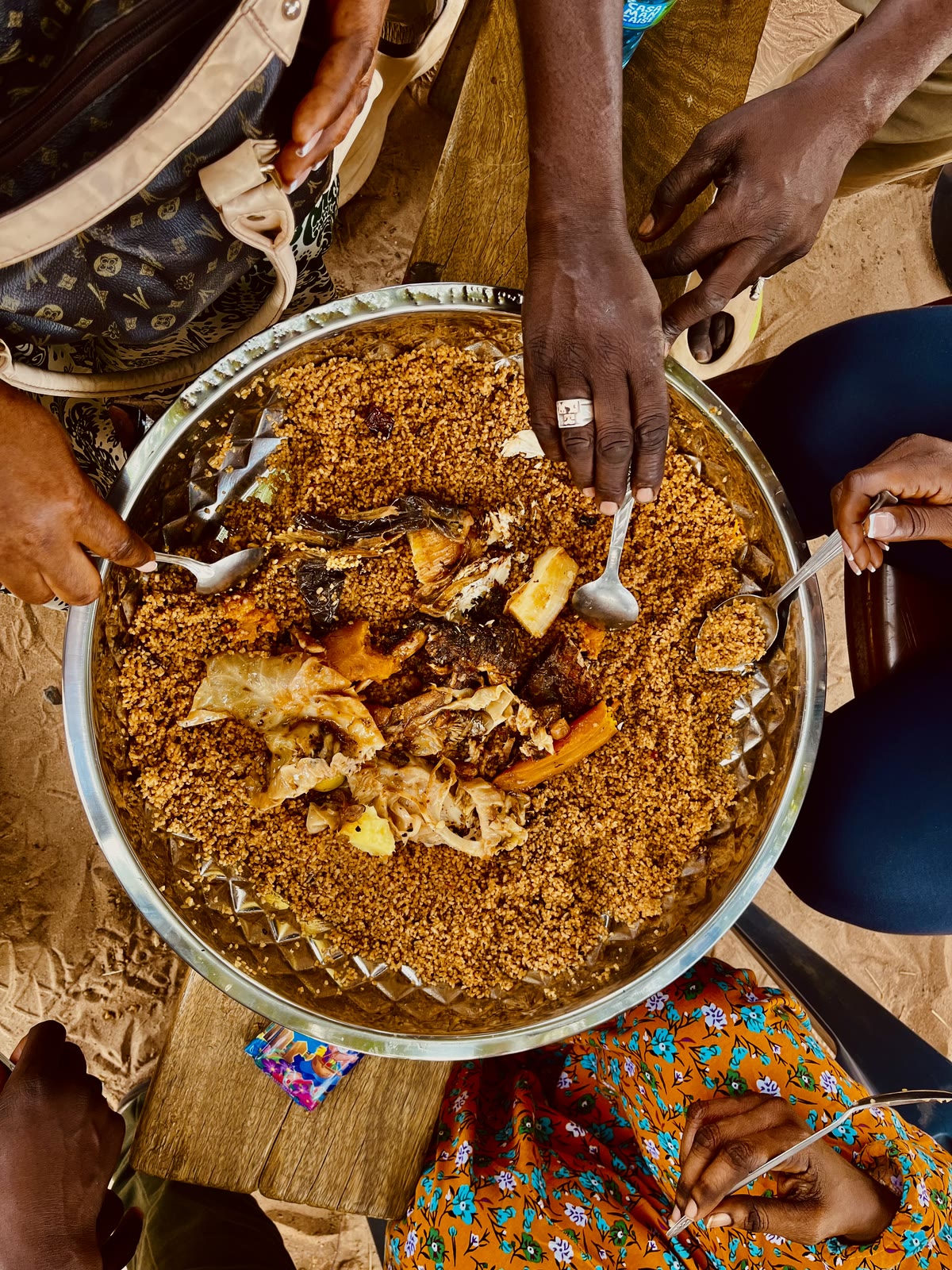
The platter looks abundant enough to have required a brigade: rust-red rice spread to the rim, fish laid across its center, cabbage folded into a glossy wedge, carrot and cassava still large enough to recognize, perhaps an eggplant gone silky at the edges. Yet the crowded composition is the work of one pot.
Not one pot in the lazy sense, where everything is abandoned to the same simmer. Ceebu jën is made through departures and returns. Fish enters, flavors the cooking liquid, and comes out. Vegetables take their turn, then leave before they collapse. Broken rice is steamed, lowered into the broth left by everything else, and covered until the liquid becomes grain. Only after the platter has been built does the cook go back for the toasted layer holding to the bottom.
That last scrape explains the whole dish. Ceebu jën—literally “rice of fish” in Wolof—is not fish served with a convenient starch. It is a carefully managed transfer of flavor in which the rice remembers every ingredient that has passed through the pot. The refinement is not separation. It is knowing exactly when to separate, and when to let everything meet again.
UNESCO’s account locates the culinary art in the fishing communities of Saint-Louis, Senegal, while emphasizing that recipes vary around the country. Its recurring structure includes broken rice, fresh fish, dried fish or mollusc, and seasonal vegetables; the quality of the fish and the choice of vegetables can also register the importance of an occasion and affection for a guest.[1] Those are not the specifications of a fixed museum recipe. They describe a living dish with a recognizable grammar.
One pot, several exits
Abdou Ka and Julie Leport’s fieldwork in Dakar and the Ferlo identifies the single cooking pot as one of ceebu jën’s defining features. Their outline is a relay: onion and fish are browned; the fish is removed; vegetables and condiments cook; those vegetables are removed; pre-steamed rice finishes in the same liquid; rice, fish and vegetables are finally reunited on the serving dish.[3]
Chef and author Pierre Thiam’s red ceebu jën follows that architecture in greater detail. His version cooks onions, green pepper and tomato paste until the paste darkens and the oil separates, then simmers the fish before removing it. Dried seafood seasons the broth. Cabbage, turnip, eggplant, squash, cassava, carrot and okra cook in stages and come out. Washed rice first steams in a cloth-lined colander above the simmering broth, then goes into the pot to absorb it.[2]
The repeated lifting is not fussy choreography. It protects difference. Fish steaks would fray if asked to survive the entire vegetable and rice cook. Cabbage and cassava do not soften at the same speed. Rice needs the broth after it has become concentrated, but the amount of liquid must be tight enough to season the grains rather than drown them. One vessel creates continuity; staggered timing keeps continuity from becoming mush.
This is where a tasting-menu kitchen may misread the dish. The temptation is to cook every element by its own supposedly perfect method, arrange each in a private patch of plate, and add a neat spoonful of sauce. That can produce excellent fish, vegetables and rice. It can also remove the very exchange that makes them ceebu jën. The pot is not merely efficient equipment. It is the dish’s editing room.
The fish is seasoned from the inside
Before the fish contributes to the broth, it receives rof. In Thiam’s preparation, garlic, parsley, onion, scallion, chile and black pepper are pounded or pulsed into a coarse paste. Slits cut into the fish steaks hold the mixture below the surface.[2] That placement matters. A sauce brushed on after cooking perfumes the outside; rof creates pockets of green, peppery intensity inside the flesh, so a bite of fish can answer the rice rather than disappear into it.
Fresh fish is only one register. Thiam adds guedj and yeet, dried seafood seasonings that deepen the broth, and suggests fish sauce when those ingredients are unavailable.[2] The substitution makes a practical bridge, but it should be named as a substitution. Salinity and fermented savor can travel; a Senegalese ingredient history does not automatically travel with them.
UNESCO’s broader description likewise includes fresh fish alongside dried fish and mollusc.[1] The combination prevents “fish and rice” from meaning only a clean fillet resting on tomato grains. Fresh flesh gives the platter its center. Preserved seafood becomes infrastructure: less visible, more dispersed, present in the rice long after it leaves the spoon.
The strongest restaurant version would make that depth legible without turning dinner into a glossary. Name the fish. Name the preserved seasoning. Let the server explain why one sits in the center and the other seems to be everywhere.
Broken rice is the desired grain
Calling broken rice a budget substitute misses what the dish has made of it. A 2022 analysis of rice demand by Ndèye Fatou Faye and colleagues traces the grain’s national rise partly to large, cheap imports of broken Asian rice during the French colonial era. It also finds a strong present-day preference for broken rice and records the widespread view that this grade is particularly well suited to ceebu jën.[4]
Ka and Leport add a culinary mechanism. They write that broken rice behaves more like millet in cooking, allowing techniques associated with an older staple to be applied to the imported grain.[3] Ceebu jën therefore resists a simple origin story in which rice is either timelessly local or merely imposed from abroad. The dish took a commodity entangled with colonial markets and worked it into a Senegalese cooking structure.
Thiam’s recipe still prefers broken white rice, although it offers jasmine or basmati as accessible alternatives.[2] Again, an alternative can make dinner possible without being identical. Long grains remain more separate and visually pristine. Broken grains give the broth more places to settle and produce the close, sauce-saturated bed that holds fish and vegetables without behaving like a neutral pilaf.
Fine dining often treats intactness as a sign of quality: the unbroken grain, the flawless fillet, the vegetable with its geometry preserved. Ceebu jën complicates that hierarchy. Its rice began as a lower-priced grade in global trade, yet within the dish, brokenness is functional and wanted. Luxury here cannot be read from the commodity ranking. It has to be tasted in the cook’s control of broth, grain and heat.
The vegetables are guests, not garnish
The platter’s vegetables carry another kind of precision. In the 2026 photograph used here, diners’ spoons converge on red rice around recognizable pieces of fish and vegetables. Nothing has been diced into decorative confetti.[5] Scale gives each ingredient a social and sensory role: a large piece can be portioned, offered, or drawn into a diner’s section of the shared dish.
UNESCO notes that vegetables vary with season and region, naming tomato, carrot, eggplant, cabbage, sweet potato, cassava and okra among the possibilities.[1] Thiam’s recipe is similarly generous but does not pretend those ingredients share one cooking time.[2] The cook removes them when ready, then restores them at service. Their flavor has entered the broth, while their shapes still tell the guest what is present.
That distinction is worth defending in a smaller restaurant portion. A chef can reduce the scale without reducing the vegetables to colored accents. One wedge of cabbage carrying fish broth, one soft piece of cassava, one bitter or silky eggplant can give the plate rhythm. The point is not to reproduce a family platter in miniature. It is to preserve the exchange between whole ingredient and shared liquid.
The bottom of the pot is a second ending
When Thiam’s rice is cooked and the liquid absorbed, his final instruction is to arrange the platter, scrape the crust from the bottom of the pot, and serve it on the side.[2] What adhered is not written off as evidence of faulty heat. It is recovered.
The texture makes intuitive sense. Above, the rice has swollen in fish-and-vegetable broth. Below, the layer nearest the metal has continued to dry and toast. The same flavor arrives in two forms: soft grains as the field of the dish, darker fragments as concentrated punctuation. A cook must stop before toast becomes bitterness, then possess the patience to free what the pot is holding.
This crust is also a rebuke to over-neat plating. If every guest receives an identical molded cylinder of rice, who gets the bottom? Serving it separately acknowledges that the batch contains a limited pleasure. A dining room can distribute it deliberately, but it should not pretend scarcity has vanished. The interesting service question is not how to make the irregular piece uniform. It is whom the kitchen chooses to honor with it.
The platter is part of the recipe
Ceebu jën’s final assembly is not just presentation. Ka and Leport found the dish closely tied to eating at home, with family, from a common plate; their Dakar respondents also described it as a meal for honoring important guests and valuing the host household and cook.[3] UNESCO records associated practices around the shared bowl and notes that restaurants more commonly provide spoons or forks.[1]
The cover photograph catches that structure after the pristine reveal. The rice has been opened into paths. Spoons enter from several sides. Hands remain at the perimeter while the platter holds the center.[5] A glossy hero shot might show the ingredients more completely, but this partly eaten dish shows what completeness actually means: ceebu jën is being finished by company.
A restaurant does not need to stage borrowed intimacy or instruct strangers to eat from one bowl. It does need to recognize what individual plating changes. A shared platter allows size, placement and generosity to carry meaning. A single plate makes the chef the sole allocator. Neither format is automatically more authentic, but the latter should compensate with service that explains the relationships it has made less visible.
Nor should refinement freeze the dish at the moment of heritage recognition. Ka and Leport describe ceebu jën as a place where imported rice, local and internationally traded ingredients, fish availability, health advice and household practice meet—and sometimes conflict.[3] UNESCO’s inscription recognizes knowledge and social practice, not an untouchable formula.[1] A thoughtful kitchen can adjust oil, fish, vegetables, portion or heat. What it cannot change casually is the structure and still expect the name to do all the work.
That structure is wonderfully clear. Season the fish below its surface. Build a broth through successive ingredients. Remove each one before tenderness becomes surrender. Give the broken rice the accumulated liquid. Reassemble the platter. Then look back into the pot.
Dinner is not finished. The best evidence is still stuck to the bottom.
Sources
- UNESCO Intangible Cultural Heritage, “Ceebu Jën, a culinary art of Senegal” — Saint-Louis origins, recurring ingredients, regional variation, hospitality, transmission and shared-eating practices.
- Pierre Thiam, “Recipe: Thiebou Jenn,” Explore Parts Unknown (April 4, 2017) — a chef-author’s detailed version documenting rof, staged one-pot cooking, dried seafood, broken rice and service of the bottom crust.
- Abdou Ka and Julie Leport, “Le ceebu jën: un plat révélateur de la dualité de l’alimentation sénégalaise entre approbation sociale et dévalorisation sanitaire,” Anthropology of Food 17 (2023) — Dakar and Ferlo fieldwork on one-pot structure, shared eating, hospitality and local-global tensions.
- Ndèye Fatou Faye et al., “Domestic or imported? An analysis of rice demand in Senegal” (2022) — national household evidence and historical context on imported broken rice, local-rice demand and ceebu jën’s grain preference.
- CelmaKoumba, “Partage d’un repas de Thiéboudienne rouge à Ndiaganiao, Sénégal,” Wikimedia Commons (photographed April 18, 2026) — documentary photograph of communal ceebu jën service used as the article image.