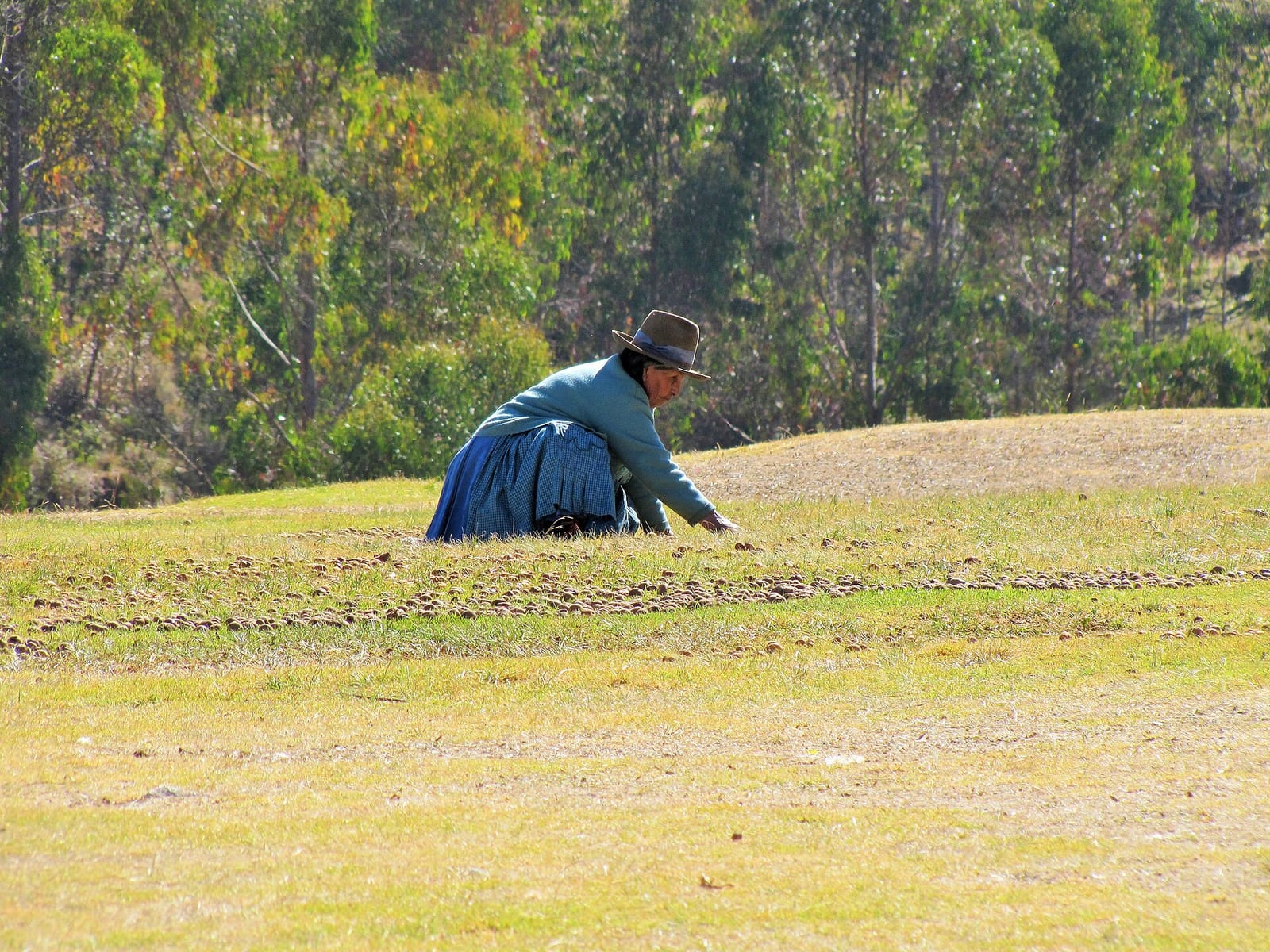
Across a sunlit field in Chinchero, Peru, a woman crouches among rows of potatoes. Wikimedia Commons identifies Chuck Moravec's July 2014 photograph as chuño making. The scene turns the restaurant word “technique” back into something physical: land as a work surface, winter air as machinery, sunlight as power, and a person moving through the crop to keep the process on course.[10]
Chuño is the Andean potato preserved by cycles of freezing, thawing, pressing, and drying. It has appeared on a contemporary restaurant plate, but not because a chef rescued an anonymous peasant ingredient from obscurity. The more interesting story runs in the other direction. Chuño arrives at fine dining with its own technology, geography, storage logic, and long political life already intact.[9]
That history gained a rare physical anchor in 2026. Archaeologists reported finding two pieces of chuño at Tambo Viejo, an Inka provincial center in Peru's dry Acarí Valley. Chuño is made in the cold highlands, not on that warm Pacific slope, so its presence on the coast is evidence of movement: a durable mountain food had entered an imperial supply system capable of carrying it far from the weather that produced it.[1]
Fine dining often describes preservation as transformation. Chuño asks for a better verb: coordination. The night freezes; the sun dries; hands and feet remove water; families judge the weather; storage extends the harvest; roads turn a local process into a portable reserve. The tasting-menu plate is only the newest frame around that accumulated work.
The freezer is the Altiplano night
Fresh potatoes are mostly water and do not naturally behave like provisions. Chuño changes the problem by using the severe daily temperature swing of the high Andes as equipment. Potatoes are exposed to hard night frosts and strong daytime sun, then pressed or trampled to shed skins and moisture before further drying. A recent food-science study describes that ancestral system as sequential freezing, solar thawing, mechanical pressing, and final dehydration. The result is light, compact, and stable enough to wait far longer than the original tuber.[2][5]
There is no single undifferentiated product hiding behind the name. The Universidad Mayor de San Andrés review distinguishes dark chuño from white tunta, related outcomes of freezing and sun-drying with different processing paths. It places the practice between 2,000 and 3,000 years ago and points to evidence from the pre-Tiwanaku Chiripa cultural period around 400 B.C. in the Lake Titicaca region.[2] Those dates should be read as the review's historical assessment, not as a claim that one recipe remained frozen in time.
The technique is precise precisely because it is environmental. A mechanical freeze-dryer can be switched on in any season; the Altiplano process depends on knowing when cold, dryness, sunlight, potato variety, and labor align. UNESCO's account of current production near Lake Titicaca describes families moving toward the coldest areas during the frost season to process their harvests.[4] Weather is not picturesque background here. It is part of the tool kit.
That distinction matters when chefs borrow the vocabulary of “ancestral technique.” The phrase can make knowledge sound mystical just as easily as it can honor it. Chuño is not magic performed by mountains. It is a repeatable human method built around a difficult climate, learned through observation and carried by communities who know how to use frost without losing the crop.
Storage turned a tuber into infrastructure
Preservation changes taste and texture, but its first historical achievement was time. The Smithsonian's National Museum of the American Indian describes chuñu as easy to transport and capable of being stored for years.[3] The ingredient therefore solved three linked problems: spoilage, distance, and the uneven calendar of harvest.
The Tambo Viejo find sharpens that point. The 2026 Journal of Field Archaeology paper places the pieces inside the remains of a state system in which freeze-dried potatoes could be kept in controlled warehouses and used to support Inka projects. The authors argue that finding highland-made chuño on the coast demonstrates distribution across the realm, not merely household storage near the place of production.[1]
The discovery does not let us reconstruct the ancient dish, seasoning, or eater. Two preserved pieces cannot tell us whether a particular meal was comforting, compulsory, festive, or dull. They establish something more basic and more consequential: the technology traveled. A potato exposed to mountain frost could become a state reserve on the coast because processing had made it durable enough for administration.
This is the lineage that a modern restaurant inherits. Before chuño was a source of contrast on a composed plate, it was a way to keep food available after fresh abundance disappeared. Before it became an emblem of Bolivian or Peruvian culinary identity for an international diner, it was portable infrastructure.
The old technique is still in the present tense
Archaeology can make a living food look finished. Chuño is not. UNESCO describes the practice in the Puno highlands as an active food-security tradition maintained by families near Lake Titicaca. A 2026 open-access food-science study, meanwhile, examines how a modified traditional freeze-and-sun-drying sequence changes the structure and function of potato starch.[4][5]
That continuity should change the emotional temperature of a fine-dining story. The ingredient is not a relic lifted from a storage jar and revived by a creative kitchen. It already belongs to soups, stews, markets, domestic stores, seasonal labor, and ordinary appetite. A restaurant joins that life; it does not restart it.
Nor should longevity be turned into a loose “superfood” halo. The UMSA review discusses mineral content and changes in antioxidants, while recent food-science work examines changes in starch structure and function.[2][5] The responsible conclusion is narrow: chuño is a durable food whose processing changes its composition. Its cultural importance and technical intelligence do not require a miracle-health claim.
The flavor also carries the method. Drying concentrates, freezing ruptures structure, rehydration does not simply rewind the potato to freshness, and dark chuño can bring an earthy intensity that a new tuber cannot imitate. For a chef, that is not damage to conceal. It is the sensory record of why the ingredient exists.
“Poor man's food” became a premium story
The move toward restaurant prestige did not happen by plating alone. A 2008 UK Department for International Development case study described chuño's importance to Bolivia's rural economies alongside its stigma as “poor man's food.” It also documented practical market problems: inconsistent quality, damaged product, soil hidden in opaque sacks, and little active promotion in major cities.[6]
Beginning in 2003, an International Potato Center initiative brought farmers, traders, processors, exporters, cooking schools, and researchers together. Bolivia legally recognized formal quality standards in 2004; selected chuño was then cleaned, packaged transparently, branded, and sold into urban supermarkets. The case study reported a shift in perception toward a marketable Andean product and benefits for roughly 250 producing families.[6]
That is a more complicated transition than the familiar tale of a chef discovering a humble ingredient. Standards can reduce waste and build trust. Better packaging can improve price and access. Culinary schools and restaurants can make a product newly legible to urban diners. But revaluation also changes who gets to describe the food, where profit gathers, and whether the people maintaining the technique remain visible once the ingredient enters a luxury room.
Fine dining is therefore neither villain nor savior in chuño's lineage. It is one market among several, with unusual power to turn material into narrative. The ethical test is whether that narrative makes the chain clearer or replaces it with the chef's own origin myth.
Gustu changed the frame, not the ancestry
The 2014 photograph gives that transition a concrete plate. Wikimedia Commons identifies it as an innovative chuño dish prepared at Gustu in La Paz. The image is valuable because it records a real restaurant use at a known moment; it should not be stretched into proof of what Gustu serves now.[9]
Gustu's current menu describes two tasting formats built around Bolivian products, including uncommon flavors encountered through exploration and research. Its cellar is devoted to Bolivian wine, singani, spirits, and beer.[7] Latin America's 50 Best placed the restaurant at No. 75 on its 2025 extended list and described chefs Jairo Michel and Kenzo Hirose leading research trips to identify endemic products and build relationships with small-scale producers.[8]
Those current sources establish an operating philosophy, not a continuous chuño signature. The distinction is useful. Restaurants change courses with seasons, teams, and supply. A historical image can show that chuño entered Gustu's fine-dining language without turning a twelve-year-old plate into a reservation promise.
What Gustu's frame adds is concentration. A tasting menu can ask a diner to notice chuño's aroma, density, color, or capacity to carry sauce in a way that a larger domestic dish may not. Service can name a producer or landscape. Price can fund research and purchasing relationships. None of those contributions invents the ingredient's intelligence. At best, they direct attention toward it.
The luxury is accurate attention
Chuño exposes a recurring weakness in modern restaurant storytelling: the belief that refinement begins when an ingredient reaches a refined room. Here, refinement began outside, in the control of water, cold, pressure, and time. It continued in storage systems, market knowledge, household cooking, quality standards, and producer networks. The chef receives the result late in the process.
A serious plate should make that lateness legible. Name the product correctly. Distinguish dark chuño from white tunta when the difference matters. Say whether the kitchen is preserving, rehydrating, grinding, frying, or merely borrowing the name. Treat the region and the people who maintain the method as more than atmosphere. Let the ingredient retain enough of its transformed character that the diner tastes preservation rather than a potato disguised beyond recognition.
The reward is not dutiful eating. It is a more pleasurable kind of attention. Chuño can be austere, absorbent, earthy, and surprisingly forceful; its texture can make broth feel deeper or give a polished plate a deliberate rough edge. Knowing the lineage does not flatten those sensations into a lecture. It lets them carry more than novelty.
The 2014 Gustu plate belongs in the story because it shows chuño crossing into a new visual and economic register. The 2026 Tambo Viejo find belongs because it reminds us how old that capacity for crossing really is. Mountain to coast, harvest to warehouse, market sack to transparent package, home pot to tasting menu: chuño has changed frames repeatedly while keeping frost inside its identity.[1][6][9]
Fine dining did not elevate an inert potato. It met a technology that had already learned how to outlast the season.
Sources
- Olivia Maule, “500-year-old freeze-dried potato snacks discovered in Inca storage room in Peru,” Live Science (June 30, 2026) — report on the 2026 Journal of Field Archaeology study, with find context and comments from archaeologist Lidio Valdez.
- J. Mauricio Peñarrieta, K. Juan Antonio Alvarado, José A. Bravo, and Björn Bergenståhl, “Chuño and tunta; The traditional Andean sun-dried potatoes,” Universidad Mayor de San Andrés research portal (2012) — historical range, processing distinction, storage, and composition review.
- Smithsonian National Museum of the American Indian, “Food Preservation: Potatoes” — museum learning resource on Inka-era freeze-drying, transport, and long storage of chuñu.
- UNESCO, “Chuño, Andean food wisdom” — current frost-season production and food-security context in the Puno highlands.
- “Structural and Functional Effects of Traditional Chuño Processing on Potato Starch,” PubMed Central (2026) — open-access study of the traditional freeze-thaw, pressing, dehydration sequence and its effects on potato starch.
- UK Department for International Development, “The success of Bolivia's bitter potato” (September 18, 2008) — class stigma, quality standards, packaging, urban revaluation, and producer-market coordination.
- Gustu, current official menu — Bolivian-product focus, research-led tasting formats, and all-Bolivian drinks program.
- Latin America's 50 Best Restaurants, “2025: 51–100 list revealed” — Gustu's 2025 placement, current kitchen leadership, research trips, and producer relationships.
- Michael Hermann, “Innovative dish made of chuño,” Wikimedia Commons — February 2014 photograph documenting a chuño dish at Gustu in La Paz.
- Chuck Moravec, “Chinchero Quechua Woman Chunos 2,” Wikimedia Commons — July 2014 documentary photograph of chuño making in Chinchero, Peru, used as the article image.